ALL RIGHTS RESERVED
No part of this book may be reproduced, stored in a retrieval system, or transmitted in any form or by any means electronic, mechanical, photocopying, recording or otherwise without the prior written permission of the copyright owner/publisher.
DEDICATION
This book is Dedicated to my Dad, Mr Evarest Opara for encouraging me on the beauty of academic excellence through those wonderful gifts and loving gaze on my eyes to express yourjoy whenever I made you proud those days in primary and secondary schools.
ACKNOWLEDGEMENT
I am very grateful to the Blessed Trinity for the gift of life and the grace to share in the Catholic Priesthood.
I am grateful to my Local Ordinary, Most Rev Lucius Iwejuru Ugorji, the Metropolitan Archbishop of Owerri Province; Most Rev Moses Chikwe, His Auxilary Bishop, for their encouraging words and support. I am particularly grateful to Archbishop Emeritus, Most Rev Anthony J.V. Obinna for the opportunity to serve as Youth Chaplain for our Beloved Archdiocese from 2013 -2022.
My gratitude goes also to the National Office of the Catholic Men Organization: the National Chaplain Fr Paul Ike, National President Prince Faith Iwuorisha and His Executives for their support. I am particularly indebted to the Catholic Secretariat Laity office for their support.
I am grateful to the Dean of Mbutu Okohia Deanery, Very Rev Fr Andrew Nkwocha who providentially appointed me the C.M.O Deanery Chaplain during which this publication saw the light of the day.
To my Friends and Benefactors: C.M.O. Owerri Archdiocese, Knights of St. Mulumba and St.John International, Catholic Women Organization of Nigeria, Catholic Youth Organisation of Nigeria, National Association of Catholic Corp Members , the Deanery C. M. O of MbutuOkohia, not forgetting my own Parishioners of St Anthony of Padua Catholic Church Ohekelem, I say, thank you all.
I thank my Printer, Chief Mark Irozuru (Marco Concepts), who has become not only a friend but a brother and sponsor for being thorough in all my publications in his office. God bless and Keep you.
PREFACE
Throughout the history of the Church, St Joseph has been revered and identified as an iconic figure for the faithful in their existential struggles of life. St. Joseph was the spouse of Mary and the father of Jesus. He accompanied Jesus through his early life on earth and supported the Holy Family amidst the various challenges that threatened their unity. With his simple and ordinary life in the family, he teaches us how to live and become part of God's family.
He was an ordinary man on whom God relied to do great things. This was so because he co-operated with God’s will not by doing extraordinary things but by doing exactly what God wanted in each and every event of his life. That is why the scripture refers to him as a “Just man.” To be just is not simply a matter of obeying rules. He did not fulfill the will of God in a routine or perfunctory way; he wholeheartedly gave himself to carrying out the will of God. Hence, St. John Chrysostom remarks that he was at the service of God’s plan of salvation. From St. Joseph, christians learn the value of an ordinary life of work done in God’s presence and in total fulfillment of His will. His life teaches us that by sanctifying our work through working with human and supernatural intensity, we participate in the creative work of God, realize our true dignity, establish bond with others and above all support our family.
Nevertheless, it is obvious that Joseph’s life in the family was simple but it was not easy. He saw his family go through life-threateningchallenges but he handled all these difficulties with a strong faith in God. His faith is not a passive submission to the course of event but a complete and unreserved confidence in God’s paternal solicitude mixed with a practical perception of reality. This was a faith strengthened by an ardent love for God and hope in God’s providence. In fact, in St Joseph’s life we find a chronicle of examples of virtues and life of heroism especially for christian men who are saddled with the responsibility of caring for the family.
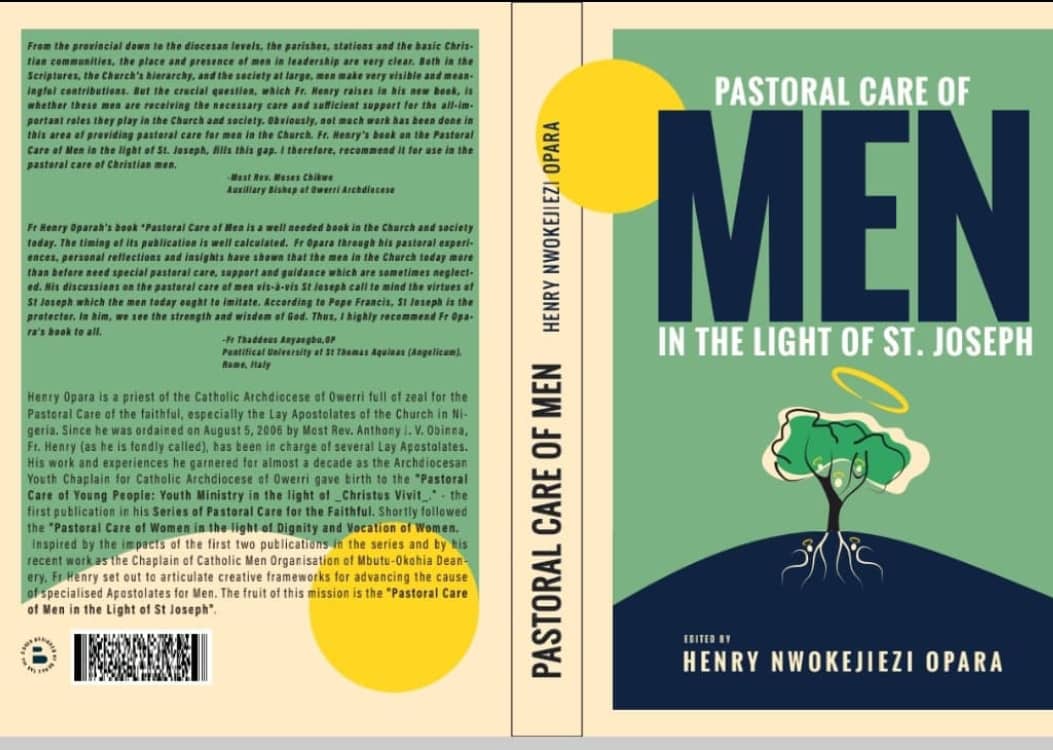
Indeed, this book by Fr. Henry Opara, Pastoral Care for Men in the Light of St. Joseph,offers our Christian men opportunity to read about St. Joseph from a privileged perspective and with renewed interest and zeal so that they can renew their commitment to their Christian vocation in the family. Renewal of commitment to Christian vocation does not just mean picking up what one has neglected earlier. It includes renewing one’s fidelity to what God wants of him and experiencing his love for God in deeds.
However, Fr. Henry challenges the Church to a continuous pastoral care for men in the family. Men are the pillars of the family. Christian men occupy a special place in the life of the Church and society since they are heads of the family which is a small church and microcosm of the society. This is an enormous responsibility that requires a lot of formation and constant mentorship to realize its optimal capacity. Fr. Henry therefore lays out blueprints on how the Church can accompany married men in their fulfillment of this basic vocation through which they share in the unique mission of the Church in the world. He argues that this is possible when pastoral care-givers reinvigorate the Faithfull’s interest and devotion to the simple life and examples of St. Joseph, the ideal husband of Mary and father of Jesus. I encourage every Catholic to pick up this book and digest the pristine submissions of Fr. Henry who is well experienced in pastoral life of the Church, given his many years in different pastoral fields.
May God bless you as you read.
Most Rev. Ernest Obodo
Auxiliary Bishop of Enugu Diocese
PREFACE II
Every human being needs care and attention. They not only value it but welcome it as essential part of human life and relationship. The place of man in the family and the society is prominent. We call them pillars, though; the basis of this nomenclature is not unconnected with their different roles in the families and society at large. This also affects the status of the faith of the family. As such one cannot give what he or she has not.
From his creation (confer Gen.2: 7- 8), man has been saddled with enormous responsibilities of leadership cum authority. He has his family to take care of. He is also responsible to other creatures around his ambience.
Oftentimes, the nature of event makes the task of men more cumbersome; for instance economic and social conditions to mention but a few.
Since, Man stands out in their primary role in this different segment of the family, there is adequate need to provide quality attention and care in order to equip them for their responsibilities.
The next question that needs relevant answers will be to ascertain the relevant materials needed in this program in order to support the family of ‘Men’ to attain to their full potentialities. This formation cut-across all factors of their lives- human, social, faith journey etc.
The Church as a mother has the primary role of taking care of the flock of God entrusted to her. The government of the day has her contribution towards their welfare by creating enabling environment for peaceful co-existence. Other segments of the family like women and children have their part to play in taking care of our men. The men themselves have their part to play. This is important because to be a good leader one must be a regular learner. A good leader should be able to understand the various languages suitable to each segment under his care. The father should speak a language understandable to the family and the woman under his care.
The place of God in this process cannot be played down. His command should be the yardstick upon which the role of man stands ( in the language of the Church preface:”from whom all takes its foundation”). Anything outside this forum becomes a distraction and misdemeanor to the divine artifice plan.
In order to effectively advance the general salvific plan for our men in the face of the challenges and responsibility, there is need to draw succinct plan or program in this regard. Fr. Oliver Onwubiko in his paper “Agents of developing and implementing a pastoral plan (with reference to parish sacramental life and spirituality) maintained “In building them up, what are the ideals and realities of the Parish that we must address today in the light of a pastoral plan.? Let it be clear that when I speak of building up the Parish I am not thinking only of put a block upon a block. I am thinking building of human life and relationships centered on the sacramental life and spirituality based on the Parish Pastoral life and Spirituality”.
This book edited by Rev. Fr. Henry Opara of Owerri Archdiocese is the third in the series on the pastoral care of the lay faithful. It contains peculiar pastoral challenges in the ministry of the Church surrounding the men family. No doubt, for them to perform their God given role they ought to be prepared like St. Peter, our Lord said ”But I have prayed for you that your faith may not fail. And when you have recovered you shall strengthen your brothers(Luke 22:32)” I recommend this book to every family and all men of goodwill.
St Joseph on whose fatherhood the book finds its realm has his responsibilities as a man bestowed on him by God. The care of the Holy Family was placed under his shoulder (Matt. 1: 20-24a). St. Bernadine of Siena in her sermon on St Joseph (Vol. II Breviary) remarks ”whenever divine grace selects someone to receive a particular grace, or some especially favoured position, all the gifts for his state are given to that person, and enrich him abundantly.”
My prayer for all men out there is as you are facing your daily tasks despite the numerous challenges confronting you, may you receive the necessary graces to be victorious and at the end receive the glory that comes from our Father in Heaven.
Fr Reginald Egbu
CMO Chaplain, Archdiocese of Owerri
FOREWORD
It is my joy associating with you in your effort toward ensuring the goodness of ‘Men’ in relation to their pastoral care and wellness. I cannot but acknowledge the serious resolve that you now uphold at an integral well being of the human person. This explains the struggle to produce a hand book for Young People and that for the Women. I heartily say: CONGRATULATIONS, FR OPARA!
I hereby celebrate your tenacity as a person of the Book, which you expressed in the Light of ‘Christus Vivit’ and ‘Mulerius Dignitatem’. These are reflections of guards for Youth Ministry and the Dignity and Vocations of Women. I join my voice to those of the youth and the women, whose work you had delivered for the success of their varied Apostolates, in saying: KUDOS!!
The serious effort you put into reflecting on the Apostolic Letter of Pope Francis, in commemoration of the 150th Anniversary of the Proclamation of St. Joseph as Patron of the Universal Church, ‘Patris Corde’, is worth commending, my dear Reverend Henry. It may help our study here to represent men as such. The impression of Blaise Pascal comes to mind here, as:
…reed, the feeblest of Nature’s growths, but he is a thinking reed. There is no need for the whole universe to take up arms to crush him, a breath, a drop of water, may prove fatal. But were the universe to kill him, he would still be more noble than his slayer; for man knows that he is crushed, but the universe does not know that it crushes him.
As a matter of fact, the need for the work lies more in the stance of Anton Chekhov, thus: ‘Man will become better only when you will make him see what he is like.’ This tastes like the Socratic, ‘Man know yourself….’ It is true that man creates his own destiny. This is so because one cannot bury his or her influence. And since history records one indispensable man… Adam, you and I have been striving to make up the list from the second spot. The seven wonders of the whirl, may aid the struggle, thus:
At 5 years, he wonders why grownups get cross;
At 10, he wonders why his older brother is crazy about the girl;
At 15, he wonders how his younger brother is not crazy about the girls;
At 24, he wonders how he ever lived without his twins;
At 28, he wonders why he ever got married;
At 41, he wonders if he will ever get a raise; and
At 75, he wonders why he wonders.
The great place of Men among humankind is summed in the role of St. Joseph, the foster father of our Lord Jesus Christ. We still savour the gains of the Year of St. Joseph, proclaimed by Pope Francis. The Apostolic Penitentiary issued a decree granting plenary indulgence for the Year of St. Joseph. The special year would last from 08 December, 2020 to 08 December, 2021.
Of course, we are not losing mind of the Encyclical of Pope Leo XIII on devotion to St Joseph, addressed to the Venerable Brethren, the Patriarchs, Primates, Archbishops, and other Ordinaries, in peace and union with the Holy See. The document remains ‘QuamquamPluries’. We remain grateful to Pope St John Paul II on his apostolic exhortation, ‘Redemptoris Custos’, addressed to Bishops, Priests, Deacons, Men and Women Religious and to all the Lay Faithful, on the person and mission of St Joseph in the Life of Christ and of the Church.
It is important that all fathers strive to discover themselves somewhat in the hidden treasures in the Life of St Joseph. This is possible if one consciously meditates on the sorrows and joys of St Joseph. Such a practice of meditation springs from a miraculous event involving two Franciscan Fathers who sailed along the coast of Flanders. Of course, the terrible tempest that sank their vessel holding over 300passengers made sense. Following from their sufficient presence of mind, they held unto a plank, while invoking the intercession of St Joseph. The request of the powerful Intercessor, that we recite the Our Father and Hail Mary, 7 times in memory of his 7 dolors or griefs, and of his 7 joys, explain the point of their devotion, thus recommended. These include:
i. The perplexity of deciding whether or not to divorce Mary, who is with child, and the angelic revelation to Joseph of the Incarnation.
ii. The anxiety of seeing Jesus born into abject poverty and the awe of beholding the Shepherds and the Magi as they adored the Christ Child.
iii. The pain of seeing Jesus’ blood spilt during His circumcision, and the privilege of bestowing the name Jesus on his child
iv. The agony of Joseph’s own soul on hearing Simeon’s prophesy of Mary’s pierced heart and the sweet knowledge that Jesus will bring salvation
v. The burden of being told to flee to Egypt to escape Herod’s massacre of the Bethlehem infants, and the honor of bringing the living God to crush the Egyptian idols
vi. The fear of Archelaus in Judea when returning from Egypt and the wonder of seeing Moses’ prophesy fulfilled when the angel directs the Holy Family to Nazareth
vii. The terror of losing Jesus in Jerusalem for three days, and the relief of finding Him in the temple.
I hereby recommend to the Catholic Men and all people of goodwill here and there, to contemplate and apply the document: ‘PASTORAL CARE OF MEN IN THE LIGHT OF ST JOSEPH’ as a vade mecum to recollect, remember, and sustain their status and vocation as catholic christians and children of the Most High. Once again, I salute the author, and pray for more blessings as he engages in the ministry of the pen… Amen and Amen!!
PRAYER
O God, who in Your ineffable providence has vouchsafed to choose Blessed Joseph to be the spouse of Your Most Holy Mother, grant we beseech You, that we may deserve to have him for our intercessor in heaven whom on earth we venerate as our Holy Protector… Grant as well that faithful to the promptings of the Spirit, we may magnify your greatness with the Virgin Mary at all times, through Our Lord Jesus Christ … Amen!!!
(Given at the Catholic Church of St John the Baptist, Odoakpu – Onitsha, on Wednesday, 31st of May, The Feast Day of the Visitation of the Blessed Virgin Mary, 2023).
Ad Maiorem Dei Gloriam!!!
I remain,
Reverend Paul Ike. NWANEGBO, PhD.
National Chaplain,
Catholic Men Organisation, NIGERIA, (C.M.O.N.)
LISTS OF CONTRIBUTORS
His Grace Most Rev Lucius Iwejuru Ugorji
Metropolitan Archbishop of Owerri
Most Rev Augustine Echema
Catholic Bishop of Aba Diocese
Most Rev Ernest Obodo
Auxiliary Bishop Of Enugu Diocese
Reverend Paul Ike Nwanegbo, PHD
National Chaplain, Catholic Men Organization of Nigeria (C.M.O.N)
Msgr (Prof) Simon O. Anyanwu
Chaplain St Augustine’s Catholic Centre ABSU Uturu and Episcopal Vicar for the Clergy, Okigwe diocese.
Rev Fr Benedict Nwachukwu-Udaku, PHD.
Catholic Diocese of Ahiara. Vicar Forane, West End Vicariate, Diocese of San Bernardino; Adjunct Professor of Philosophy, Azusa Pacific University, CA.
Rev Fr Dominic Nnoshiri, Cssp
Diploma in Safeguarding of Minors and vulnerable Adults from the Pontifical Gregorian University Rome.
Rev Fr Henry Ifeanyichukwu Nwokoro, CSsr
Redemptorist of the Vice-province of Nigeria. Formator as well as Student of Spirituality and Religious Formation in Tangaza University College, Nairobi, Kenya.
Fr. Julian Okoroanyanwu
Priest of the Catholic Diocese of Ahiara. He is presently working in St. Elizabeth Ann Seton Parish, Ontario California United States of America.
Very Rev Fr. (Brigadier General)
Former Chief Chaplain, Armed Forces of Nigeria.
Rev Fr Henry Opara
C.M.O. Deanery Chaplain, MbutuOkohia Owerri Archdiocese; National Coordinator Liturgy and Catechesis C.Y.O.N
Fr Ambrose Ukaonu
Department of Religious Studies, Imo State University, Owerri
Fr Stephen Akinnusoye
Youth Chaplain, Catholic Diocese of Ondo
Very Rev Fr Reginald Egbu
Chaplain C.M.O. Owerri Archdiocese; Vicar Pastoral for the Archdiocese.
Josef Iorkpen Ishu,
C.B.C.N Secretary for The Laity, Catholic Secretariat Of Nigeria, Abuja
Lady Ngozi Anthonia Obah LSM
National President, Ladies of Mulumba Nigeria
Chinwe Irene Mgbajiaka
Supreme Subordinate President, Ladies Auxiliary Knight of St. John International, Nigeria.
Chief Lady Regina Nwamaka Emehelu(LSM)
Immediate past Chairman Governing Council, Alvan Ikoku Federal College of Education, Owerri, Imo State, Nigeria.
Etubom Justin Asuquo
President Catholic Men Organisation, Archdiocese of Calabar
Lady Meg Anozia LSM
Immediate Past Noble President Ladies of St. Mulumba Nigeria
Mrs Joy Akubueze, M. ed
Counselling Pyschologist
Dr Fidelis UzozieAnyika, MBBS, FMCOph, KSM,
Consultant Ophthalmologist, Federal University Teaching Hospital, Owerri, Imo State.
Dr Chris Osita GODSON, KSJI
Director of Entrepreneurship Development and Entrepreneurial Studies, Christopher University, Kilometre 34 Lagos, Ibadan Expressway, Mowe.
Prince Faith Iwuorisha
National President Catholic Men Organisation of Nigeria (C.M.O.N)
Dr Boniface Chizea KSM
Fellow Chartered Institute of Bankers (FCIB), Member Nigerian Institute of Management (MNIM), Member Nigerian Institute of Directors (MNIoD)
Dr Mrs Chinyere Louisa Agbasi
Institute of Women, Gender, and Development Studies (IWOGDS) Federal University of Owerri (FUTO).
Amboson David Sixtus, B.A, M.A
In Christian Religious Studies Kaduna State University, Professional Diploma Kaduna State College of Education Gidan Waya.
Senior Lecturer Kaduna State College of Education Dept of CRS.
Okonkwo Kenechukwu Callistus
President,Nigeria Federation of Catholic Students (NFCS),Lagos Ecclesiastical Province.
Kelechi Darlington Eke, JP
HND, Mass Communication, President, Owerri Archdiocesan Council of Catholic Men Organization (OACCMO).
INTRODUCTION
Do men cry? This is a simple and direct question. Many people ask the same question at different times and moments. I do not really know the situation and circumstance by which this question emanates. Whereas some people will opt for the affirmative, others will choose the negative.
On the affirmative, the question posed involves a lot of dynamism as far as life is concerned. Does the trouble of this world affect a normal man; and to what extent? Does it reach to the level at which he can cry? Is ’man’ or ‘manliness’ synonymous with beingsuperhuman? Man is known as a strong being.
In Igbo language, he is ‘Dike’, a powerful being. He is an embodiment of strength. He has capacity to withstand pressure, aggression, pain, agony, disappointment. He is not expected to be too emotional like the female gender. The fact remains that he feels the same sensitivity like every human person.
For people in this category, a man also cries. He feels the same pains, uncertainties and challenges of life. In that case, he needs our love, care, support, sympathy and consolation.
On the negative, there are those who maintain that men should not cry; for them, a man should be strong hearted, not to display his inner feelings outwardly. Even if he feels pain, he should endure. That is why we have expressions like:‘behave like a man’, ‘are you no longer a man? Or are you a woman in man’ uniform’? This is the same attitude expected of a man even if, he is dying at that moment.
For them, though to be a man is not easy, he should not express it by any way through emotional outburst. That is what makes him a man. Anything devoid of this standard reduces or deflates his position as a man.
The reason for this publication is because of these two classes of people and their divergent views on the affairs of men. The truth is, man as the opposite sex needsthe same care, support, and appreciation in the enormous work handed over to him right from the creation story, and the task before man (the male factor) becomes clear as demanding and difficult. Thus, Yahweh God took man and placed him in the Garden of Eden to till it and take care of it. “(Genesis 2:15).The aphorism, “Uneasy lies the head that wears the crown” is true at this point. Taking care of any environment,organisation or institution comes with responsibility.
The man is known as the head of the family. Can the head operate alone? Does he need the help and co-operation of the neck and other parts of the body? The teaching of St. Paul will be relevant here. “The body has not just one member, but many...God himself arranged the body in this way, giving more honour to those parts that need it, so that the body may not be divided, but rather each member may care for the others. ‘‘When one suffers, all of them suffer, and when one receives honour, all rejoice together (1 Cor.12: 14- 26)’’. The Apostle Paul emphasizes the need for collaboration and respect for each other.
From the scripture, Christ is the head of the Church. In St. Paul’s letter to the Philippians (2:6-8), we read how Christ,” though he was in the form of God, did not count equality with God” but humbled himself. More so, in his teaching to the Apostles as recorded in Mark’s Gospel (Mark 10: 42-45); Jesus gave them an example of true leadership in these words “As you know, the so-called rulers of the nations act as tyrants and their great ones oppress them. But it shall not be so among you; whoever would be great among you must be your servant, and whoever would be first among you shall make himself a slave of all. Think of the Son of Man who has not come to be served but to serve and to give his life to redeem many.” Was it funny to be the head of his Church? Did we notice more display of authority and power or more of service and humility? Did we notice the act of self-emptying and obedience until death to obey the mission of his Father?
St. Joseph stepped in as the foster father of Jesus in the Holy Family. He played the role of the father. He experienced the challenges of being a father to protect and guide the Holy Family. Fr Cyril(2017, 92) captured this phenomenon in this way, “Apart from the divine maternity, there is no such great a dignity as St. Joseph’s paternity of Jesus, which was conferred upon him by God’’. We call to mind that Jesus was not just born of a virgin, but of “A virgin betrothed to a man whose name is Joseph.’’ (Lk. 1: 27). This shows that St. Joseph was the father of Jesus because of his marriage to Mary. So when God told St. Joseph to name His son Jesus, since it is the father’s office and right to confer names upon his children, God constituted St. Joseph his representative and confided in him the paternal care of his son.”. In St. Joseph, one encounters a father who is responsible, without compromising, who carries his work with what Pope Francis described as “Loving heart of a father’’.
One of the most essential needs of a leader is prayer. The man who is at the helm of affairs need our prayers or call it divine support. Jesus was very aware of this when he prayed for Peter as the head of the Apostles. “Simon, Simon, Satan has demanded to sift you like grain, but I have prayed for you that your faith may not fail. And when you have recovered, you shall strengthen your brothers”(Lk. 22: 31-32). The Church in the same vein prays for her leaders (Pope and Bishops) at every mass. She is very aware of human imperfection as captured by Pope Benedict XVI in his book, Called to Communion(1996, p.61), ”On theone hand, the papacy remains the foundation of the Church in virtue of a power that does not derive from herself. At the same time, individual Popes have again and again become a scandal because of what they themselves are as men, because they want to precede, not followChrist, because they believe that they must determine by their own logic the part that only Christ himself can decide:‘‘you do not think God’s thoughts but man’s’’ (Matt. 16:23)”. In our prayers, let us remember the men who serve as pillars of our families, the Church and the society at large.
St. Joseph was very close to Jesus and the Blessed Virgin Mary. The Holy Father, Pope Francis in his Apostolic Letter, Patris Corde remarked that, “with a Father’s Heart; that is how Joseph loved Jesus, Whom all four Gospels refer to as “the son of Joseph”. The grace from this relationship was very instrumental to his mission. To be effective as an adult male in one’s family and society at large, one needs to develop close relationship with Jesus and the Blessed Virgin Mary.
What can we do to change certain obvious narratives within our environment? The activities of the Men within the Church and the society such as Father’sDay do not garner enough momentum such as those of the women. Unlike their male counterparts, women have wonderful innovations that add fun to their celebrations.Forinstance,theyhave a lot of songs revering mothers on Mother’sDay but how many do we have for Father’s day? Recently, my Priest friend was sharing their experience during his days in the seminary in these words, ‘‘Fr Henry, do you know that in my Alma Mater, St. Joseph Major Seminary, Ikot Ekpene, on the feast of St Joseph, people do leave the statue of St. Joseph who is the Patron Saint of the Institution to clean the grotto of the Blessed Virgin Mary?’’
Has the Church any part to play here? The answer is yes. In my recent article on Developing Close Relationship with the Blessed Virgin Mary, published on The Leader Newspaper(June, 25,2023,p.6), I pin pointed that the Church in her annual calendar has not less than fifteen (15) feast days for the Blessed Virgin Mary but less than (5) of same for St. Joseph. No one is advocating for the same place for St. Joseph with Blessed Virgin Mary or raising a kind of competition between the two but the fact remains that frequent celebrations enact more awareness and consciousness.
In the libraries of the Church or elsewhere, it is much easier to see books and documents written on the Women and the young people when compared with that of the men as adult males. The few reference to men as adult males can be seen on documents on the Laity, Family and Love.
The men, themselves have some works to do in this regard. It is not about making- mouth or standing on past glory. If you do not say, you are, no one will do that for you. In fact, no one will know you exist. The ball is in your court. Stand up to take your place. In our Nigerian environment, it can be observed that almost every sector has dominated by the female counterparts except politics.
The hallmark of this work is to reawaken the place of the men in our families, church and the society at large and the need for encouragement, care and love. Let us continue to appreciate the sacrifices being made by our men. To be a man is not easy. The men themselves should be supportive of one another.
The topics here encompass the place of Men in families, Church and, theSociety, the need for their formation and regular peculiar challenges. There are topics bordering on reawakening in us all the corresponding care, support and every other dimensions of encouragement for the Men among us.
REFERENCES
Pope Benedict, Called To Communion, San Francisco: Ignatius Press, 1996.
Pope Francis, Patris Corde as published in the Manual for the Year of St. Joseph by The Archdiocese of Owerri.
Cyril Uduak Udom,OCD, Saint Joseph, the Glorious and Indispensable Father, Enugu: Zamama prints, 2017.
Donald H. Calloway, Mic, Consecration to St. Joseph, U.S.A: Mariam Press, 2020.
BEING A FATHER
PRINCE FAITH UCHE IWUORISHA JP
National President CMO
The word “Father” means different things to different people depending on its usage. With regard to gender, a father simply means a male parent. There are many ways one can become a father. However, to be a father one must be able to protect his family from dangers, provide for the family needs and show good examples as his children look up to him as their role model.
Being a father is divine. It is an opportunity to be like God, to love and care for children as God loves and cares for us. Fathers are pillars in the development of their children’s emotional well-being. Children look up to their fathers to lay down rules and enforce them. According to the scripture, a father is the head of his household. He guides his wife and children among other roles such as:
1. Be the child’s first teacher (Proverbs 22:6)
2. Exemplify a good life (2 cor. 3: 2 – 3)
3. Provide for the family (1 Tim 5:8)
4. Discipline his children (Proverbs 13: 24)
5. Spend time with his children/family (Deut. 6: 6-9)
6. Show compassion (Psalm 103: 13)
7. Pray for his children (1 Chronicles 29:19) etc.
UMBRELLA BODY OF FATHERS IN THE CATHOLIC CHURCH
The lay apostolate consists of three major groups of which one of them is the umbrella body for the fathers known as Catholic Men Organization (CMO); though before now, it had answered different names at different times.
The CMO is a non-political, non-tribal religious organization and loyal to the Apostolate See, the church hierarchy and the clergy on all matters pertaining to the Catholic faith.
The main objective of the organization is to enhance the spiritual, moral, intellectual, and welfare development of the members/catholic community, as well as support the church in the work of evangelisation and salvation.
Leading the fathers is as difficult as being a father. To lead the fathers is not an easy task. However, through the umbrella body - the CMO, providing leadership direction to fathers is made less burdensome. It is a pleasant experience to preside over the affairs of a group with members cutting across all spheres of life and varying age brackets.
Commendation
Rev Fr. Henry Opara, a former Owerri Archdiocesan Youth Chaplain has been consistent in his publications and pastoral duties to the catholic community and beyond. Little did I know that after his book on pastoral care of the young people, he would also publish another book on pastoral care of women, he went another mile further to publish this master piece on the pastoral care of men.
Fr. Henry Opara is a blessing to the present generation, especially the reading public. May God bless and strengthen you the more in your pastoral ministry as you touch many lives through your books.
I recommend this book to all fathers, fathers-to-be and the general public.
This book is a must for every home. Grab your copy now.
MENTAL HEALTH
JOY AKUBUEZE
M.ed Counselling Psychologist
Mental health has various definitions which are generally accepted. Mental health is the psychological, emotional and social well-being of individuals. It influences how they feel and think and behave. It can also be referred to as the state of cognitive and behavioral well-being.
IMPORTANCE OF MENTAL HEALTH
A person with emotional stability always feels vibrant and lively and can manage effectively their emotional condition. Being emotionally strong means you are physically fit. Mental health is usually an individual thing; what affects one person may not affect the other. Yet many emotional factors have significant effects on our fitness level.
Mental well-being denotes having a positive sense of how we feel, think, act or behave, which can improve the ability to be self-determining, proactive and sensible.
MENTAL HEALTH ISSUES DO NOT JUST START
It starts gradually, noticed or unnoticed but not given attention. Men think it is proper to handle their issues alone and as men, they feel it is just a woman thing to cry or nag over circumstances. So they bottle up circumstances which at worst lead to problems such as:
- Quiet misery
- Deteriorating job performance
- Personal unhappiness
- Family stresses or breakdown
- Turning to alcohol, drugs or tranquilizers
Men who are faced withmore challenging mental health issues might find themselves falling into depression and anxiety. Other serious mental health illnesses are schizophonic bipolar disorder, delusion, and addictive behaviour. You might feel less concerned and wonder that it does not matter to you, but itdoes certainly. If you should look around you,the person who upsets customers, snaps at you, leaves their work unfinished ,or are always moody could be doing these out of the effects of stress. This could in turn add to your mental health, because it has a way of falling back to their nearest partners, thereby forcing you to do more work, having shame of their unpleasant tone, sorting out the problems and living in an unconducive environment.
You do not exist in isolation; you are part of every one’s life. So, if you have similar issues, share from the difficult moment. You should be true to one another and be a hero by helping someone out of their difficult time. You would not want to live in an environment where no one cares about the next person.
MENTAL HEALTH THREAT TO YOU
Men enjoy their space and freedom and do not like interferences. Their psychology is quite different from that of women. Male psychology still prevails because they still dominate. Men:
- Would rather talk sport than stress
- Get things done regardless of other pressure
- Prefer to keep emotion under control, do things rather than thinking about it
- Ignore physical or mental symptoms for long
- Regard anxiety or mobility to cope as personal weakness rather than show of natural emotions
- Would rather not cry, say how they feel or show lack of confidence.
They feel all these make them real men, action men, at the top of their game and life. But men really do have feelings, are sensitive to other emotions, status and are receptive to feelings to change messianity.
Life is all about change and that cannot be overemphasised. It is very important for men to start to plan and prepare for the unforeseeable future. When you are very young and active, consider that life is a continuous phase and change will definitely come with age, strength and health.
You may be one of the heroes affecting the change or be one of those facing job loss.
Here are some coping techniques:
- Planning: Plan on how to live and what to do in time of change
- Accept the change: You cannotinfluence the change but accept it and thrive with it
- Training: Ask for training on how to cope and overcome the fear of the unknown
- Talk to someone/professional: Share your feeling, talk about the insecurity, frustration, uncertainty and fear. Don’t try to bottle up things. Learn to discuss your changes in a supportive and constructive way as condemning your change will cause you more harm.
- Get feedback: Be open to positive advice, ask for feedback to know if you are coping well with changes and be ready to adjust if need be
- Be happy: Happiness is a personal choice, choose to be happy always.
CAN A MAN BE ASSERTIVE without being aggressive? It is proper and normal to learn to live and manage your feeling. It is a useful tool.
Here are some important steps:
- Feel positive and confident about yourself when acting right
- Avoid shouting, insulting, degrading or belittling situations
- Repeat your request or thought until the other person understands you well enough
- Be simple and clear: Make body language positive, keep eye contact straight and firm, do not be too proud and lousy
- Learn to be assertive: Avoid weak words and know when and how to compromise without forcing either party to feel bad.
STRESS
It is the pressure exerted on someone or something which if it happens long enough can make a man breakdown. The mind affects the body and if stress occurs it causes an increase in breathing, heart rate, and tenseness of muscles.
Stress is the response the body gives anything that requires attention or action. It is the changes that cause physical, emotional or psychological strains. When overwhelmed with stress, it causes mental and medical health problems. Prolonged stress increases the risk of mental health problems such as sleep disorder, anxiety, depression, muscles tension and substance use problems.
Is stress necessarily a bad thing? It is a natural part of life and little of it motivates us to face the challenges of life, overcome obstacles, or aim for the top. Positive stress (Eustress) stimulates our health and life would be dull without it, while the negative stress (distress) is a stress level that a person cannot cope with and it impacts negatively to life. It is better you learn how to manage stress than to think of doing away with it.
HOW TO DEAL WITH STRESS
The level at which stress can be managed differs among individuals. Some men can work on the clock yet have a stream of women on top. Others can easily fail to resist the pressure and have negative force of stress with related disorders. They are those who worry too much about every issue. It has to do with our different personalities. No doubt our personalities have a great deal to do with our lifestyles and managing stress levels.
Stress-triggers
Some challenges are proven to trigger stress no matter what the person’s personality may be.
If you have control over your life and situation, you cannot be easily stressed. Stress-trigger differs and can be categorized into four:
- Money and work
- Temperament health
- Relationship
- Lifestyles
It is very important you identify your own stress trigger and take action. Whenever you lose control of your emotions and feel stressed, it is advisable you identify the trigger. With such, you can help yourself do the needful and feel better. But if you feel stressed and cannot identify what triggered it, you may keep doing the same mistake over and over again.
When you are able to identify the trigger, you devise means to deal with the stress.Such a technique helps situations better e.g. breathing consciously, healthy diet, regular exercise and good sleep.
The four stress trigger:
Money and Work
- Being in debt/Indebtedness
- Unreasonable employer/co-worker
- Not having sufficient fund/ poor remuneration
- No job/ means of livelihood
Temperament/ Health
- Being depressed
- Worrying too much
- Long term health issues
- Quick – tempered and impatient
Relationship
- Break-up/ Divorce
- Getting married
- Death of loved ones
- Expecting a new baby
Lifestyle
- Vacation
- Relocation/ change of environment
- Noisy/ Nosy neighbour
ANXIETY
Anxiety is a mental health problem which shows up in the feeling of nervousness and worrying about something with fear. The fear may be unease, uncertain or very specific events such as job interview, meeting with a new client or going for a first date. At times these may not even be the main reason for being anxious, it just happens.
Anxiety can make you pick on anyone angrily because you are unease and makes you react irrationally. It zaps energy in an unproductive manner. It keeps folding your mind with the same topic repeatedly, and squeezing out the goal directed thought that should be utilised for more meaningful endeavours.
Anxiety can affect someone in two ways; physically or psychologically.
Physical effects: Anxiety can affect someone physically in so many ways e.g. shortness of breath, heart palpitation, sweaty shoulder, pain from tensed muscles which can extend to the neck region. It can cause severe headache, stomach wimbling, indigestion etc.
Psychological effects: Anxiety makes someone get weak and tired easily, have sleepless night, lack concentration at work and other activities. It also affects the memory, sex life and neglection sets in. It causes general distraction in life.
Anxiety triggers:
The triggers are always associated with a certain fear. Difficult experiences in life can also be a trigger e.g. emotional or physical abuses, fear, phobias, panic attack etc.
What triggers anxiety also depends on what type of anxiety you show up with, it could be habits and various stressors that fall out of your control, such ashealth issues, lack of sleep, conflict, finance issue, life transitions, negative self-talk etc.
Anxiety can be good or bad as well. A degree of stress in our lives is a motivator, but you probably would learn to draw a line and know what the cause is and where it is leading to. Learn to seek help from a professional early enough.
HOW TO COPE WITH ANXIETY
If anxiety is becoming a regular part of your life, it is very necessary to look for lasting solution to help you keep it in check. You can ask for the combination of medication, cutting issues that trigger it or a talk therapy. You can visit a mental health professional for suggestion, or help to put you through this time.
- Identify and learn to manage your triggers
- Identifying your triggers can be done by you or your therapist. It can be obvious to you but not like addiction to alcohol consumption, smoke or any other related situation which may take some time to figure out such as financial issues.
When you identify it, it is a step to working out strategy on how to get it treated
1. Meditation: practice mindful meditation and do it regularly, this can help train your brain to dismiss anxiety disorders; you can try yoga, walking meditation.
2. Socialize: People are differently made. While some find it difficult to socialize, others see it as great fun. Socialization can help relieve stress, encourage feeling of laughter and togetherness and ward loneliness
3. Identify and learn to manage your trigger: stress at work, driving for a long journey, drugs and their side effects, trauma, phobia, illness/pain, mental disorders.
4. Cognitive behaviour therapy use: This will help you to learn different ways of thinking up and reacting to anxiety causing situation through the help of a therapist. A therapist will help you develop ways to change negative thought patterns and behaviours and replace them into positive ones.
5. Keep demand: Take note of the causes and the triggers of anxiety. This can help you keep track of when, what and how it happens, what you did to make you feel happy again. Healthy diet or healthy living requires regular exercise, balanced diet and meals, getting good sleep, staying around good and positive minded people. Taking supplement can help overcome anxiety symptoms.
6. Talk to your doctor: You can be referred to a doctor for medication if need be, depending on your symptom.
When is anxiety?
It could be difficult to identify what sort of anxiety you are dealing with because everyone reacts differently to perceived danger at all times. Generally it is a feeling or event that has an uncertain outcome and we tend to deal with it the way it comes.
Different forms of anxiety attack (panic attack)
- Rapid heart rate
- Sweaty, trembling or chills
- Tiredness or weakness
- Feeling of dangers, panic or dread
- Pain
- Difficulty focusing
Panic attack:
- Fear of dying
- Source of detachment
- Shortness of breath
- Feeling like losing control
- Heart partition
- Chest tightness or pain
- Numbness or tingle in your extremities
- Feeling hot or cold
- Feeling light headed or dizzy
A mental health professional can help you figure it out, identify your triggers, maintain his term coping strategies through behavioral therapy medication.
Once you find what treatment works best for you, you can better live a more enjoyable life with less stress.
DEPRESSION
Depression is a common and serious medical and mental illness that negatively affects how you feel, the way you think, and act. Fortunately, it is also treatable. It causes lack of interest in activities you like doing, feeling of sadness. It can lead to emotional and physical problems and affects the ability to function well at work and at home.
SYMPTOMS OF DEPRESSION
Depression symptoms vary from mild to complex. They include:
- Loss of interest or pleasure in activities you like
- Thimble sleeping or sleeping too much
- Feeling sad or depressed mood
- Change in appetite - weight loss or gained
- Feeling worthless or guilty
- Loss of energy
- Lack of libido (sexual desire)
- Difficulty in concentrating, thinking or decision making
- Restlessness
- Suicidal thought or attempt
You must have these feelings for at least two weeks or more before you can be diagnosedwith depression.This is because some medical conditions, like brain tumour, vitamin deficiency can mimic the symptoms of depression. So it is very important you rule out generally all these medical issues.
Depression affects more adult than teen. Men might prefer to call it exhaustion or “being on edge” or “nothing that a good drink and a night out with their mates won’t cure”. While this might help with brief episodes of low moods, they are useless when it is a more prolonged or severe depression and in that case, alcohol may worsen the situation.
Depression is different from sadness or bereavement. It is normal to feel sad and a grieving process is natural to each individual. Both grief and depression may involve intense sadness and withdrawal from enjoyed activities. They are also different in some ways.
In grief, a painful feeling comes in waves with positive memories of the deceased. Its debut affects self-esteem, but in depression mood and interest are affected,accompaniedwith the feeling of worthlessness etc.
Depression can affect anyone even a person who appears normal and calm. The factors that can play out in depression.
- Genetics- depression can be a family thing
- Phenomenal factor explosive to violence, neglect, abuse or poverty may make you depressed.
- Biochemistry difference in certain chemicals in the brain may cause symptom of depression.
- Personality- People who are generally pessimistic have low self-esteem and easily overwhelmed by stress.
Depression trigger
Life events such as:
- Bereavement- serious illness- money or job pressure
- Divorce- personality - alcoholism- drugs.
COPING TECHNIQUE
-Talk to your doctor: Doctors are your first point of call if you suspect depression or even if you do not feel well. After assessment your doctor can give you some anti-depressants.
I’M NOT DEPRESSED
Not everyone can accept that they are depressed and do not accept that they have emotional challenge. Men, especially consider that they are thick-skinned, and that emotional ups and downs are part of life. You can endure it but it is very dangerous to do it alone because it may affect family and work, and you may turn to the use of alcohol and drugs to escape pains. Moreover, you cannot be forced on treatment unless in the case of suicidal thought.
- Use of counselling and psychotherapy help
The use of human behavioural therapies like CBT finds a way of altering how you look at the things that are causing your mood change not just the mood.
To benefit from counselling therapies you must be prepared to open up and be frank. It helps to have insight into your psychological make-up.
- Self- help measures:It’s difficult for a depressed person to help themselves
You can help yourself by seeking help from a professional. Identify and recognize it, and review obvious stressors, get quality sleep, talk about it, exercise, improve your mood.
- Electro convulsive therapy(ECT)
This is a medical treatment commonly reserved for patients with severe major depression who have not responded to other treatments. It involves electrical stimulation of the brain while the patient is under anaesthesia.
Bipolar- a mental illness associated with episodes of mood change ranging from depressive low to manic high.
The cause of bipolar disorder is not known yet, but it has a combination of environment, genetics and alter brain structure.
Bipolar disorder is very common, it is a serious mental illness which can be treated but cannot be cured. It can last for years or even lifetime. Bipolar can be diagnosed medically.
SYMPTOMS
Bipolar disorder symptoms include high energy , being irritated, adventurous, easily distracted and reduced sleep level.While depression episodes include low energy, loss interest in daily activities and low motivation.
Treatment
Treatment of bipolar disorder is for life time and it can be a combination of psychotherapy and medication.
1. Cognitive behaviour - is therapy that helps to manage a patient with bipolar disorder. Psychotherapy is the one-on-one discussion with two or more people with same issues. It helps them to manage their thoughts, their behavior the way they perceive things. The therapist can also help in finding a way to deal with the problem.
2. Psycho education- is therapy that helps a patient to accept their present condition, by explaining the situation and treatment options, encouraging them to expect it and be proactive in managing it. Psycho education also helps in creating awareness to the illness, sticking to treatment, early deactivating and recurrence, and lifestyle regularly.
3. Medical- Doctors use the drugs Anti-psychotic medics which are sometimes given to treat mania, anticonvulsants and lithium and also mood stabilizer.
Family focused therapy- livelihood; working as a family or group support to look at behavioural traits identifies risks and builds communication and problem-solving skills. Other mental health illnesses
- Post - traumatic stress disorder (PTSD)
- Schizophrenic
- Eating disorder, disruptive behaviour and dissocial disorder, Neurodevelopmental disorder.
Negative impact
It is important we check on our mental health. The way we fall sick physically is the way we fall sick mentally.
These include instability of one’s health like emotion, thoughts and behaviour. Stress is the major cause of mental illness and it can be due to genetic factor, biochemical balance, abuse or trauma, social disadvantage, poor physical health condition, etc. Mental health is curable. We can also seek help from professionals, positive thinking and changed lifestyle. The mood is avery powerful organ in the body which helps to regulate the function of all other organs. When the mind is affected, it affects all other parts of the body. Men should be aware of the consequences of itchiness and must pay proper attention to keeping it, for physical health cannot be separated. We must learn to balance both. It is highly important we live and work to achieving this goal- seek help when necessary.
MEN AND LESS
ATTENDANCE TO CHURCH
CHINWE IRENE MGBAJIAKA
Supreme Subordinate President,
Ladies Auxiliary Knight of St. John International, Nigeria.
INTRODUCTION
Church was curled from a Greek word ‘ecclesia’ which means ‘called out’’ This means that the members of a church are expected to be people who have been separated from the filthiness and corruption that are attendant with the word and its systems. Lending credence to the afore-mentioned assertion, the bible, in the book of 1 Peter 2:9 (KJV) stated that, “We are a chosen generation, a royal priesthood, a holy nation, a peculiar people that are called out to show the praises of Him, who has called us out of darkness into his marvelous light.” Thus, the societal conducts of members of a church ought to be distinct from non-members of a church. In addition, one of the obligations of members of a church is to identify with the activities of the church. This can only happen, when their attendance to church is given its pride of place.
Attendance to church is an issue that is of paramount importance and must not be relegated by any christian. This is rather supported by the book of Hebrews 10:25 (KJV) which stated, ‘‘Not forsaking the assembling of ourselves together, as the manner of some is…..’’ Apparently, the bible recognizes the fact that some persons are in the habit of absenting themselves from the church; hence the injunction. The poor attendance of some Christians to the church is an issue that ought to be a source of worry to relevant stakeholders in the church viz: priest, elders among others. Suffice it to say that poor church attendance is not exclusive to a particular gender. However, the observation of the writer as one who has held high positions in the church is to the effect that the attendance of men in church is less than that of women. Thus, the current article seeks to focus on men and less attendance to church.
Young Men and church attendance
It is instructive to note that the frequency of church attendance among men could differ along age lines. For instance, there appears to be so much depravity in the society that some male youths tend to see no need for the church. This is arising from the fact that the evolution and subsequent ubiquity of social media have clouded the knowledge of male youths to the truth (being the word of God). Not a few males in modern day youths have been inundated with copious information from the internet that appears to de-emphasize the place of the church in their economic advancement. Rather, information or messages from the internet seem to be extoling the ‘virtues’ of ‘vices’ These messages promote money-making strategies without recourse to biblical principles; church attendance inclusive. Apparently, it goes without saying that there is a preponderance of male youths that are caught in this web of vices.
McMullin (2013) noted that part of the problem is that many people think that churches represent an antiquated institution that simply have no relevance in the modern world or to their everyday lives. When modern people have questions about life, it rarely occurs to them that a church might be a place to seek answers. Consequently, it seems that much of the recent decline in interest in the church among male youths stems from this widespread perception that church is irrelevant, antiquated, and obsolete rather than individuals’ lack of religiosity. There is therefore a growing need to understand the factors involved in this phenomenon.
Church-going male youths with alternative views may present a key opportunity to reflect upon, challenge and change inequitable gender norms when they are equipped to do so before they may internalize societal messages that dictate (often negative) behaviours deemed appropriate for men (Michael, 2021). The inclusion of church-going male youths as an indispensable part of gender equality and masculinity programmes in churches reqruires an approach that includes them not just as individuals but also as a collective. More intense promotional efforts are required as part of public education, early adolescent education and church policy and programme development related to gender equality.
Various stakeholders have proclaimed that “religious organizations can do little to reignite interest in attending church simply because external forces have eroded the religious desires of the entire population” (Flatt, 2018, p. 79). However, the issue is not so simple. Other distinct factors contribute to the decline in church attendance among male youths that are not connected exclusively with a decline in religiosity. These factors can be divided into two general categories: internal and external. Internal factors can be defined as those which church leadership directly manages or influences. Conversely, external factors can be defined as those which are entirely outside the direct influence of the church.
Apart from the secular influence of college, an additional factor that relates to low religiosity among young males is the perception that churches are out-of-touch. Jones (2020) argued that youths are walking away from the church because they no longer find the church to be socially and spiritually relevant to their lives. Specifically, young people are not being provided with theological and moral instruction that they can apply in their daily lives outside of a church context.
Furthermore, Hewitt (2014) found that church leaders must become open to new learning, for an absence of knowledge will be replaced with a fearful and reactionary response to change. The urgency and radical essence of the gospel that Jesus proclaimed needs to be translated into a form which can mobilize the millennials to become involved in the world agenda of the gospel.
As proclaimed in Matthew 28:19-20 and Mark 16:15-18, when Jesus Christ charged the Church with the Great Commission, he forever established evangelism as a significant priority for his people (Pollock, 2015). Despite being a crucial activity in the Church, Barna Research (2018) reports that 51% of evangelicals do not even understand the Great Commission and as many as 64% of "Bible-minded" evangelicals have forgotten the meaning of this teaching. This apparent disconnect can explain why evangelism is being outpaced by relocation as one of the largest sources of growth for churches. However, without proper knowledge of the role of evangelism, some church leaders may not be fully ready to embrace this strategy. In those cases, education can be a powerful tool for equipping leaders to be effective witnesses to the gospel (Hewitt, 2014).
Adult Men and Church Attendance
Apparently, the low Church attendance among adult men may not be unconnected to the fact that the chunk of the adult men are married. Marriage comes with enormous responsibilities. The enormity of responsibilities that adult men have to shoulder may dispose them to absenting themselves from the church. Buttressing this point, some men have to work even on Sundays to fend for their families not minding the scriptural injunction to ‘‘remember the Sabbath day and keep it holy’’ Going further, the society tend to be awash with old men who tend to be more involved in idolatry than their younger counterparts.
This worrisome trend may make them see no need for church and thus, incline them to absent themselves from church. Flatt (2018) found that congregants perceive busyness, negative perception of churches, and secularization as being the most vital factors related to church attendance decline. Both groups tend to agree that Sunday competition is the number one external cause. As far as internal factors, both the congregants and the clergy agree that resistance to change is a significant internal factor. However, neither clergy nor congregants consider a lack of evangelism to be a primary factor in church decline.
Though many changes in attendance are viewed as being affected by larger social forces and long-term external trends, there are also internal factors involved. One aspect of decline in church attendance among men relates to a lack of willingness on the part of the church in making changes needed to respond to external factors, even when some men clearly have lost interest in the style, type, or version of religion currently employed by the organization.
Limited innovational competency due to religious beliefs and an inflexible adherence to traditional leadership methods can restrict church leaders to obsolete and ineffective ways of performing their duties. Such deficiencies can negatively impact church attendance among the men. What is more? Christian leaders are more effective at identifying solutions to problems when addressing business needs. However, when dealing with the needs of church members, they demonstrate limited proactive expertise (Choi, 2014, Addai-Duah, 2020).
When a man who has a family to take care of does not see the church as ‘a family within family’ he will not have the proclivity for regular church attendance. A man seeks to see the church as rising to the occasion to fend for his family as and when the need arises. Thus, such a kind gesture is obviously in short supply in the church, and men’s attendance to church will be adversely affected. Even in moments of grief, men who do not see the church queuing behind them will not prioritize matters of church attendance. This further explains why a lot of men’s loyalty is more to their social groups than their church. Thus, proper management of the foregoing concern is key to men’s regular church attendance.
One of the significant threats to any organization concerns how well they deal with change management—especially for leaders who are resistant due to loyalty to organization norms and beliefs. Without skillful change management, it is impossible to assure the survival of any organization. To effect change, Bielefeld and Cleveland (2013) suggested religious leaders must: (a) be flexible, (b) adopt new leadership abilities, and (c) be ready to set aside their operational beliefs, which means the willingness to change practices. Douglas (2019) found that modern societies value change and people who respond positively to change. However, individuals tend to resist change when the resulting benefits to the organization are not perceived to agree with their own interests. Therefore, for churches to end their stagnation and reverse the decline in men’s church attendance, churches must recognize the value of change, keeping in mind the expressed interests of their congregants.
Conclusion and Recommendation
The advent of social media has to all intents and purposes, predisposed the youths, predominantly the males to the relegation of church to the background. More so, the enormity of family responsibility has in more ways than one taken the attention of men away from the church in their bid to make ends meet even on days dedicated to the worship of God in the church. Much of the use of social media tend to have negatively influenced the perception of male youths on church attendance, it can be innovatively employed by the church to elicit male youths’ church attendance. Similarly, the church leaders should strain every nerve to make the church a home from home. That way, the male adults will see the need to regularize their church attendance.
REFERENCES
Addai-Duah, C. R., Hoon, S. N., & Sinatra, S. J. (2020). Non-profit church leaders’ perceptions and lived experiences involving innovation competency and change management: A phenomenological study. Journal of Social Change, 12(1).
Barna Group (2018). 51% of churchgoers don't know of the great commission. Retrieved from https://www.barna.com/research/half-churchgoers-not-heard-great-commission/.
Bielefeld, W., & Cleveland, W. S. (2013). Defining faith-based organizations and understanding them through research. Nonprofit and Voluntary Sector Quarterly, 42(3), 442–467.
Choi, M., & Ruona, W. E. A (2013). Individual readiness for organizational change. The Wiley-Blackwell Handbook of the Psychology of Leadership, Change, and Organizational Development, 1(1), 331–345.
Douglas, R. R. (2019). A comparison of resistance and openness to change in church leadership and church growth through the 200 barriers. Nyack College, Alliance Theological Seminary.
Flatt, K. N., Haskell, D. M., & Burgoyne, S. (2018). Secularization and attribution: How mainline Protestant clergy and congregants explain church growth and decline. Sociology of Religion, 79(1), 78-107.
Hewitt, R. R. (2014). Evangelism as discipleship. International Review of Mission, 103(2), 200–214.
McMullin, S. (2013). The secularization of Sunday: Real or perceived competition for churches. Review of Religious Research, 55(1), 43-59.
Michael, L. P. (2021). Understanding declining church attendance and strategies for growth. Doctoral Dissertation,Vanderbilt University – Peabody College.
Pollack, D. (2015). The great commission # 2 - priority of evangelism. Retrieved from https://www.spiritofgrace.org/articles/nl_2015/00_priority_evangelism.html.
SAINT JOSEPH: A MODEL HUSBAND,
AN EXEMPLARY FATHER, AND A HERO OF THE SPIRITUALITY OF SILENCE AND QUIETUDE
MSGR (PROF.) SIMON O. ANYANWU
Chaplain St. Augustine's Catholic Centre
ABSU Uturu and Episcopal Vicar for the Clergy, Okigwe Diocese.
INTRODUCTION
The rising profile of St. Joseph, the spouse of the Blessed Virgin Mary and foster father of Our Lord Jesus Christ, in the magisterial teachings of the Popes, took on an additional dimension recently. The occasion was the proclamation of a "Year of St. Joseph”, from 8 December 2020 to 8 December 2021, by the Holy Father Pope Francis to commemorate the 150thanniversary of the declaration of St. Joseph as Patron of the Universal Church. By this gesture, Pope Francis joined popes like Pius IX who declared St. Joseph "the Patron of the Universal Church" on December8, 1870; Leo XIII who honoured him in 1889 as "a model for fathers of families"; Benedict XV who proclaimed him “the protector of workers”; Pius XI who raised him to Patron of Social Justice; Pius XII who in 1955 established the feast of St.
Joseph the Worker to be observed annually on May 1 (Delaney, 2004).
The write-up that follows wishes to illuminate the life of St. Joseph with the help of the utterances and silence of the New Testament vis-à-vis this humble servant of God whose figure continues to attract the attention of recent Popes. The article is neither a theology of St. Joseph nor a commentary on the Apostolic Letter "Patriscorde" ("With a Father's Heart") with which Pope Francis commemorates the one century and half anniversary of the declaration of St. Joseph as Patron of the Universal Church. It is rather a personal reflection/meditation by the author on the towering personality of St. Joseph and what we of today can learn from it to enrich our vocations as husbands and fathers in today's noisy world.
A Model Husband
Joseph, the husband of Mary and the foster Father of Jesus is one of the prominent personalities the New Testament presents as answering God's call to him in a most eminent and exemplary manner. The scriptures have not much- but indeed enough-to tell about him. As a husband, it is clear that his life was spent in a family, a normal environment of everyday life. In fact, his greatness as a model of response to the divine call is primarily to be identified in the type of husband and father he was to Mary and Jesus, respectively.
The first thing one observes about his life is that he was a considerate and humane husband. This reveals itself in his reluctance to expose his wife, Mary, as he did not yet know the origin of her pregnancy. Rather than expose her to public ridicule, he resolved to put her away secretly. No wonder the scriptures speak of him as "a just man" (Mt 1:19).
It is also evident that he was a man who looked before he leaped. He did not simply rush into actions. He took time to think over things. What a contrast to many people who act before they think! It was in the process of thinking over the situation of Mary's pregnancy that God revealed to him that her child was conceived of the Holy Spirit (Mt 1:20). During this revelation Joseph was instructed by an Angel of the Lord to remain faithful to Mary, his wife. He complied with the instruction without any reservations. Like the obedient servant of God he was, he recognized in the message of the Angel the will of God for him.
And he promptly embraced it with neither grudges nor complaints. Thus Joseph proved himself a husband that his wife could rely upon, even in the most vulnerable of circumstances. In the company of such a reliable and caring husband, Mary, who was in an advanced stage of pregnancy, did not mind travelling from Nazareth in Galilee to Bethlehem in Judea to be enrolled together with Joseph who was of the lineage of King David (Lk 2:1-7). Joseph was ever found on her side both before and after delivery of her child which took place while they were still abroad (cf. Lk 2:15). He accompanied Mary to Jerusalem to present the child Jesus to the Lord (Lk. 2:22). Joseph was also available to share with Mary the prophecies Simeon made about the child (Lk 2:25-33).
From the above insights, one can say with certainty that Joseph was a dedicated husband. There is no single reference that we know or read of that put him in questionable light in his relationship with Mary.
An Exemplary Father
As the foster father of Jesus, his record is no less than that of a caring, devoted and dedicated father. Not only Matthew’s but also Luke’s infancy narrative depicts him as a thoughtful and painstaking father. As he was instructed by an Angel, the child was named Jesus, “the name given by the Angel, before he was conceived in the womb" (Lk 2:21).
To save Jesus’ life from the murderous hands of King Herod, Joseph had to flee by night with Mary and the child, Jesus, to Egypt. Their sojourn there till the death of the tyrant, Herod; hardship not withstanding and Joseph’s wise decision later on to return with Mary and Jesus to Nazareth in Galilee instead of to Judea where Archelaus, the successor of Herod reigned, are some of the eloquent examples of Joseph’s dedication and commitment to God’s call upon him to serve as the foster father of Jesus (Mtt 2:13-23).
A Hero of the Spirituality of Silence and Quietude
On the whole, reflecting upon Joseph's life as it is presented in the New Testament, one's attention cannot but be drawn to the fact that he was all in all a person of reticent, quiet disposition. Upon all that Joseph accomplished, strikingly not one word of his own is recorded in the whole of the Bible. One begins to wonder whether he was only meant to be seen and not to be heard. But therein lies an unmistakable singular and attractive element of this holy man's deep spirituality namely, love of quietness and silence. Only with the eyes of faith and spirituality can one understand and underscore prominently the import of the said silence and quietude which many people otherwise find strange and rebuffing.
Joseph devoted himself to Mary and Jesus quietly and noiselessly. Thus he demonstrated his humility and courage. Through his silent disposition, he could listen to God and embrace his mind and message and bring the same to bear in his relationship with Mary and Jesus (cf. C.O. Ukeh, 2019, p.33). St. Joseph thereby leaves to humankind a shining example of the fertility and fruitfulness of quietude which a young prolific writer amazingly tags a fertile desert (cf. C.O. Ukeh, 2018).
Much of what has, so far, come to light in this reflection on the life of St. Joseph can be seen to be well captured in the following two excerpts from two different writers on the lives of the Saints namely, Clare Ukken, FSP (n.d.52-53) and Theodor Schnitzler (1982:120). According to the former, "As head of the holy family, as spouse of the Blessed Virgin Mary and as protector of the Son of God, St Joseph performed willingly and uncomplainingly the various duties as they arose... he played his role faithfully, silently and lovingly." As presented by the latter, St Joseph's "ways of life and after-life" are described "as silent, obedient, trustful and manlike, full of love to Jesus and Mary..." (Eng.transl.mine). The two authors' views like those of many other writers, endorse what we have presented above as the major features of St. Joseph's everyday life in the holy family of Jesus, Mary and Joseph.
Conclusion
All and sundry, especially the male folks, who like St Joseph double as husbands, fathers, and heads of families, are earnestly invited to borrow a leaf from St Joseph: model husband, exemplary father, and a silent achiever. Undoubtedly, our families, nay communities, and the wider society will be the better for such an uncommon gesture. These thoughts are worth giving consideration as we celebrate St. Joseph's feasts on 19th March, 1st May and during the rest of the year.
REFERENCES
John J. Delaney (2004) Dictionary of Saints, New York, Lond. Image Books, Doubleday.
Chibuike O. Ukeh (2019) Man Astride The Worlds, APT Publications Nigeria.
Chibuike O. Ukeh (2018), Quietude: The Fertile Desert, APT Publications Owerri
Clare Ukken, FSP (n.d.) Saints for All. Lives of Saints for Every Week, Paulines Publications Africa.
Theodore Schnitzler (1982), Die Heiligenim Jahr des Herrn. IhreFesteundGedenktage: Freiburg.Basel.Wien:Herder.
THE LETTER TO DIOGNETUS AND THE IDENTITY AND ROLE OF CATHOLIC MEN IN NIGERIA
REV. FR. BENEDICT NWACHUKWU-UDAKU, Ph.D.
Catholic Diocese of Ahiarabr
Vicar Forane, West End Vicariate, Diocese of San Bernardino
Adjunct Professor of Philosophy, Azusa Pacific University, CA
1. Introduction
To talk about the identity of the Catholic men and their role in the life of the Church in promoting the reign of God in Nigeria is not only worth exploring but also morally imperative. Identifying who a person or a group of people is in terms of their goals and aspirations is essential for forming humble souls, great minds, good people, and admirable societies. The question of who one is or a particular people have both anthological and theological implications. For example, in his scholarly work, After Virtue, Alasdair MacIntyre discussed the problem of understanding the identity of the modern and contemporary man, which he described as “disquieting.”
The renowned theologian, Stanley Hauerwas in the bid to figure out what could be the true identity of Christians in this morally complex world intuited that Christians ought to constitute a “Community of Character.” In the same vein, to read the most important literary work of Chinua Achebe, Things Fall Apart, without exploring the identity and modus vivendi of the Igbo people, is to approach this groundbreaking literary piece with reduced intellectual rigor. Therefore, the question of who the Catholic men are in the light of their roles in the Church in Nigeria is in so facto, crucial and worth exploring.
To explore the identity of Catholic men in the light of the Letter to Diognetus would give a better understanding of the role of men in the Nigerian Church and Nigeria society at large. I wish to utilize the wisdom contained in this patristic epistle to argue for more enduring virtues that ought to be found in Catholic men to enable them to become the best versions of themselves thereby fulfilling their vocation as moral agents, spiritual fathers, and light bearers in their families and in our troubled nation, Nigeria.
2. The Contents of the Letter to Diognetus
It is important to underscore the contents of this letter as was received by the early Church Fathers and preserved for many centuries. The letter goes this way: “Christians cannot be distinguished from other men either by nationality, language or customs. They do not inhabit separate cities of their own, or speak a strange dialect, or follow some outlandish way of life. Their teachings are not based upon reveries inspired by the curiosity of men. Unlike some other people, they champion no purely human doctrine. With regard to dress, food and manner of life in general, they follow the customs of whatever city they happen to be living in, whether it is Greek or foreign.
And yet there is something extraordinary about their lives. They live in their own countries as though they were only passing through. They play their full role as citizens, but labor under all the disabilities of aliens. Any country can be their homeland, but for them, their homeland, wherever it may be, is a foreign country. Like others, they marry and have children, but they do not expose them. They share their meals, but not their wives. They live in the flesh, but they are not governed by the desires of the flesh. They pass their days upon earth, but they are citizens of heaven. Obedient to the laws, yet they live on a level that transcends the law.”
In the Church’s intellectual history, no one has been able to identify who Diognetus was nor who sent him this letter. However, Letter to Diognetus was cited in Lumen Gentium (Dogmatic Constitution on the Church, no 38). It is referenced three times in the Catechism of the Catholic Church: on the duties of Christian citizens (2240); on the right to life of the unborn (2271); and on the “public” meaning of the Lord’s Prayer as directed to the One who is “in heaven” (2796). This patristic letter has also been a fundamental text for Christian pro-life work, not only in the Western world but anywhere where the dignity of human life is being compromised.
In this ancient text, we savor winsome intellectual locus and fruitful arguments that support religious freedom, promote pluralism, defend the common good, and deepen our appreciation for Christian witness. Therefore, if a theological study on the Church’s role in society fails to reference this patristic document, it would surely fall short of its set goals. Thus, the anonymous Christian apologist who wrote to Diognetus has created an image of the relationship between the Church and the world that can be classified as “Church-in-the-world.” This image has a powerful influence on Christian reflection and witness, as he passionately affirmed that “what the soul is to body, Christians are to the world” (Letter to Diognetus, 6).
3.The Letter to Diognetus with Respect to the Role of Catholic Men
This ancient text intends to underscore who Christians are in a pluralistic society. Its purpose is to provide a vademecum of how Christians are called to be the salt of the earth (Matthew 5:13) and the light of the world (Matthew 5:14). For example, to be “the soul of the world” as the Letter recommended, Catholic men ought to be intimate with the world around them and, at the same time, distant from the ugly things that poison and destroy the soul. Catholic men as spiritual fathers in their homes ought to help their children and those under their paternal authority and care to appreciate that Eziokwu-bu-ndu (truth is life), that Igbakebeeziokwu (witness to the truth) prospers a family and a nation.
They have the responsibility of promoting the dignity of life by insisting that the human person is mma-ndu (goodness of life). By so doing, they join with God in affirming the lives of His people. St. Irenaeus, a second century Church Father and renowned theologian, proclaimed with great joy, Gloria Dei homo vivens (The glory of God is human being fully alive).
To be the soul of the world is to ensure that Catholic men are life-giving agents in a world where a culture of death is welcomed in almost every home, school, medical facility, government house, and judicial system. Catholic men ought to confront this inhuman culture and witness to a culture of life, a culture which has its foundation in the Bible and which the Igbo culture has promoted through age-old values, practices, beliefs, and celebrations. What the Scripture says about human life is no different from what our forebears promoted and practised.
For example, while the Scripture teaches that life is a fundamental value, as seen in the different narratives, wisdom literature, books of the Prophets, words of Jesus, and writings of the Apostles and disciples, we, Igbo people uphold the inviolability of human life in our revered ethos, pristine testaments, didactic proverbs, life-enhancing rituals, oral traditions, and cultural practices. It is the duty of the Catholic men and Christian fathers to fight against those structures and institutions that tend to trivialize the value of the human person like prostitution, 419 groups, “Yahoo or Gee work,” “hook-up business,” etc.
Through the image of the “resident alien,” the Letter to Diognetus wishes to remind all Catholic men and Christian fathers from a deep spiritual perspective that our homeland is in Heaven. Our true home cannot be found in the Ivory Towers of London, at the White House of Washington D.C, at Hollywood Boulevard of Los Angeles, at Concord Hotel Owerri, or at Nkwobi junction Afo-Ogbe but in Heaven (Phil. 3:20). Heaven is the city of the living God (Hebrews 2:11). It is a place where God will “wipe away every tear from their eyes, and death shall be no more, neither shall there be mourning nor crying nor pain any more, for the former things have passed away” (Revelation 21:3-4). St. Cyprian wrote, “What an honor, what happiness to depart joyfully from this world, to go forth in glory from anguish and pain, in one moment to close the eyes that looked on the world of men and in the next to open them at once to look on God and Christ” (St. Cyprian, Treatise to Fortunatus).
It is on this note that we appreciate the famous song by Ndom Ihiagwa in Owerri West L.G.A. which goes like this, Anyi biarabian’eluuwa, uwaanyi no n’imeyaabuighinkeanyi, iheanyibiaranaeluuwaobuahia, uwabuonyezurunkeya, yaalawa (We are strangers in this world). James Travis Reeves (1923-1964), popularly known as Jim Reeves gave the world a beautiful song titled: “This world is not my home, I am just passing through, my treasures are laid up somewhere beyond…. Heaven open door.” Therefore, Catholic men ought to embrace this eschatological truth and transmit same to their children.
To be a resident alien is to belong to what St. Augustine called the “City of God,” composed of individuals whose foundation is the shared Love of God. On the opposite side of the spectrum is the “City of Man,” which is comprised of people who are consumed with self-love and moral lawlessness. De Civitate Dei(City of God) is a city that mirrors the community of the saints and angels in heaven, an icon of the heavenly order. This way of living corresponds to God’s original and deepest intention toward the world, from the creation story of Genesis to the establishment of the New Heaven and New Earth in the book of Revelation (Rev. 21:1).
The City of God is a place of right worship where God is revered and celebrated as the measure of all things. It illuminates our earthly cities, where the political aspirations of any given state or country does not come against the reign of God. It is on this note that we appreciate the United States Pledge of Allegiance, “I pledge allegiance to the flag of the United States of America, and to the Republic for which it stands, one Nation under God, indivisible, with liberty and justice for all.” The USA is a nation under God. The Founding Fathers of the United States of America firmly promoted Christian values like freedom, equality, and the pursuit of happiness. St. Thomas Aquinas referred to the latter as the Summum bonum, the highest or ultimate good, which can only be received in its perfect form in Heaven.
The words of Nigeria’s national anthem reveal that it is a nation founded on the same evangelical virtues that are present in the City of God. Let us review the words: “Arise, oh compatriots, Nigeria’s call to obey. To serve our Fatherland, with love and strength and faith. The labor of our heroes past, shall never be in vain. To serve with heart and might, one nation bound in freedom, peace, and unity.” The sentiments expressed in this patriotic song resemble those that children of God trustfully pledge before our all-knowing, all-powerful, and all-present Heavenly Father.
It shows that none of our earthly cities is bereft of the presence and reign of God. Indeed, in order to belong to the City of God, members of society are called upon to promote life-affirming Christian values in the polis. This constitutes a great responsibility for any Catholic man whose goal is to make the world, especially Nigeria a better place.
The pseudo-evangelical values of disunity, strife, and corruption that are promoted in the City of Man have their origin in the rebellion of Adam and Eve. In the original sin, Augustine sees the first human decision to sever the relationship with God, to deny the implications of creation and communion to establish a kind of “secular” realm apart from God. The violence and corruption we are experiencing today in Nigeria are consequences of this original rebellion. Believers in the City of Man, like our Catholic men are called to evangelize and make present the love of God in Nigeria and other places where evil tends to have the last word in the moral character of the populace. What Catholic men are asked to do is to look for the seminaverbi (the seeds of the Word) that can be found in our culture.
Indeed, there are always aspects of a given culture that enhance the proclamation of the Gospel message. This was what most of the early Church Fathers did in their ministries. For example, St. Justine Martyr (AD 100-AD 165) discovered in the Roman empire some seeds of the Word that enabled him to defend the faith and write his great work the Apologia. Origin of Alexandria (185-254 C.E.) found in the Greek philosophy and culture significant spiritual elements that supported his allegorical reading of the Sacred Scripture. When the Irish missionaries arrived in Igboland in the 1800s, they found great seminaverbi in the cultural values of the Igbo, such as hospitality, respect for elders, communalism, and love for the deities. They were able to use these evangelical ingredients to promote the knowledge and love of God among the people. This is a task at hand for convinced Catholic men.
The Letter to Diognetus also indicates that Christians “marry and have children, but they do not expose them. They share their meals, but not their wives. They live in the flesh, but they are not governed by the desires of the flesh.” This fundamental truth reminds us of how Catholics ought to view marriage and human sexuality. That sex ought to be channeled to its proper use and function remains a challenge to Catholic men as we witness greater trivialization in the attitude of most people towards sex and sexuality. As Catholics, we are called to live a chaste life. To be chaste means to be sexually upright. It means to have a rightly ordered sexual life, which means a sexual life that is ordered to love. St. Thomas Aquinas (1225-1274) indicated that to love means to will the good of the other.
Love is not a feeling or sentiment, which comes and goes. Authentic love is an act of the will. Do I live my sexual life in such a way that I am willing the good of the other all the time? The Church teaches that sexuality is rightly expressed within marriage. In marriage, there are two goals of sexuality which include; unity and procreation. Unity, which implies the love for one’s spouse and procreation, which leads to loving one’s children.
It is important to note that sexuality is like our desire for food and drink, is a desire for life. The desire for food and drink is for the preservation of one’s own life and sexuality is for the preservation of the life of the species. St. Thomas Aquinas says that these life drives are the most powerful and are spiritually dangerous. Because they are so powerful, they can force us to draw the world into ourselves. This means that when these life drives are not checkmated, people can do anything to satisfy their sexual desires. To help us, the Church comes up with a solution by recommending that we live a chaste life, which is evangelical. The call to chastity is a call to live a responsible sexual life, which secures and promotes the goals of marriage and human sexuality.
Therefore, if every Catholic man resolves to live chastely, to have his sexual life ordered to love, there will be a collapse of the use of indecent materials making inroads in our homes and families. A resolve to a just sexual life will decrease the rate of sexual immorality in our different tertiary institutions and work places. Catholic men in Imo-State should fight for the establishment of industries in the capital city of Owerri than the building of more hotels and hide out rendezvous.
4.Conclusion
The Letter to Diognetus remains a moral code, a spiritual recipe, and a vademecumfor all Christians, especially for the Catholic men as they navigate their lives in our most complex and seemingly post-Christian era. It is a wake-up call for all men. I invite all men to make theirs the prayer of Thomas Merton, one of my spiritual heroes as we intend to fight the good fight of faith, to run the race to a finish, and to keep the faith (2 Timothy 4: 6). Our prayer is: My Lord God, I have no idea where I am going.
I do not see the road ahead of me.I cannot know for certain where it will end.Nor do I really know myself,and the fact that I think I am following your will does not mean that I am actually doing so.But I believe that the desire to please youdoes in fact please you.And I hope I have that desire in all that I am doing.I hope that I will never do anything apart from that desire.
And I know that, if I do this,You will lead me by the right road,though I may know nothing about it.Therefore, I will trust you alwaysthough I may seem to be lostand in the shadow of death.I will not fear, for you are ever with me,and you will never leave me to face my perils alone, Amen.
THE ROLE OF THE KNIGHTS (MALE)
IN THE MISSION OF THE CHURCH
DR. BONIFACE CHIZEA, KSM, FCIB, MNIM
Lagos
It will be interesting to learn of any discernible difference between the roles which the Male and Female knights play in the Nigerian society. In the first place the Ladies do not enjoy any autonomous membership, they are members to the extent that they are in the first place wives of the male Knights who had the responsibility of facilitating their admission into the membership of the Order.
What one is trying to drive home here is that as a Lady, you could not on your own accord enjoy the membership of the Order except you joined on your husband’s ticket. But it is also in order to observe that once a Lady has been admitted as a member, she is a member for life even in the circumstances of the unfortunate death of her husband (Brother).
The women wing of the Order known as the Ladies of Knights of Saint Mulumba was inaugurated on June 24, 1978 in Calabar in present day Cross Rivers State while the Order of the Knights of Saint Mulumba was established on the 14th of June, 1953 with the initial Sub-Councils both at Owerri and Onitsha. But having made this opening observations we must not foreclose matters here. We must keep an open mind as it is quite possible that there is a slight difference in the roles which the Ladies fulfill different from that of men particularly those that are gender specific.
What we want to do here is to attempt a delineation of the roles which the Knights play now as against what they are expected to play in the mission of the Church which in summary is: ‘Go and make disciples of all nations, baptizing them in the name of the Father, the Son, and the Holy Spirit. The Catholic Church’s primary mission is to spread the good news of the coming of the Kingdom of God amongst men.
In the broader sense, the Kingdom of God means the reign of righteousness, justice, and peace. However, as we all know, widespread social, political, and economic inequity tramples the rights of the weak, and therefore the Church has its work cut out for it. While the Vision statement encourages the Church to be actively visible in the Community, share its spirituality through fellowship, and foster a commitment to serving God, we wish to interrogate here what role the men Knights play in evangelization; spreading the word and winning souls for Christ.
The expectations are that by the time we explore the activities of the Knights, their role in fostering the Kingdom of God here on earth will be shouting out from the content of this discourse. The Church as a prominent organ of the society should also be expected to have a role to play in ensuring that the social contract between the State and its citizens is not kept in the breach.
THE MISSION OF THE CATHOLIC CHURCH IN NIGERIA
The Catholic Church’s primary mission bears further elucidation. It is primarily to spread the Kingdom of God. In the broader sense, the Kingdom of God means the reign of righteousness, justice and peace. The mission of the Church is encapsulated in the injunction which Jesus Christ when about to ascend to heaven left the disciples; “Go and make disciples of all nations, baptizing them in the name of the Father, the Son, and the Holy Spirit (Matthew 28: 19).
Opinion has been expressed to the effect that the Mission of the Catholic Church could be seen along the lines of the following dimensions; proclaim the gospel, perfect the Saints, and redeem the dead. But as followers of Christ, our Mission is to be disciples who in turn make disciples for Christ. The Church is a channel for the followers of Jesus Christ; Christians to act together as one body, with Jesus as the head, to fulfill this mission.
On the other hand, the aims and objectives of the Catholic Charismatic Renewal of Nigeria; a vibrant evangelization arm of the Catholic Church are as follows:
To deepen the spiritual life of the individual through personal conversion, foster commitment to Jesus Christ, commit to routine, regular compulsory daily prayers and scripture readings, and a deep participation in the sacramental and liturgical life of the Church.
The vision of the Church reminds Catholics that God and heaven are mysterious. They are spiritual and transcendent and cannot be reduced to the material.
WHO IS A KNIGHT OF SAINT MULUMBA?
The Knights of Saint of Mulumba was founded at Onitsha, Anambra State, Nigeria on June 14, 1953 with the name THE ORDER OF THE KNIGHTS OF BLESSED MULUMBA. It was formally inaugurated on June 14, 1953 at the Holy Ghost College Chapel in Owerri Imo State with Bishop Whelan presiding. It was founded on the principles of Catholic Action and modelled after the sacred Order of Catholic Knighthood. The Order was founded by a Nigerian Cistercian Monk, Rev. Fr. Abraham IsidahomeOjefua having received approval from the Catholic Bishops of Nigeria. The Knights are lay members who aim to be outstanding in their defense of the faith and the Church.
MEMBERSHIP AND STRENGTH
Only practising Catholic men and their wives are admitted. Membership spans all cadres of professionals such as Government Administrative Officers, Teachers, Lawyers, Businessmen, Professors, Engineers, Bankers, Doctors and other professionals in all strata of the economy. The Order has grown in strength over the years from the two sub-councils in 1953 to the period 1974 to 1982 when Sir Da Silva increased the Sub-Councils to eighteen and the Ladies of St. Mulumba came on board. Under the leadership of the current Grand Knight Sir (Dr.) Charles Mbelede, the membership of the order stands at over 23,000 with over 280 Sub-Councils across the length and breadth of the Nigeria Federation including tentative foray into Nigeria’s sub-region.
The Order established the Order of Catholic Knighthood in Uganda in 2004 known as “Order of the knights of St. Matia Mulumba Uganda and in April 2008 inaugurated a subordinate Council at the Diocese of Mamfe, Cameroun, with the intention of establishing presence in more African countries in the not too distant future.
THE CHERISHED VALUES OF OUR HONOURED ORDER ARE AS FOLLOWS.
Working towards the welfare and spiritual development of members.
Working towards high sense of order and discipline within the society.
Cooperating with other Christian denominations and persons of goodwill without compromising Catholic doctrines and principles.
Being sensitive to the needs of the poor and giving succor to the destitute, the disadvantaged and oppressed in the society.
Trusting in God always rather than in man or material possessions.
Working for justice always and everywhere for the benefit of mankind.
Living exemplary Catholic life, defending the Catholic faith and loving one’s neighbor as oneself or rather as Jesus loves us.
AIMS AND OBJECTIVES OF THE ORDER
To foster a perfect christian life among members. To guard and protect the interest of the Catholic Church and foster a Catholic conscience and outlook in the respective communities of members and to apply Catholic principles to all phases of societal life through examples and enlightenment, to embark upon, foster and sustain the work of evangelization of the Catholic Faith and ideals with a view to gaining more converts to the Church; to undertake projects and schemes of educational, social, commercial and economic nature with a view to realizing income to be used in advancing the purpose of the Order. To borrow and lend money on such terms as the Supreme Council may deem fit in the interest of the Order and the Universal Catholic Church.
A Knight of Saint of Mulumba is a practisingCatholic who is at least twenty-five years old and not more than sixty-five years old at the time of his admission, married in the Church, and is willing to volunteer his talent, time, treasure and energies for the service of God, the Church and mankind. He must possess a minimum of Senior Secondary School Certificate or its equivalent and have reasonable financial resources. He aspires towards a high sense of Christian discipline and co-operates with other Christian denominations and persons of goodwill without compromising Catholic doctrines and principles. He lives an exemplary Catholic life, making use of the Sacraments to grow in the Grace of God. He defends the Catholic Faith, gives succor to the destitute, disadvantaged, poor and oppressed in the society.
He must be a man of prayer and does meditative reading of the Catholic Bible, the Catechism of the Catholic Church, the encyclicals and other spiritual publications to obtain spiritual strength. He is knowledgeable in his local customs and relates them to Catholic doctrine, thought and life. He fights societal ills and the denial of any manner of human rights in the polity. He participates in active politics and brings Catholic tenets and precepts to bear on national life.
Upon admittance, membership of the Order shall be for life, unless a member is disqualified by reason of forfeiture, suspension, or expulsion, as provided in the Constitution of the Order. Once a Brother is admitted into the Order, the spouse automatically becomes a member of the Ladies of Knights of Saint Mulumba Nigeria.
Every Bishop of the Catholic Church in Nigeria is, ipso facto, a member of the Order and need not go through the admission rites. A Priest of the Catholic Church in Nigeria could be admitted into the Order with the approval of the Bishop of his Diocese, provided that he will be required to put on the black suit, (the official uniform of the Order for Brothers), white shirt, and the Roman Collar during the admission ceremony.
OTHER INFORMATION
The Order performs various charitable works for the benefit of members of the public, both Christians and non-Christians alike. On regular basis, members both as individuals or in groups visit hospitals, the needy in old people’s homes and ostracized in various homes where they are cared for, visit those in prisons and render diverse support to Religious organizations such as the building of churches and sponsorship of numerous religious projects, donations to orphans, disabled and old people’s homes, training of clergy, donations to convents and monasteries and giving generously towards development of various parishes, in addition to fraternity within the Order underscored by profound solidarity.
It also contributes towards the development of various needy parishes throughout the country. The Order counts on its numerous membership to leverage on their formation, exposure , knowledge, positions within the community and resources to fight a good fight with celebrated successes to the greater glory of God Almighty, the Church the body of Christ here on earth and for the growth and development of mankind.
THE LIFE OF A KNIGHT
The Order is not like any other society in the Parish but a worthy knight maintains a good visibility where ever he is found like a light that is not lit and hidden under the bushel. The Knights populate the societies, playing visible roles mainly as leaders or advisory roles. They are found as members of the Parish Pastoral Councils offering various leadership roles and engaged in advisory capacity. The Knights are mature members who the priest often sees as sounding boards for the pastoral work at the Parish.
Here at Lekki Sub-Council of the Order, members have given initiatives and made popular in the Order, scheduled regular visits to the prisons; correctional centers. On such visits the knights join the inmates at Mass and take household items to distribute amongst the inmates. The prisoners are also sumptuously fed during such visits. The prisons are woefully over crowded particularly with awaiting trail inmates.
The knights targeted this very problem by providing legal services to assist most of those held because they were poor and could not afford the cost of legal representations. This assistance has played a major role in the reduction of the population in the prisons thereby contributing to a healthier environment at the prisons. It is on record that the Knights of Saint Mulumba in the past organized international conferences to draw attention to the problem of overcrowding in correctional centers due largely to the awaiting trail syndrome.
The inmates are also encouraged to seize any available opportunity and not to waste the period of their incarceration by encouraging them to take advantage of distant learning opportunities which the Knights take responsibility for the payment of applicable fees. As a result, some of the prisoners upon release go with qualifications that make them an overall improved version of their persons. This practice of regular visits to the prisons is a corporal work of mercy which the knights across all the other Sub-Councils now participate in. Whatsoever you do to the least of my brothers, that you do unto me.
The Order is Marianist as well as prolife. The Knights therefore protest vehemently against the practice of abortion in the community. At the Lagos Metro an annual prolife vigil is held during which the dangers of abortion are highlighted at formal sessions followed by the sharing of pamphlets amongst the population in pre-selected designated areas to create awareness. Sometimes, the Order organizes high profile lectures during which some notable personalities are invited as guest speakers to further send important messages to the population at large.
The Knights also now and again contribute their time, talent and resources to various areas of the Church’s life to facilitate the attainment of laudable goals and objectives. When the Catholic University at Abuja was conceptualized, the Knights contributed considerably in bringing to realization that noble project. Infact , the Knights of Saint Mulumba single-handedly built the Church building at the Caritas University, spending over 450 million Naira to do so.
The Knights have played the role of the conscience of the community by sometimes joining in protest marches to draw attention to all aspects of mis-governance in the society acting as veritable conscience of the nation. In short, the Knights have made available their talents, treasures and time to directly contribute to the improvement of the quality of life in the community in more ramifications than one.
It is indeed correct to observe that the Knights have, in appreciation of the fact that they remain only custodians of whatever resources that is in their possession, have contributed their quota for the improvement and sustenance of the quality of life of a generality of the population and no doubt they remain conscious that there is a lot more distance to cover in this respect and will not be resting on their oars.
THE ROLE OF MAN IN RESTORING PEACE, JUSTICE AND DEVELOPMENT IN OUR SOCIETY
LADY MEG ANOZIA
Immediate Past, Noble President,
Ladies of St. Mulumba (LSM), Nigeria
Introduction
Since the fall of man, as recorded in the book of Genesis, the entire world has been in turmoil, bedevilled by several consequences of sin such as pain, labour, sufferings, difficulties, affliction and death. Just as sin came into the world through the fall of man (Adam), redemption also came through man, our Lord Jesus Christ.
The word “man” can be used in different contexts, but for the purpose of this writeup, emphasis is directed explicitly on the adult male human being.
Traditionally, the role of man centres around being the provider, protector and head of his family. Naturally a man usually wants to be at the helm of affairs, where ever he finds himself, be it in the home, groups, church or society. They are regarded as the stronger sex.
As man goes about his daily activities, there are opposing thoughts/actions emanating from other people, if not resolved may lead to internal and/or external conflicts. When a consensus cannot be reached, the results may lead to violence and the breakdown of law and order. How then can man now live up to the responsibility of restoring peace, justice and development?
Who is Man?
There are several standpoints from how to identify who a man is. From the biblical point of view, man is a being created in the image and likeness of God the Almighty (Genesis1:27).
God created man in the image of himself, in the image of God he created him, male and female he created them.
From the above verse, man is referred to as the crown of creation and a product of divinity. He was created specially by the Holy Trinity as compared to other living creatures that were brougth forth from the earth by the spoken word of God. The bible further tells us that man was created in three parts – body, soul and spirit, 1 Thessalonians 5:23.
May the God peace make you perfect and holy; and may your spirit, life and body be kept blameless for the coming of our Lord Jesus Christ.
From the theological perspective and according to Bugiulescu,(2017), man is a personal being, characterized by reason, will and freedom, and by the responsibility for his deeds.
From the logical viewpoint, as stated in the Merriam Wesbter dictionary; “A man is an adult male human being, possessing in high degree the qualities considered distinctive of manhood such as courage, strength and vigour.”
From these three outlooks, it can be observed that there is no exact definition when it comes to generally identifying man, but taken separately, specific interpretation can be obtained.
The Expectations of Male Gender
When we refer to the expectations, we mean the characteristics to watch out for in a man. This is a presumption of the behaviours exhibited by the male gender.
The male gender is raised to hide his emotions. In addition, a lot of responsibilities are vested on them even before attaining adulthood, such that they are most times overwhelmed. Every society has its peculiar expectations from the different genders. Traditionally, it is expected that men should exhibit their masculinity, and downplaytheir emotions and affections. In the Nigerian setting, the adult male is known as the head of the family and his job is to provide, protect and play the leadership role. For him to effectively take up such a challenge, he needs to equip himself with the following:
Position himself where he can be totally respected by his family and society.
Depend completely on the word of God
Be a role model in their homes, work place, etc
Appreciate other people’s principles and differences
Be ready to make concessions for peace
Avoid violence in all its ramifications
Peace and its Attributes
Peace is a necessary precursor for growth and development of any society. According to American history, peace is described as the absence of war. Peace is derived from the Latin word “pax” meaning a deal or pact, a control or an agreement to terminate conflict or any form of dispute among people, and countries. Albert Einstein’s popular quote on peace states that “Peace is not merely the absence of war but the presence of justice, of law, of order – in short, of government”. Peace requires respect for human dignity and diversity. The search for peace commences from within us. It is a state of serenity, an absolute tranquillity.
In the absence of violence and cohesion, there is said to exist a positive type of peace, whilst in the presence of force and hurt and suffering there is negative peace. Positive Peace is also associated with many other social characteristics that are considered desirable, including better economic outcomes, measures of well-being, levels of inclusiveness and environmental performance (Vision of Humanity, 2022).
Peace can also be classified as internal or inner when it concerns the mind or soul, and external or outer peace when approached from outside an individual, encompassing society, communities and countries. It is a state of peaceful and harmonious co-existence of people and the environment. Inner peace is usually referred to astrue peace as it is attained through the training of the mind such that it is not influenced by hardship, or suffering, it is achieved through spiritual practices.
On the national level, peace has increasingly eluded Nigerians as a result of bad governance, increased corruption and no mechanism for accountability by top government officials. For there to be peace and fairness in the country, the federal governing structuring programme needs to be implemented.
According to Aja (2007), sustainable peace includes;
a. Good governance
b. Good followership
c. Non-violent value system
d. Preservation of human rights, including the prime sacredness of life and liberty
e. Fear of sovereign creator and respect for man
f. Security measures to guarantee the absence of fear or threat to the subjects and core values of a society
g. Mutual commitment between actor in support of free flow of communication (dialogue) as the supreme strategy of conflict transformation and conflict resolution
h. Sensitiveness to the early conflict signals and a pragmatic response to forestall their graduation into conflict scenario (proper)
i. Religious tolerance that guarantees to each the “natural” liberty to any form of worships (in spiritual terms)
j. Creating an institutional mechanism for the promotion of more collaborative activities than discord
k. Introducing appropriate remedies, timely and where applicable.
He further stated that, there is no gainsaying that the fact that when all these points stated above are in place, we have sustainable peace and sustainable peace is a precondition for development.
Justice
Justice is the concept of moral rightness based on ethics, rationality, law, natural law, religion, fairness, or equity.Justice concerns itself with the proper ordering of things and people within a society. Justice therefore, is one essential thing that helps create peace in society and in the world. Without Justice, there is no peace.
Majority of the executioners of the law are skewed towards the male gender, as they hold the position of judges, magistrates, and even those enforcing the law are predominantly ran by the male gender. Although the justice system is principally operated by the male gender, the male gender also takes advantage of his physique and strength to mete out injustice to the opposite sex. These unjust practices include domestic violence and sexual harassment. To prevent such, the members of the justice system at the forefront ought to be scrutinised for proper morals so they may appropriately be able to carry out dismantling structural and cultural barriers that hinder gender equality.
On the national scale, the gap between the rich and poor keeps widening as our political leaders continue to amass the country’s wealth to the detriment of the masses. According to Nelson Mandela, overcoming poverty is not a gesture of charity; it is an act of justice. It is the protection of a fundamental human right, the right to dignity and a decent life, while poverty persists, there is no true freedom.
Development
Development involves the delivery of basic services such as education, health care and social amenities. Socioeconomic development is related to literacy level, income, wealth and occupation of a group of people. Its objective is to maintain the social and material well-being of a community or people with the goal of attaining the peak human development. The ultimate objective of social development is to bring about sustained improvement in the well-being of the individual, groups, family, community, and society at large.
Man has been known to take up executive, economic decision-making, civil rights, media, academia and judiciary positions both at the local and global levels. This implies that they are already at the forefront of the development and implementation of policies that are mainly in their favour, leaving the female gender at the receiving end.
Globally, over 2.7 billion women are legally restricted from having the same choice of jobs as men (UN Women, 2018). Socioeconomic development begins from the home where the household functions as a unit, where there is equity in the control of resources and decision making. Man’s role in development should accord the rights to education to both male and female genders. There is strong evidence that gender equity aids the promotion of socioeconomic growth and development. When women are exposed to education and employment without bias, this effectively reduces poverty and enhances her contribution towards the family upkeep.
Taking up the Challenge of Restoring Peace, Justice and Development
Peace, justice and development are necessary ingredients for mutual coexistence and stability in any society. The achievement of peace must begin from the home. There should exist a democratic decision-making process where every gender is given the opportunity from the family level to contribute their quota to the positive development first in the home and the society at large.
There is a need to strengthen organisations solely created to defend their faith and improve upon the spirituality of the male gender such as the knighthood of the church, Christian Men Organisation (CMO) and other pious societies. They are the decision-makers and therefore have to spearhead restoration and work harmoniously with the women and youths to achieve true peace.
At the government level, those at the helm of affairs should be accountable and lead by example, ensuring they are devoid of corruption and other negative vices.
Conflict resolution is a major way of achieving peace among opposing parties. The country has experienced for some time now, conflicts between farmers and herdsmen, banditry, kidnapping and armed robbery that have affected the socioeconomic growth of the country. Farmers are now scared to go to their farms which has led to food crisis. Travelling from one part of the country to another is now a nightmarish experience due to the poor state of our roads and insecurity in the country.
There should be expansion of women’s rights as related to the evolution of laws that allow women to own and control separate property, to write contracts, to own and control their earnings (Farré, 2013).
Conclusion
Within the family unit, peace can be achieved by fathers playing their God-given role as protectors and providers, but also giving respect and authority to their wives to illustrate the beauty of balance in the family. It would also help both genders fare better if there is elimination and discrimination of gender inequality and equitable distribution of power in all units of the society. Peace requires both financial stability and harmonious coexistence.
On the national scale, there must be diversification of the economy, with less dependence on oil in order to reduce the current rate of unemployment, thereby leading to infrastructural and economic development. There should also be accountability from our leaders. Every Nigerian must have a sense of belonging where the issue of marginalization is eradicated.
Lastly, ultimate peace can only be achieved by surrendering completely to the Prince of Peace, our Lord Jesus Christ. As stated in John 14:27.
Jesus said to his disciples: “Peace I leave with you; my peace I give to you. Not as the world gives do I give it to you. Do not let your hearts be troubled or afraid.
REFERENCES
Aja, A. A. (2007). Basic concepts, issues and strategies of peace and conflictresolution: Nigeria – African conflict case studies. Enugu: Keny & Brothers Ent. (Nig) ; Centre for International & Strategic Studies.
Bugiulescu, M. (2017). Man and Cosmos from the ChristianTheology perspective. Icoana Credintei, 3(6)(25), 25-37. doi:10.26520/Icoana.2017.6.3.25-37
Farré, L. (2013). The Role of Men in the Economic and Social Development of Women: Implications for Gender Equality. Policy Research Working Paper; No. 6323. World Bank, Washington, DC. © World Bank. Retrieved August 31, 2022, from https://openknowledge.worldbank.org/handle/10986/12
UN Women. (2018). Facts and Figures: Economic Empowerment. Retrieved August 31, 2022, from https://www.unwomen.org/en/what-we-do/economic-empowerment/facts-and-figuresbr
Vision of Humanity. (2022). Defining the Concept of Peace: Positive & Negative Peace. Retrieved August 30, 2022, from https://www.visionofhumanity.org/defining-the-concept-of-peace
MEN AS POTENTIAL VICTIMS OF SEXUAL AND DOMESTIC ABUSE IN OUR CONTEMPORARY SOCIETYbr
FR. DOMINIC NNOSHIRI, C.S.Sp
Diploma in Safeguarding of Minors and Vulnerable Adults
from the Pontifical Gregorian University Rome.
Introduction
The incidence of sexual abuse and domestic abuse are twin evils that have continued to plague human society right from time immemorial. However, the prevalence of this pandemic came to light in the early mid-1970s. Since then, feminists have done much to publicize the plight of rape victims, and many support services have been developed for women who are coming to terms with the effects of rape or abuse. Ironically, the publicity that rape and abuse have received as a feminist issue has contributed to the isolation experienced by male victims of sexual assault.
Hence feminist ideology holds that the relation between masculinity and domestic violence is patriarchy that promotes male dominance by giving men power to dominate and control women.
With the above mindset and the myth about men’s sexuality and nature, people believe that sexual and domestic abuse happens only to women, but the reality is that men can be victims too.
This paper will try to explore the unique experiences of men who have been sexually or domestically abused thereby debunking the myth on how men are perceived. It will also x-ray the reality of abuse in men’s world though not often spoken about because of the misconceptions we have built over the years. Since the overall theme of this book is on the Pastoral Care of Men in the light of St. Joseph, it will look briefly into the experiences of Joseph in the Old Testament and Joseph the husband of Mary in the New Testament and then propose some ways we can support or help victims of abuse in men’s world to reintegrate themselves into the society.
Myths Regarding Men’s Sexuality and Abuse
There are many myths, stereotypes, and unfounded beliefs about male sexuality that make the society believe that men cannot be assaulted.These include perceptions that men in non-institutionalized settings are rarely sexually assaulted, that male victims are responsible for their assaults, that male sexual assault victims are less traumatized by the experience than their female counterparts, and that ejaculation is an indicator of a positive erotic experience.
As a result of the prevalence of such beliefs, there is an underreporting of sexual assaults by male victims because of fear of being stigmatized. There is also a lack of appropriate services for male victims; and effectively, no legal redress for male sexual assault victims. These victims simply carry their cross and live in shame for fear of being disbelieved.
However by comparison, male sexual assault victims have fewer resources and greater stigma than do female sexual assault victims. Many male victims, either because of physiological effects of anal rape or direct stimulation by their assailants, have an erection, ejaculate, or both during the assault. This is incorrectly understood by assailant, victim, the justice system, and the entire society as signifying consent by the victim. Studies of male sexual physiology suggest that involuntary erections or ejaculations can occur in the context of non-consensual, receptive anal sex.
Erections and ejaculations are only partially under voluntary control and are known to occur during times of extreme duress in the absence of sexual pleasure. How then can we change the above narrative and misconceptions if not by trying to debunk the mindset of the society in which we live.
Debunking the Myth about Men’s Sexual and Domestic Assault
There is a common misconception that men can't be victims of sexual or domestic abuse. But the truth remains that anyone can be a victim of abuse, regardless of their gender, age or status in the society.
Despite all these, there is still a lot of shame and stigma surrounding male victims of abuse. This attitude needs to change. Men need to feel like they can speak out about their experiences without fear of judgment. Below are some of the misconceptions that need to change.
1. Men can experience domestic abuse: Anybody can be a victim of this kind of behavior whether they are men, women or another gender identity because domestic violence is what someone uses in a relationship to deliberately dominate, threaten, coerce and control someone else. Men can experience this from partners in a heterosexual relationship, from family members, siblings, etc.
2. Domestic abuse against men is not only about violence: It must be noted that domestic abuse against men cuts across physical violence, emotional and psychological bullying, sexual violence, etc.
This means that a man who is abused may experience the following:
Bullying: Being humiliated, mocked, insulted or often criticized.
Control: Being checked on frequently, followed or stalked.
Threats: Being intimidated, attacked violently, etc.
Isolation: Being stopped from seeing family members and friends.
Being forced into sex or denied of their conjugal rights.
3. Men should be bold enough to ask for help when assaulted: It is very important to emphasize that men who experience domestic violence or abuse are not to blame no matter what the perpetrator of the abuse may say. Even though they may feel ashamed or afraid of judgment by others because of stereotypes, but it does not make a man ‘less manly or weak.’ They must understand that they are not alone hence the need for help.
4. The world tells us that men can’t be victims of abuse: From studies conducted so far 1 in 10 men has experienced physical violence or assault by their partners or family members.
5. Men are always perpetrators but never victims: Though from so many researches conducted we notice that women are more victims of abuse than men but this does not in any way preclude the reality of abuse in men’s world.
6. Men are told not to express their feelings or see themselves as victims: Here our cultures cling to narrow definitions of gender (though social norms are shifting and changing). Young boys are taught not to express their emotions. You hear words like ‘be a man’, etc. This can be detrimental to boys as they age, especially if they find themselves in an abusive relationship. They may feel discouraged to talk about what is going on in their personal lives, or they feel like no one will believe them. They may not even realize that they are being abused, or they might assume they should just deal with the abuse on their own.
So, if you're a man who has been a victim of sexual or domestic abuse, know that you're not alone. There are others out there who have been through what you are going through. Try to seek out support groups and counseling if you need help dealing with the trauma. You deserve to get the help you need to heal. Your life is more important than what the society thinks about you.
Who are the Perpetrators of this Abuse?
It must be noted that perpetrators of this abuse can be anybody but most importantly those familiar to us. They can be any gender identity, sexual orientation, or age, and they can have any relationship to the victim. Like all perpetrators, they might use physical force, or psychological and emotional tactics. It must be noted that in the case of boys, 80% of the abuse are carried out by familiar people; hence abuse of trust through the process of grooming.
Sometimes perpetrators, especially adults who sexually abuse boys, will use physiological responses to maintain secrecy by using phrases such as “You know you liked it.” One must be clear that in no way does an erection invite unwanted sexual activity, an ejaculation in no way condones an assault.
Finally, sexual and domestic abuse is about power and control and that is why it is also called ‘abuse of power.’ Many perpetrators are charming and charismatic in public, which can make it difficult for others to believe that they are capable of such abusive behavior. So if you are concerned about someone’s behavior, trust your instincts and get help from a professional.
Ways Men can be Victims of Abuse
Although generally women can be physically abused, this isn’t the primary way men find themselves experiencing abuse in a relationship. When it comes to physical abuse, women are far more likely to experience it. Physical abuse by a woman is typically a response to physical abuse by their partner. As a result of this, women tend to use the under-mentioned ways to abuse their partners:
1. Verbal and emotional abuse
Many men have been rightly taught never to use their physical advantage over women in an abusive manner. As a result of this, a woman who is abusive,however ,might exploit this restraint by giving in to her own anger issues or manipulative instincts and becoming verbally or emotionally abusive toward her partner. This kind of “you can’t touch me” approach leaves a man unsure of what to do, other than to take it and live with it. A nagging woman could give her husband sleepless nightsand which the husband may not have an option but to endure till morning.
2. Sexual coercion
Men are also more prone to sexual coercion by women. So, rather than forcible sexual abuse, a woman may use sex as a weapon to try to control a man. This may take the form of:
withholding sex from the man
promising sex or sexual acts in order to get what she wants
using sexual flirtation to control or outrightly hurt him
covert sexual abuse such as forcing fellatio or grabbing genitalia.
3. Psychological abuse
Women can also employ psychological abuse tactics. These can include:
demeaning the man in their life
undermining the man’s confidence
causing the man to feel isolated and dependent
These can manifest in a few ways for the man, including:
being socially cut off from friends and normal activities
calling names or intimidating
interfering in family relationships
making unfounded accusations of infidelity
constantly monitoring calls, texts, and social media
exerting financial control and manipulating or undermining behavior — such as overspending
Additionally, a man’s children may be used against him. Some women, who may have a strong influence over their children’s behavior, use this influence to negatively manipulate and alienate the children against the father. They may threaten a man’s access to his children or expose certain flaws or behaviors to his children that will turn them against him.
This is abusive behavior to both the man in question, as well as the children who are caught in the middle and being used. This is because the mothers have natural custody of their children and they are closer to their mothers naturally.
Some Cases of Violence against Men in Nigeria
According to Purple Lifeline Connection, 25% of men suffer abuse in the hands of their partners in Nigeria (Tribune, May 8, 2022). This claim can be substantiated by series of examples that abound in Nigeria.
For instance, in Bayelsa there is a reported case of a girl pouring hot water on her boyfriend because they had a fight. Another horrible and dehumanizing example is of a man whose manhood was cut off by his girlfriend for alleged cheating. In addition to these, a 36 year old engineer who was treated at the University of Port Harcourt Teaching Hospital had hot water poured on him by his wife in annoyance during a misunderstanding.
Finally, in Taraba State a 32 year old woman by name Halima Umar cut off her husband’s manhood for marrying another wife. While another cut off the husband’s manhood for impregnating another woman (Guardian October, 2020).
Series of similar cases like this go unnoticed daily in our different homes because of the misconceptions in our societies about men being the perpetrators of abuse and not the victims of it. Thanks be to God that social norms are changing and more revelations are recorded daily as men are now ready to report this ugly situation in their world as no one deserves being abused.
Joseph Experience of Assault in the Old Testament
As mentioned in the introductory part of this write-up, I will use the story of Joseph with his brothers in Gen. 37:12ff and Joseph in Potiphar’s house in Gen. 39: 1ff to buttress my point of how men could be abused. If not that Joseph was resolute and the hands of God at work in him, his story would have been more disastrous than what we have today.
Joseph’s brothers became jealous of him because of his dreams and the long sleeve clothes their father made for him. This jealousy led them into trying to kill him if not for the timely intervention of Reuben who asked them to throw him into an empty well intending to save his life. While they were deliberating on what next to do, providentially, they saw some Medianite merchants passing by and they sold Joseph to them for twenty shekels of silver.
These men took Joseph to Egypt and in turn resold him to Potiphar, one of Pharaoh’s officials and commander of the guard.
One can see here that despite the fact that the bible was written thousands of years ago that it has much to say about what we might see as a modern problem; human trafficking. This singular action of his brothers puts Joseph in the dangerous situation of being at the mercy of his master and mistress.
Reading Gen. 39:1we notice that God was really with Joseph because of the ugly experience he had with his brothers while going to attend to them. Potiphar providentially reposed a high trust in him that he, Potiphar, made Joseph his personal attendant and in charge of all the possessions he had. As is always the case when the blessing of God was smiling on Joseph, the devil came to truncate it through the wife of Potiphar.
The blessing of God on Joseph did not come so easy, but because he did well in Egypt. He had moved up the ranks. He was hard working and became a trusted servant. Joseph had a special relationship with Potiphar. He was a superstar. He was powerful in his own right.
While Joseph was discharging his duties conscientiously and religiously, the wife of his master started admiring him lustfully. She made several attempts to seduce him sexually, but Joseph knowing the implication of her request, refused to yield. However, reading from verses seven and following we see how she used all available means not excluding intimidation in order to sleep with him but Joseph maintained his stand. When she saw that she could not have her way, she got hold of Joseph’s clothes which Joseph left for her and ran away.
The price Joseph paid for not yielding to her inordinate desires was the same as anyone trying to be just in our society today. She turned the story upside down by telling the husband lies on how Joseph tried to rape her. Of course Joseph was eventually thrown into prison. Thanks be to God for his faithfulness that saw Joseph through the trying period. The above presents one of the many clear examples of men as victims of sexual assault in our society. We noticed that Joseph was not believed by his master not minding his innocence.
What are the Indicators that a Man is Experiencing Abuse
The truth is that no one deserves to be a victim of any form of abuse regardless of their gender or age. Unfortunately men are often overlooked as victims of sexual and domestic abuse. This is connected with the stereotype in our different cultures as discussed above that men are supposed to be strong and able to protect themselves from any attack. However, experience has shown that this is not always the case. Men can be just as much victims of abuse as women, and it becomes important that we be aware of the signs and indicators that a man is experiencing abuse.
Below are some of the indicators and signs that a man is being abused:
Personality change: The writer of this article is not in any way saying that every distinct change in personality in any man means that there is abuse going on but could be an indicator of it. For instance an outgoing man suddenly becoming withdrawn or a responsible or a steady man acting in an angry or irresponsible way could be an indicator of abuse.
Being overly apologetic: A man who is facing this abuse issue could be unnecessarily apologizing or overly explaining his actions and behavious to the predator or partner,
Depression: In men, this depression can manifest as anger more so than in a despondent mood. Unfortunately it may be difficult to notice as it is in the realm of the psychological effect than physical.
Being fearful about his partner’s response: The man is regularly concerned how to please the spouse at any cost to avoid any punitive or abusive measure on him. This will make the man live a false life or pretending to be happy when he is not.
Alcohol or substance use: An average man believes that he can use alcohol as a way of escape when he is facing a disturbing situation in life. So when a man begins to drink more than usual or start smoking cigarettes which he is not used to before, it could also be a warning sign that could lead to a red flag.
Low self-esteem: When a man is no longer in control or unsure of himself especially in areas he once was confident, he may be an overlooked survivor of abuse. He may not be able to relate well with his peers in the society.
Withdrawal from home: The man begins to withdraw himself from family members and friends. He will begin to isolate himself from others too in a bid to manage his situation alone or hide his predicaments from others.
It is important as caregivers that when you notice any of the above indicators in a man you know, try to reach out to him and offer your support. You must convince him to know and believe that he is not alone and that there is help available somewhere.
Why some men choose to remain in an abusive relationship
Leaving an abusive relationship is not easy regardless of the gender. It becomes even harder if the person has been isolated from friends and family members for a long time. According to the National Domestic Violence, it takes an average of seven attempts for a person to finally leave an abusive partner. Reason being that quitting from this relationship could not only be emotionally difficult but can also be life threatening. Let us now examine some of the reasons why men don’t leave an abusive relationship.
Feeling of shame: Because of the cultural stereotypes many men feel ashamed, embarrassed and blame themselves for the abuse. They blame themselves for failing to withstand this problem as a man, husband or father; hence the preference to remain in it.
Religious beliefs: For Catholics, right from cradle we have been given the orientation that divorce is against the will of God as the creator made them male and female. Such men may feel a sense of bonding with the partner despite the trauma they are going through. They are now constrained or their self-worth is low that they feel that this is only what they deserve or destined for them.
Lack of resources: Many men worry about the difficulty of being believed by the authorities if they are bold enough to report. They know also that there are limited resources in place specifically to help abused men in comparison to their female counterparts.
Living in denial: As it is customary with every male victim of abuse; there is a belief that their partner will change the bad behavior with time or believe in their ability to help them change their ways of life. But the truth remains that change in this domain will only come when the abuser takes full responsibility for their behavior and seeks professional help.
Custody of children: Since women are naturally the custodians of their children in the event of separation, this makes men worry about their safety in the hands of their spouse and of the possibility of having access to them when they want to. Some men will even want to keep the family together just because of the children and considering the danger of raising them alone.
From the above discussion, it is perfectly normal to miss an abusive partner but that does not mean that it is right to remain there forever. However it shows that there was some good in that relationship but the bad outweighs the good. Since everyone deserves a healthy, safe, empowering and joyful relationship, there may be need for separation in extreme cases even if it is on temporary basis as even recommended in Canon 1152 – 1155. This separation may afford them time to resolve their differences which ordinarily they wouldn’t see if they had remained together.
How to support or help male victims of abuse
We have established how difficult it is for men to disclose this abuse in their world because of the stereotypes about their masculinity. Men even find it difficult themselves to believe the reality of this abuse especially when perpetrated by women. So, if someone chooses to disclose this ugly experience to you, try the following to see how you can help him.
Listen to the person: This is one of the most essential tools in counseling. In crisis many people feel as though no one understands them or takes them seriously. Reassure them on how much they matter by giving them an undivided attention throughout the session. Remember that it is not easy to disclose this ugly part of their lives, coupled with the stereotypes they battle with. You may be helping a brother by this singular act.
Express concerns: It is a truism that everybody needs love and wants to be loved. You should tell them directly how much you care about them by saying things like this, ‘I care about you’ or ‘I am here all for you.’
Validate their feelings: Bearing in mind that this is a deep wound that needs time to heal, avoid making overly positive statements like ‘it will get better’ or ‘I know how you feel.’ Or trying to manage their emotions like ‘you shouldn’t feel so bad.’ Such statements annoy them more as you can never be in their shoes. Rather make statements like ‘I believe you’ or ‘that sounds like a really hard thing to go through.’
Do not ask specific questions of the assault: Ask general questions even when you are curious about what happened and feel that you want to understand it fully. Bear in mind that the person may abruptly stop reporting if he notices the change in your countenance. His emotional brain has been tampered with at the point of the abuse and hence the need for you to maintain appropriate decorum during the counseling session.
Provide appropriate resources: If you have the capacity don’t stop at only listening but try to attend to his psychological, spiritual and material needs. Above all, there may be need for referrals for a professional help.
Avoid self-blaming: Drum it to their ears that abuse is a choice and that it is not their fault that someone chose to hurt them. If there is anybody to blame here it is the perpetrator and not the victim.
However painful this experience may be on the men, their response to sexual or domestic abuse depends on the intensity, duration, the relationship to the offender, the individual coping resources and the support of the social environment. These make it very crucial that we create awareness and understand the victim’s situation in order to help rather than castigate them.
Saint Joseph the protector of Mary and model of all of us
Reflecting on the general topic of this book “The Pastoral Care of Men in the light of St. Joseph”, we cannot lose sight of this just man who rather than disgrace/expose our Lady Virgin Mary when he discovered that she was with a child chose to divorce her privately Mtt. 1:18–19. The life of this humble man St. Joseph challenges our assumptions about true masculinity and forces us to contend with the fact that our culture has sold us a false bill of goods that has only led to the continued abuse of women, children, men, poor and marginalized, at the hands of men and women as the case may be.
St. Joseph for instance is a defender and protector of the Holy Family. However, these attributes of masculinity are very often under attack and misunderstood. From a man simply holding a door for a woman to the men who run to save others, men are accused of being aggressive because of their God-given drive to defend and protect others. Regardless of what our culture tells us, men are meant to defend and protect.
As a result of our different perspectives many have argued especially women that those who assault their male spouses did that out of frustration for what they considered uncharitable act done to them by their men. In fact they claim that their actions are more of reactionary than intentional. For them, this is a kind of self-defense action, and a normal life-saving reaction of women who are being physically attacked by their male partners. Be that as it may, I am not here to delve into the plausibility of their claims but rather to advise husbands to imitate St. Joseph by standing for their wives rather than pushing them beyond their limits. They should be there for each other as brothers’ and sisters’ keepers.
Conclusion
The topic discusssed has exposed the nuances and the damage done to the society due to our cultural stereotypes and those who have abused such God-given gift called ‘power’ negatively in their relationships. There is urgent need for a change of narrative and understanding that people could live together harmoniously without abusing each other in the relationship.
St. Joseph offers us, through his quiet service and gentle strength, a vision of authentic masculinity, different from the one proposed by so much of our culture today. Where our culture often tells men they must be dominant, Joseph is meek and humble, ever listening and attentive to the needs of those who depend on him most. Where our culture paints a picture of the quintessential man as powerful and aggressive, Joseph shows us a man that uses his strength for the protection of the vulnerable, especially women.
As noted above, we cannot continue to engage in the disordered power struggles that are celebrated in our culture. We must seek to live our God-given masculinity and femininity side-by-side in order to reveal to the world the complementarity of the sexes, not just in marriage, but as human beings.
Suffice it to say that men need St. Joseph as well as women, but we live in a time when men are under constant attack. Masculinity is repeatedly labeled as toxic, misogynistic, and aggressive. Men are told they must either become more like women or sit down and be quiet. They are mocked and berated. Instead of all these, we should look up to the Holy Family of Nazareth in order to be considerate in any relationship we may find ourselves; that is looking for the good of others in the relationship and not necessarily our own selfish interest.
BECOMING MANLY MEN OF GOD THROUGH
FAITHFULNESS TO PRIESTLY AND RELIGIOUS VOWS
Rev. Fr. Henry Ifeanyichukwu Nwokoro, C.Ss.R.
Redemptorist of the Vice-Province of Nigeria.
Formator as well as a student of Spirituality and Religious Formation in Tangaza University College, Nairobi Kenya.
ABSTRACT
As soon as little boys become aware of their masculine identity, they begin to differentiate themselves from girls through various activities like testing the strength of their muscles. As adolescents, the need to establish and confirm their masculinity increases. They fulfill this need by testing their ability to woo a girl, and engaging in deviant activities like drinking alcohol, smoking cigarette, and fighting. Sometimes this can become the beginning of a bad habit. If they outgrow these tendencies, they may as adults confirm their masculinity through hard work, getting married, having children, financial success, and becoming more responsible.
Men who are called to the Catholic Priesthood and Brotherhood are required to freely sacrifice the exercise of certain aspects of their masculinity, by living a life of chastity, poverty and obedience. Contrary to the notion that these vows are in opposition to the manliness of Priests and Brothers, I will advance the idea that the vows affirm the identity of Priests and Brothers as manly men of God. The aim of this article is to understand how Priests and Brothers can become manly men of God through faithfulness to their priestly and religious vows. It is guided by the need to understand what determines masculinity in a man, the challenges faced by Priests and Brothers in living their vows, ways of living the vows of chastity, poverty, and obedience as manly men of God, and the responsibilities of the laity towards Priests and Brothers as manly men of God. The study will be based on some available literature on the subject matter.
Determinants of Masculinity
In different cultures and at different stages in the development of the male child, certain actions and activities are used to establish a sense of manliness. In urban informal settlements in South Africa, hegemonic masculinity is established by being an economic provider for the household. This is a way men establish their authority in the family. A negative way of achieving this is observed among the more youthful generation, where violence may be used to establish dominance over women and children. The same is true of those who think that masculinity is proved by having multiple sexual partners. These are immature ways of proving one’s masculinity.
It is important to note that “masculinity is not permanently achieved” (Andrew Gibbs, Henri Myrttinen, Laura Washington, Yandisa Sikweyiya & Jewkes, 2018, p. 537). Men usually continually prove their masculinity.
Among the Meru people of Kenya, training towards manliness consists in developing physical strength and enduring pain. Similarly, among the Enga people of New Guinea, the militarization of young boys involves not only teaching young boys how to fight, but also how to differentiate between friends and foes. Even in societies like the Dahomey people of West Africa, where women are trained for war, they are required during their training to declare that they are no longer women but men (Brian Ferguson, 2021, p. 118). This shows that they consider the work of a soldier strictly for men, and for women who have decided to become men.
In a research carried out among the Dagaaba people of Ghana, some boys said they were motivated by the desire to maintain the image of a winner. They are encouraged not to appear soft. One of the participants is quoted to have said, “Real men are winners.” (Isaac Dery, 2020, p. 90). For this reason, even those who have no intention of being violent can become violent so as to meet societal expectations. They had been socialized and encouraged to engage in fighting as well as “hard work, machismo, and imbibe physical strength and bravery to become successful masculine figures in the future.” (Isaac Dery, 2020, p. 86). Unfortunately, the need to prove one’s masculinity has made men both perpetrators and victims of violence. Some men become violent in order to prove their masculinity and others endure violence in order to prove their masculinity. Yet, there is nothing manly about being violent or enduring violence.
In Nigerian societies, men would fight to prove their masculine dominance over others. They would also engage in hard work like hunting and farming. A proof that one has become of age as a man includes getting married, having children, building your own house, buying your own car, and becoming materially wealthy. In fact, the Igbo name for a Jeep car is “Okwuotoekeneeze”, which translates to, “The one who greets the king standing”, referring to the height of the Jeep.
It seems to mean that those who own Jeep car do not need to prostrate before a king. There is a popular saying among the Igbo people that, “Mgbeonye ji nwere ego, ozabaafannaya”, which translates to, “When a man becomes rich, then he will truly bear his father’s name”. Also, the Igala people of Kogi State, Nigeria believe that, “Oko d’imotoch’ogijo”, which translates to, “Money turns a child into an adult”. For the Igbo people, being autonomous is very important in the journey to manhood, as they believe that every man should be a king within his own household.
In general, men, especially in African societies, do not want to be looked down upon. They prefer to mask their vulnerability in order to meet masculine ideals, and for this reason they sometimes engage in dangerous activities, including the use of violence to establish dominance. They are socialized to believe that masculinity is about being socially, culturally, economically, and politically powerful.
Priestly and Religious Vows and the Challenges of Living Faithfully as Manly Men of God
The vow of Chastity does not only require that Priests and Brothers remain unmarried and so without biological children. It also requires that they abstain completely from any form of sexual activity for the rest of their lives. This often makes them subjects of suspicion by people who wonder how possible it is for a man to live without any form of sexual activity. One of the suspicions is that they are engaging secretly in sexual activities. Another suspicion is that those who go into the priesthood and religious life are biologically deficient as far as sexual activities are concerned. There exists a tendency to rank them as subordinates to married men, or to classify them as neither male nor female but belonging to a third gender, “because they have rejected central features of masculinity” (Meri Heinonen, 2015, p. 472).
Priests and Brothers do not only face the challenge of explaining their vow of chastity to others; they are also held responsible for the failures of other Priests and Brothers to keep this vow. An American priest once recalled how, as a little boy, his parish priest used to greet his parents very well, but did not pay any attention to him. He then decided that if he became a Priest in future, he would make little children feel special. As a Priest, he once went to a coffee shop, wearing his clerical shirt.
There he saw a child who smiled at him and when he smiled back, the mother of the child withdrew the child from him, and he believed it was because of the stories of paedophile Priests on the media (John S. Grimm, 2013, p. 22). He knew he was not a paedophile, but he, as well as many Priests and Brothers suffer for the sins of their erring brothers.
One of the causes of the complexities related to the vows is the supposed tension between the vows and African culture. Carl Jung said that, “Deep-seated unresolved conflicts are associated with unconscious reactions to defend the ego that functions both externally and internally” (James O. Juma, Danie du Toit, 2018, p. 1). Jung posits that personal integration begins with awareness of cognitive conflicts and unconscious behavioral patterns. This involves reconciling contradicting forces within a person. Is it possible for someone to take a vow because it is a requirement, without believing in that vow?
In a research conducted among Catholic Priests from different parts of Africa (Cameroon, Nigeria, Kenya, South Africa, Tanzania, and Uganda), 80% of the participants indicated that they experienced conflict between cultural values of manhood and the demands of their vows. This made them to put on a ‘persona’, which is the person they want to present to the world, rather than who they really are. A persona is a mask designed to fit the expectation of society and it has a survival function. Everybody has a persona, but it becomes a problem if someone begins to believe that the persona is who they really are (James O. Juma, Danie du Toit, 2018, pp. 1–9).
In African societies, men are expected to contribute to their families. If the African Priest or Brother does not accept the idea of poverty as proposed by the Catholic Church, he may feel guilty and ashamed for not being able to provide for his family. This has led some Priests and Brothers to engage in business activities in order to help them support their families. Many Priests and Brothers find it difficult to accept that there is poverty in their family while they are unable to help. They also feel guilty that they are eating well, living in good houses, and driving cars, when certain members of their families are suffering. People also find it difficult to understand how Priests and Brothers can live in beautiful houses, drive beautiful cars and still claim to be poor. They wrongly believe that all the money given as offering belong personally to the Priest. The lavish lifestyle of Priests and Brothers who have become wealthy through whatever means has made other Priests and Brothers seem stingy, foolish, or both.
In traditional African societies, building a house is a significant way of establishing one’s masculinity. Sometimes people build houses even when the house is not a necessity, just to register one’s name among those who have their own houses. This poses a temptation for the Priest or Brother, to build a house in the village in spite of an existing family house, and in spite of the fact that he hardly visits the village. Many Priests and Brothers face undue pressure from family and friends who look upon them as breadwinners rather than as grace-winners. This has misled many young men to join the priesthood as a career rather than a vocation.
It has been observed that the number of Priests and Brothers are reducing in many parts of the world. Many European countries now depend on Priests and Brothers from India and Africa. One of the reasons for this is the style of leadership by some Bishops and Superiors, marked by favoritism, authoritarianism, and equating serving God to serving the Superior or Bishop (Shaun Joynt, 2017, p. 7). Such is the case with the vow of obedience, whereby it is believed that obedience to the Bishop or Superior is obedience to God, and that is true. However, it is also the responsibility of Bishops and Superiors not to take advantage of this vow in such a way that men are being treated as boys.
Some Priests entered into the seminary at a very young age. This can affect their development into men because very little space is given to them to develop in their own way. “While a certain degree of misbehavior, which often includes drinking and promiscuity, was anticipated (if not permitted) among the other students of standard boarding schools, these activities were unacceptable at a seminary preparing boys to become priests.” (Iida Saarinen, 2014, p. 118). The daily schedule of the seminary is full of spiritual activities, and the Formators often monitor their movements.
In some seminaries and religious houses, particular friendships are discouraged, and students are not allowed to enter into the rooms of other students, without any serious reason. The only women they encounter often are the domestic staff, to whom they are not expected to be close. This, as well as other regulations, can make them unfit for life outside the Church. According to someone who left the seminary, “My teachers rendered me so unfit for any secular work, I was forced to embark upon a spiritual career. The outside world was unfamiliar, frightening and full of vice.” (Iida Saarinen, 2014, p. 122).
It is important to pay special attention to those who embrace vocation to Brotherhood. Some Brothers belong to Congregations that are exclusively for Brothers. For them, the challenge of masculinity is less. However, for Brothers who belong to Congregations of Priests and Brothers, there is usually the danger of Priests positioning themselves higher than the Brothers, thereby assigning to Brothers functions like shopping, cooking, and baking, which are more traditionally feminine.
In these cases, if obedience is freely chosen, it becomes heroic. If not, then it creates a sense of servitude and a big challenge to their masculine identity. Brothers are easily forgotten and neglected, partly because they do not engage much in liturgical functions and so are not seen on the pulpit like Priests are. There is a tendency to classify Brothers as lower or subservient “clerics” (Donald Luc Biosvert, 2019, p. 100). They are not clerics, but they have a unique vocation that should equally be respected and encouraged.
Becoming Manly Men of God through Faithfulness to the Vow of Chastity
As much as it may be argued that those in the seminary are cut off from the outside world, they are also influenced by the outside world, especially in our digital world, and this influence can be used to their own advantage. “The Roman Catholic priesthood and its pious values were made more attractive by associating them with established masculine themes.” (Iida Saarinen, 2014, p. 127). “If marriage and the acquisition of household and wife (and the ability to support them) was the ultimate sign of manliness, then ordination could perhaps complete this aim for the seminarian.” (Iida Saarinen, 2014, p. 126). Priests and Brothers are to understand ordination and final profession as very significant moments in their growth into real men.
Masculinity is demonstrated either by having control over others or by having control over oneself, and sometimes the two coexist within the same person. Having control over oneself is a more superior proof of one’s masculinity than having control over others. In the early Christian centuries, virginity and celibacy were considered “the ultimate sign of a person’s devotion to God” and “the most important form of asceticism (Meri Heinonen, 2015, p. 472).” Masculinity is proved, not by sexual practice, but by self-control.
Those who lived chaste lives were considered to be morally higher than those who did not. In the Greco-Roman period, a radish was put in a man’s anus if he was caught committing adultery (Eric Stewart, 2019, p. 4). In a world that no longer values virginity and celibacy, what we get is an increase in teenage pregnancies, sexually transmitted diseases, and divorce caused by unfaithfulness. Priests and Brothers should see their lives as pointing to a moral ideal towards which all should strive.
In traditional African societies, masculinity and the virtues of chastity, poverty, and obedience are not opposed to one another. For example, among the Meru people of Kenya, in training boys towards becoming men, “Urges for sexual gratification and material accumulation were repressed. The youth learned subordination to the group to see success in terms of his age-set, to be subordinate to elders, and to follow traditions.... As they approach the age of military participation, their individual self-worth was ground down by rituals of submission and loyalty to the group… the young were taught that life’s sole purpose was to strive upward.” (Brian Ferguson, 2021, p. 117).
Similarly, among the Enga people of New Guinea, the militarization of boys involves teaching boys, “that too much contact with women is harmful, and they start spending nights with their fathers.” (Brian Ferguson, 2021, p. 117). This shows that, “feeling sexual lust or being able to commit a sexual act” is not the only proof of manhood. Even married men are expected to remain faithful to their wives. Therefore it is important for all men to have “the ability to reject sexual passion through a strong will and intellect” (Meri Heinonen, 2015, p. 473).
Priests and Brothers, by virtue of their vows of chastity, poverty, and obedience, are sometimes considered less manly for not exercising the use of their sexual faculties, by not making money in order to provide for their families and by remaining under the control of an authority. On the other hand, rather than show their weakness, these virtues show their strength and manliness in the sense that it is easier to say yes to sexual act than to say no to it. It is easier to desire wealth than to give up its desire. It is easier to seek power than to relinquish it. Living these virtues require self-control, which is more in line with manliness than yielding to one’s natural impulses.
Part of the aids to living a chaste life is the discipline of prayer, fasting, and mortification, which in themselves are heroic and manly, involving a lot of sacrifices and self-denial. The manliness of Priests and Brothers is “demonstrated in their highly disciplined lives.” (Iida Saarinen, 2014, p. 116). Celibacy, rather than being seen as emasculating, can be seen as a test of self-control, and a sign of virile strength in the face of carnal weakness.
Priests and Brothers are encouraged to take St. Joseph as their model. St. Joseph fulfilled the role of husband for the Blessed Virgin Mary without engaging in sexual act with her. His title as a “chaste husband of Mary and foster father of Jesus” (Donald Luc Biosvert, 2019, p. 105) makes him a model of how a Priest or Brother can love a woman without engaging in sexual act with her and be called a ‘Father’ without having biological children. The Priest and Brother are not called to live a love-less life, but to be chaste lovers. Like St. Joseph, he should not be deprived of relationship with women, but he should become a chaste lover. Priests and Brothers do not have to feel alone. They can find a sense of family in their religious Communities, in the fraternity among priests, as well as in their parish communities.
St. Joseph exercised his manliness in the way he protected the lives of Mary and Jesus, fleeing all the way to Egypt and back. He was protector and provider for Jesus and Mary. He is associated with the virtues of humility, silence, work, and a sense of family responsibility. These virtues are also to be exercised by Priests and Brothers who are married to the Church, the people of God.
The title ‘Father’ might sound strange when used for a young Priest, but as he grows older, he grows more and more into the image of that title. A Priest is called ‘Father’ not because he is older than others, but because of the "relationship of his inherent role and authority with divine wisdom and authority” (Oguejiofor C.P. Ezeanya, 2021, p. 2). This is supported by the Igbo saying that, ‘Anaghienwenwataudeneebe ha nchabuchaisi-nkwocha’ meaning that, There is no baby vulture since all vultures are bald-headed. It implies that all Priests are elders. The title itself originates from the Greek word ‘Presbyter’ which literally means ‘Elder’, as used among Christian communities in the early Church. Having this title creates a sense of manly responsibility in the priest.
The experience might be different for the Brother, for whom the title ‘Brother’ might become challenging as he continues to advance in age. Their title differentiates them from Priests but does not in any way diminish them or undermine the importance of their vocation. Priests as well as Brothers are to play in the lives of all, the role of Joseph in the life of Jesus. Just as Joseph brought Jesus up, they are to bring up the people in the faith. Just as Joseph taught Jesus, they are to be teachers to the community. Just as Joseph provided guidance to Jesus, so are they to guide the Christian community. Joseph sacrificed for his family, and so should Priests and Brothers sacrifice for the Church (D.D. Emmons, 2017, pp. 18–19).
They are called to become fathers to the fatherless in a world full of fatherless children. Statistics taken in 2021 showed that 42% of children in South Africa do not live with their fathers. Though there are cases of fatherless children who succeed in life, nonetheless, absence of fathers is considered the main cause of social ills. The same research revealed that 65% of youth suicide occur in fatherless homes (Fazel E. Freeks, 2022, p. 3). People look up to Priests and Brothers as voices of the voiceless in situations where peace and social justice are needed (Oguejiofor C.P. Ezeanya, 2021, p. 1). It is their duty to fight for the rights of women, children, the weak, the oppressed, the unborn, the disabled, the poor, and the less privileged in the society, especially those who are abandoned.
Becoming Manly Men of God through Faithfulness to the Vow of Poverty
All Priests and Brothers are called to live in imitation of the poverty and simplicity of Jesus Christ. Brothers as well as Priests who belong to religious Congregations expressly make a vow of poverty. It is important to note that the virtue of poverty does not mean lacking food to eat or clothes to wear, but it is about living a life of simplicity and a life opposed to amassing of wealth for oneself. This is based on the understanding that the Priesthood and Brotherhood is not a career but a vocation and so should never be entered into for the purpose of monetary profit. Priests and Brothers are to consider themselves wealthy, though not in the material sense of the word.
Archbishop Abegunrin of Ibadan Archdiocese, Oyo State, Nigeria, once said that priests are not to be considered breadwinners, but grace-winners. Through the Holy Eucharist and the sacraments they celebrate, they obtain graces for the world. For example, the mass is celebrated for the living and the dead, hence the belief that for every mass celebrated by the Priest, one soul is released from purgatory and one soul on earth is converted. In a private revelation, God once revealed to a priest that his prayers had released fifty souls from purgatory, converted fifty sinners, and helped fifty good people to grow in virtue (Meri Heinonen, 2015, p. 479). The same is also true of Brothers, through their prayers and the various ministries they engage in. The sacrifice of their lives, expressed in the vows they have taken is united with the sacrifice of Jesus on the cross for the salvation of the world. A priest, like Jesus, does not only offer sacrifice, but is also himself a sacrifice.
Becoming Manly Men of God through Faithfulness to the Vow of Obedience
St. Joseph was docile to the will of God, even in the midst of uncertainties and this can be seen as subservient and being taken advantage of. His obedience to the commands, to take Mary as his wife, to flee into Egypt, and to return from Egypt is a sign of his trust in God. Priests and Brothers are to also place similar trust in God. It is surprising that something like being transferred from one parish or community to another can become a nightmare for the Priest or Brother. This can be a sign of lack of trust in God, to take care of him wherever he has been posted to.
Viewed from the lens-view of patriarchal society’s idea of manliness, the one who lives a life of obedience may be considered stupid, but it is to be understood in the sense of Catholic heroism, which, unlike heroism in general is often associated with humility and sacrifice, and not in grand actions (Donald Luc Biosvert, 2019, p. 107). The obedient Priest or Brother follows the example of Jesus, who is said to be obedient unto death. His obedience is not in conflict with his freedom because he freely chose to be obedient. When understood this way, obedience becomes a way of exercising his freedom.
Obedience should not be understood as blindly doing whatever one is told. That kind of obedience is a sign of fear and is not a virtue. A story is told of Brother Andre of the Congregation of the Holy Cross, who had to work as a Porter, Cook, Sacristan, and Messenger. He also worked in the community laundry. He did it all with humility and joy.
On the other hand, he began a healing ministry, which, at first, was resisted by his Superiors, but they eventually allowed him, and through his ministry, recognition and funding were attracted to the community (Donald Luc Biosvert, 2019, p. 108). He never at any point engaged in anything he was told not to engage in. It is one thing for Superiors and Bishops to question a Priest or Brother and it is another thing for them to tell him to stop doing something. This helps us to understand that obedience also involves dialogue and negotiation.
Superiors and Bishops are to help Priests and Brothers to live out their obedience as manly men of God in a way that is fruitful. As much as they are respected and obeyed, they also need to engage in servant-leadership, such that they do not lord it over the men who have vowed obedience to them. They are to listen to their Priests and Brothers and dialogue with them, such that obedience does not become an imposition, but a free choice of Priests and Brothers. This way they will exercise their vow of obedience as manly men of God.
There will always be times when the Priest or Brother is tempted against his vows. If they deny their weaknesses, the weaknesses become worse and come out in other ways, but if they accept their weaknesses, they become easier to manage. The Priest or Brother is to accept his limitations and strengths so as to become a unique person. He is to live according to what he is convinced about and according to what he is committed to. This is what it means to have attained maturity and individuation. His first obedience is to the Holy Spirit, who speaks to him in his heart, through the scriptures, the signs of the times, and sometimes through his Bishop or Superior.
The idea of being manly also comes with a sense of resilience. However, it is important to know that having the courage to admit the truth to oneself and having the courage to quit are also manly. A seminarian or candidate for Brotherhood may be convinced that he is unable to live according to the vows, but remain in the seminary or house of formation, only motivated by fear, especially the fear of being called a failure for withdrawing from the seminary or house of formation, and the fear of being rejected by family and/or friends. They are to be manly enough to tell themselves the truth and live according to the truth they know.
Responsibilities of the Laity towards Priests and Brothers as Manly Men of God
The laity also has a role to play in enabling Priests and Brothers to live as manly men of God. This is true of their biological families as well as other Christian families. They are to make their homes a place where the Priest or Brother can always feel welcomed and loved. Every human being needs to feel loved and Priests and Brothers are no exceptions. Personal friends of Priests and Brothers, especially women, have a role to play in respecting their chosen vocation and helping them to live according to the vows they have taken.
Family members and friends of Priests and Brothers have the duty of understanding the demands of their chosen way of life. They can freely share their problems with the Priest or Brother, but they are to refrain from putting them under undue pressure for material support, knowing that this can become a temptation to them. Their inability to provide material support should not lead to disrespect to them as men. Their poverty is not due to laziness, but a free choice for the sake of the kingdom of God. People should demand more prayers and guidance from them than material things. In the area of spiritual goods, Priests and Brothers have a lot to provide. The laity should also understand that it is their responsibility to see to the upkeep of their Priests and Brothers. This is also a way of encouraging them.
Perhaps a very sensitive point is the attachment of the laity to Priests and Brothers. It is important to love them, but it is also important to let them go when it is time for them to go, and also to allow them to be available to others as well. Attachment to the laity makes it difficult for Priests and Brothers to obey whatever assignment they have been given. If one Priest or Brother is leaving, remember that another is coming. Do not hate Bishops and Superiors for transferring your favorite Priest or Brother, but understand that the good of the whole church supersedes your own personal attachment to a particular Priest or Brother.
Fr. Mario Dibie of Iseele-Uku Diocese, Delta State, Nigeria once encouraged the laity to support priests using the letters in the word “PRIEST”.
Prayer: It is the duty of Priests and Brothers to pray for the laity, but the laity also has the responsibility of praying for Priests and Brothers, who are constantly tempted by the devil.
Respect: The respect given to the Priest or Brother is not for him as an individual but for his office in the Church. A man who does not feel respected cannot feel like a real man. However, Priests and Brothers should also respect the laity, because respect is reciprocal.
Invitation: The Priest or Brother should be invited to celebrations like birthdays, and weddings. He should also be invited for a meal, for a drink, for an outing, etc. However, just as you invite the Priest or Brother, allow him to also be invited by others as well, and do not use it as an opportunity to abuse his mind against others.
Encouragement: There are various ways of encouraging the Priest or Brother, without becoming patronizing. Tell him when he has done something well. Show concern for his welfare. Give him a little gift. Remember his anniversaries.
Support: This does not mean you cannot question whatever they are doing. However, do not be the one who frustrates their efforts. Sometimes when the Priest or Brother is starting a new project, even for the good of the people, they fight him like children who are about to receive an injection.
Trust: Trusting them does not mean they are perfect. It is to recognize that they mean well. Do not judge a Priest or Brother by the mistakes of other Priests and Brothers. It is difficult to give your best when you are not trusted.
Conclusion
This article began by examining the way in which men in particular cultures affirm their masculinity. It also discussed the challenges experienced by Priests and Brothers in remaining faithful to their vows as manly men of God as well as ways of becoming manly men of God through faithfulness to the priestly and religious vows of Chastity, Poverty, and Obedience. It concluded by highlighting the responsibilities of the laity towards Priests and Brothers as manly men of God.
BIBLIOGRAPHY
Andrew Gibbs, Henri Myrttinen, Laura Washington, YandisaSikweyiya, and, & Jewkes, R. (2018). Constructing, reproducing and challenging masculinities in a participatory intervention in urban informal settlements in South Africa. Culture, Health, and Sexuality, 22(5), 535–550. https://doi.org/10.1080/13691058.2019.1614671
Brian Ferguson. (2021). Masculinity and War. Current Athroporolgy, 62(23), 112–124.
D.D. Emmons. (2017, March). A Model for All Priests: St. Joseph is an Incredible Witness to Fatherly Love. The Priest, 16–19.
Donald Luc Biosvert. (2019). Saint Brother Andre´ of Montre´ al and the Performance of Catholic Masculinity. Studies in Religion, 48(1), 97–114. https://doi.org/10.1177/0008429819828211
Eric Stewart. (2019). You are not a man, none of you are men! Early Christian masculinity and Lucian’s the Passing of Peregrinus. Theological Studies, 75(4), 1–8.
Fazel E. Freeks. (2022). A fatherless South Africa: The importance of missional parenting and the role of the church. Theological Studies, 78(4), 1–9.
Iida Saarinen. (2014). Boys to manly men of God: Scottish seminarian manliness in the nineteenth century. The Innes Review, 62(2), 113–127.
Isaac Dery, and J. K. G. (2020). “Who Knows, You May Overpower Him”: Narratives and Experiences of Masculinities Among the Dagaaba Youth of Northwestern Ghana. Journal of Men’s Studies, 28(1), 82–100. https://doi.org/ttps://doi.org/10.1177/1060826519846932
James O. Juma, Danie du Toit, and K. van der M. (2018). The ‘Persona’ Lives of Roman Catholic Priests. Theological Studies, 74(2), 1–9.
John S. Grimm. (2013, March). Meditation in a Coffee Shop. The Priest, 22.
Meri Heinonen. (2015). Friedrich Sunder and the boundaries of gender. Journal of Medieval History, 41(4), 446–483.
Oguejiofor C.P. Ezeanya, and B. O. A. (2021). Addressing the biblical and ecclesial obligation of Nigerian Roman-Catholic priests in promotion of peace and social justice. Theological Studies, 1–9.
Shaun Joynt. (2017). Exodus of clergy: The role of leadership in responding to the call. Theological Studies, 1–10.
MAKING PEACE IN THE POSSIBILITY (CASE)
OF DIVORCE: THE ROLE OF MEN
FR. JULIAN OKOROANAYNWU
Priest of the Catholic Diocese of Ahiara
He is presently working in St. Elizabeth Ann Seton Parish
Ontario California United States of America.
Marriage is a divine institution established by God. God has a plan for his people, a plan of communion and covenant. That is why the prophets have always described the relationship between God and Israel in conjugal terms. This communion is very essential for man that at the beginning of the book of Genesis, at the culmination of the creation account, it says, God created man in his own image, in the image of God, he created him; male and female he created them… Therefore, a man shall leave his father and mother and cleaves to his wife and they become one flesh (Gen. 1:27; 2:24). The man joyfully recognizes the woman “as the bone of my bone and the flesh of my flesh (Gen 2:23). God blesses the man and woman and commands them to be fertile and multiply” (Gen 1:28).
Marriage as designed by God is a faithful, exclusive, lifelong union of a man and a woman joined in intimate community of life and love. The two commit themselves completely to each other and to the wondrous responsibility of bringing children into the world and caring for them. The catechism of the Catholic Church says that Man and woman are equal; they are also different. This difference points marvelously towards their complementarity. This complementarity draws them together in a mutually loving union that should always be open to the procreation of children (CCC #1602-1605).
As stated above, the plan of God for marriage is that Man and woman enter a lifelong bond of love and life, giving themselves as equal persons completely to one another. By this gift of self, they cooperate with God in bringing children to life and caring for them.
Christ elevated the natural institution of marriage to the dignity of a sacrament during his public ministry. He echoes the teaching of Genesis when he stated, “…. from the beginning the creator made them male and female and said for this reason a man shall leave his father and mother and joined to his wife… and the two shall become one flesh” (Matt. 19: 4-5). He worked his first miracle at a wedding and taught that marriage in the new covenant is permanent and holy. Throughout the New Testament, the apostles continued to emphasize the beauty and deep significance of marriage.
The purpose of marriage is not only for the procreation and caring of the children but also for communion and the good of the couple. Through marriage the human family is formed. The institution of the family has been the foundation of the society throughout human history. In our modern world now, many people are trying to bring a different definition of marriage whereby the purpose of marriage is no longer recognized, the man and woman coming together has been put in the background and same sex marriage in being elevated. So-called same sex unions lack both natural complementarity and ability to generate new life naturally.
Marriage contributes to society because it models the way men and women live interdependently, committing for life and seeking the best for each other. Additionally, the marital union provides the best conditions for raising children through the stable and loving relationship of the parents present in marriage. Because of the impact of marriage in society, the state recognizes this relationship as a public institution in its laws as a great contributor to the common good.
WHAT IS DIVORCE
One of the primary purposes of Marriage is Indissolubility whereby couples live in mutual fidelity and the permanence of the marital bond. This permanence is expressed by our Lord Jesus in the gospel of Mark, “what God has joined together no human being must separate” (Mark 10:9) Marriage requires mutual fidelity for life. The permanence of the marital bond gives the spouses the freedom of married life lived without fear of abandonment and helps them to be faithful to one another. God’s plan for marriage as we have noted above involves a permanent covenant embraced by the couples. Pope John Paul II offered that “Marriage is also the natural basis of the family and thus of the care of children and the continuation of human society. Properly understood, marital love “demands indissolubility and faithfulness in definitive mutual giving” John Paul II, FamiliarisConsortio: Apostolic Exhortation on the Family (1981) 13.
This indissolubility strengthens the marriage bond and makes it stable. It is necessary therefore for marriages to be indissoluble because it is conducive to greater respect, charity and over all behavior of the spouses. It is very important and essential for parents to remain together not only for each other but also for the sake of the children.
In these modern times, marriage has been under attack so much that divorce rate has increased. Divorce is a widespread problem these days. Divorce can simply be defined, “as a legal action between married people to terminate their marriage relationship (vocabulary.com). It can also be referred to as dissolution of marriage and is basically the legal action that ends a marriage before the death of either spouse”. The Chambers Dictionary defines it as a legal ending of a marriage, a complete separation to end one’s marriage. Divorce is an age long phenomenon that in biblical times Moses advised the Israelites that they can write a certificate of divorce to the wife because of some factors (Deuteronomy 24:1-4), When one gets a divorce, it shows that the marriage is over.
Divorce could be a stressful experience for the couple as well as the children where children are involved. There is a possibility of disagreement between couples as well as differences in opinion but couples should avoid issues that will result in divorce. It could be a time of bitterness especially after a bitter war over property or over who gets the custody of the children.
It is a difficult time when couples who decide to live the rest of their life together, have children and share their problems and difficulties would now find themselves at each other’s throat. It leaves emotional and psychological wound in those involved. The Bishops of Australia opines “Because it responds to the deepest human aspirations, it follows that breakdown of marriage has a profound potential for hurt and disillusionment. Hardly any family in modern society would not be deeply touched by the pain of members or relatives experiencing marital breakdown (Marriage in the Catholic Church: Frequently Asked Questions; Committee on Life and Family, Australian Catholic Bishops, 2006: P.3).
There are really challenges in marriage because these two people who came together to give themselves to each other are unique and have different perspectives on issues as well as different backgrounds. No two persons are the same. But they need to remind themselves that these challenges are potential growth points in the relationship. Whenever they start looking at the challenges as weakness or an avenue for attack on each other there is a potential danger. It is a time to seek help either from professional counsellors or from priests so as to help them to restore the line of communication and rekindle their love. Coming together in prayer as well other sacraments can also be a beautiful way of restoring their closeness in this relationship and avoid all forms of separation.
MOST COMMON FACTORS THAT CAUSE DIVORCE
Despite the fact that the ideal in marriage according to the book of Genesis is that it is indissoluble, there have been marriages because of the way things are handled have ended in divorce. The biblical quotation in Malachi also attests to this ideal of marriage (Malachi 2:16). In the traditional African society, divorce has not been rampant as it is in the western world. The generally accepted norm is that marriage is indissoluble. This stems from the fact that the “marriage was not an affair between two individuals but an alliance between two families. Family involvement was very conspicuous right from declaration of intention to the wedding ceremony.
This practice often acted as a social support and security for marriage in that whenever a crisis threatened the survival of the marriage, the family would intervene and save it” (Takim A. Ojua, Felicia E. Lukpata and Chimezie Atama, "Exploring the Neglect of African Family Value Systems and its Effects on Sustainable Development," American Journal of Human Ecology 3/3 (2014), 43-44).Many people perceive marriage in the western world as trial and error while in the African climate it is “till death do us part” But in our modern times some people in African society are changing this perception especially those in the entertainment world. The rate of divorce has continued to increase. It is important to look at the factors that may lead to divorce in the present time.
The reasons people get divorce are as diverse as the reasons they fall in love in the first place. While some could be external which means the couple allow such to influence their marriage, many are internal which means that the couples are the initiators. The factors that make divorce possible also differ from culture to culture and from one situation to another.
Generally, some of the reasons why couples seek for divorce are Infidelity, Deceit, Finance, which can be seen in insufficient income or poor management of income, Abuse which can come in the form of physical abuse, emotional abuse, psychological abuse as well as financial abuse, Childlessness, Lack of commitment in the marriage. Other factors include interference from relatives, such as in-laws and friends, lack of understanding, which brings incompatibility in marriage, Cultural and religious differences.
Many marriages have failed because of the infidelity of one or both of the spouses and this has continued to increase in this modern times. In traditional African society, polygamy would have seemed to be a respite to this problem but majority of couples are Christians hence the elimination of polygamy and the problem of infidelity persists.
Deceit in marriage eliminates trusts and therefore makes the marriage covenant to be toxic. When one party discovers of this deceit it makes it difficult to remain in such a deceitful union.
Finance is another issue that brings divorce in marriage because money constitutes a vital aspect of human life. Having a healthy financial situation can help to actualize a lot of things in marriage but the contrary would be the case when there is insufficient income. This can cause friction and also neglect of either of the spouse and possibly divorce in marriage.
As Jane Akponye expresses, “the inability of some couples to meet their basic needs arising from insufficient income has brought insecurity to the home and led to so many broken homes, which negates the quality of married life.” (Jane Akponye, Children of Divorced Parents 2014 p. 62) Another side of this problem is when there is poor management of the finances or income. There have been many incidents where the couples accuse each other of mismanagement of their income or finances. This can arise when the couple have a joint account or even do not disclose their income to each other.
Another factor, which opens the door for divorce is abuse in its different forms. There is physical abuse which when sustained can lead to domestic violence. There is psychological and mental abuse as well as verbal abuse. In such a relationship, one person gains power or control over their partner through this abusive behavior. All these when it is not curtailed can lead to divorce.
Infidelity: Being cheated on by a person who vowed to remain faithful to one is always a bitter pill to swallow in marriage and most people consider this an unforgiveable offence. Cheating changes the way marriage is perceive and breeds lack of trust. This is viewed as a great betrayal and can give a great wound to the marriage partnership.
Differences in Ideas: Many couples have fought over differences in race, religion, nationality and culture. Some may have or develop opposing values or morals and neither is willing to see things from each other’s perspective. This can likely lead to divorce. Interference of family members, friends and colleagues can also be a factor that causes divorces. When the couple start listening to advice against one party or the other, the signs of divorce are showing.
As I mentioned above, there are many factors that lead to divorce and the list could go on from one culture to another, from one society to another, it cuts across countries and continents.
THE IMPACT OF DIVORCE ON THE FAMILY AND SOCIETY
Divorce rate continues to increase every day and it has huge impact on the society. Divorce continues to cause irreparable harm to those involved. It is imperative not to overlook the damage divorce has caused in our society especially on large and growing population of children.
FAMILY: Divorce hinders society by dissolving families and weakens belief in the family as an essential cohesive unit. Family does more than uniting people, it provides for the moral, educational, emotional as well as financial support that the society needs to thrive, without this support, those involved both adults and children become weak both physically and psychologically and cannot be optimally productive in the family. Divorce leads people to question whether the family is worthwhile.
CHILDREN: Children are the mostly affected by divorce in the family. They bear the major impact of their parents’ decision. In the case of divorce, parents are realizing new ways of relating to each other as well as new ways of parenting their children. Even though the effects of divorce on children can vary due to their age and temperament but generally they are not spared the distraction. This can affect their academic performances because as they are trying to understand the changing dynamics of the family, it can leave them confused and distracted. The more distracted the children are, the less likely they will focus on their school work.
It has been pointed out that children whose parents are going through divorce may have a harder time relating with others and tend to have fewer social contacts. The often feel insecure wondering what is happening to them. Diribe Damota identifies anti-social behavior and delinquency in children and adolescents as a consequence of divorce (Mulugeta Deribe Damota, The effect of Divorce on Families, Journal of Culture, Society and Development, vol 46, 2019) One can also observe feelings of anger and irritability in children of divorced parents and this can be directed on a wide range of perceived causes.
One may note that divorce does not occur suddenly. It takes some time, is filled with intensive quarrel and bickering. This may lead to neglecting and upsetting the children. At this time, children may feel helpless and disregarded in their attempt to intervene. These may not yield any meaningful fruit. Many a time, in order to get the children to accept that the decision to divorce took them into consideration, the parent who got custody of the children may want to sway them to his or her side. According to Jane Akponye, once divorce occurs, the parent who retains the custody of the childusually the mother, may disparage the absent parent and question his or her trustworthiness. This may create doubts in the mind of the children about the value or sincerity of the absent parent’s love and support. When children go through a divorce, unresolved conflicts may lead to higher unexpected and future destructive behavior.
Researches have shown that children involved in divorce are more likely to be involved in crime, rebelling through destructive behavior such as acquiring smoking habit and drug use. Lauren Hansen in her article 9 negative effects of Divorce reportedly has on children, observes that sons and daughters of divorced families are significantly more likely to begin smoking than their peers whose parents are married. She continues that they are most likely to use prescriptions drugs, be poor in mathematics and social skills, susceptible to sickness and have a high rate of dropping out of school (Lauren Hansen 2015) Akponye affirms this when she says, “Rationally, it’s ideal to conclude that living through the divorce of one’s parents, especially when young, predisposes a person to later loneliness, low self-esteem, distrust of others, health problems and doubts about one’s own marriage” (p.99).
FINANCE: Divorce increases the financial burden on the couple because dual income and cost shared between two individuals increase standard of living. With divorce, the couple will start making different living arrangements, sharing their property as well as financial changes and who to take custody of the children. These bring financial burden on both parties. Divorce weakens the family structure and can furnish a negative view about marriage in general.
BRINGING PEACE IN THE POSSIBILITY OF DIVORCE: THE ROLE OF MEN
It is an obvious fact that divorce does not portend good in any marriage. It destroys marriage and takes away the joy of those involved as well as the children who seem to be in the middle of the cross fire. If all these are true therefore what can be done to remedy the situation. For some it is a better choice to work on the relationship. If one wants to stay with one’s partner and avoid divorce, there are proactive measures one can take.
The men are known and have been accepted as the head of the family despite the equality being emphasized in marriage. The letter of St. Paul to the Ephesians puts it succinctly “the husband is the head of the wife, just as Christ is the head of the church. The church is his body and he saved it” (Ephesian 5: 23) The headship of the man is not a matter of being autocratic or lording it over his wife and children. It is about organizing the family and bringing its ideals which are peace and harmony.
What does a father need to do for this peace and harmony to reign and to avoid divorce? Pope John Paul II expresses the role of the father thus; “within the conjugal and family communion-community, the man is called upon to live his gift and role as husband and father. In his wife he sees the fulfillment of God’s intention: it is not good that man should be alone, I will make a helper fit for him” and he makes his own the cry of Adam the first husband: “this at last is the bone of my bones and flesh of my flesh” (FC 25). The men need to have the idea of indissolubility in marriage. Toying with the idea that one might be better off outside of marriage can put a major strain on the relationship. To combat the risk to your relationship, decide ahead of time that divorce is not an option.
Being committed to the marriage will help one to focus on making the relationship stronger. Therefore, in carrying out this role the man should make time to connect lovingly with his spouse every day. To improve significantly their chances of marital success, the man must try to devote at least 15 minutes every day exclusively for each other. This include taking time to have a meaningful conversation with each other and listening with the same intensity.
It will also bring a lot of good if the men honor and respect their wives. Understanding and appreciating the woman is critical to the health of the marriage. Many marriages are fraught with disagreements over finances. Coming to an agreement about how money is to be handled is a critical component of a successful marriage. The man should be a provider to the family so as to eliminate all the problems associated with money in the family.
The man as the leader of the family should show leadership qualities. He should be firm and humble and be able to protect the wife and the whole marriage from external forces. He will not allow interference from extended family members because this can cause friction in the marriage. He should create an enabling ground for both the wife and children to be happy with the family. As I said above, the man being the head of the family does not mean that he has absolute power. In healthy marriages both partners have mutual respect for one another and do not insist on their own way. There is the need to collaborate on big decisions making sure that each person’s opinion is respected. Partners who attempt to control one another risk becoming emotionally abusive and this frequently leads to divorce.
The man is the head of the family as Christ is the head of the church. Men should be the standard bearer in the spiritual welfare of the family. He should lead the family spiritually such as leading in prayers and sharing in the word of God because the family that prays together stays happily together. Being close to God will lead them to be able to forgive each other. Holding a grudge takes up mental and emotional space and almost always impacts the health and stress levels. Remaining faithful to one’s spouse is essential to successful marriage. It then means that husbands should always be faithful to their wives because any whiff of unfaithfulness has brought mistrust in the marriage.
To express the role of the man in fostering a successful marriage and family life, Pope John Paul II puts it succinctly, “Authentic conjugal love presupposes and requires that a man have a profound respect for the equal dignity of his wife. You are not her master’ writes St. Ambrose, but her husband, she was not given to you to be your slave, but your wife… Reciprocate her attentiveness to you and be grateful for her love. With a wife, a man should live a special form of friendship”. (FC 25)
At any time, there is a crack in the marriage, it is time to go to the drawing table with dialogue and iron out issue with making peace at the back of the mind.
CONCLUSION: Marriage is a great institution which needs to be protected but also enjoyed. This means that the couple should commit themselves to it with all their strength. Though divorce has been rampant in modern times but it does not negate the beauty of married life. The focus of this write up is mainly on the role of the men but marriage need both partners to be successful. If there is enough love and the good will of the couple to make the marriage work, the marriage will be successful. Marriage is a work and all hands must be on deck to realize its potentialities.
REFERENCES
Catechism of the Catholic Church United States Catholic Catechism for Adults, Washington DC, 2006
Catholic Bishops of Australia, Marriage in the Catholic Church: Frequently Asked Questions; Committee on Life and Family, 2006
Jane Akponye, Children of Divorced Parents, Xlibris LLC. 2014
Kevin Orlin Johnson, Expressions of the Catholic Faith, Ballantine Books, NY, 1994
Lauren Hansen, 9 negative effects Divorce reportedly has on children 2015
Mulugeta Deribe Damota, The effect of Divorce on Families, Journal of Culture, Society and Development, vol 46, 2019
Pope John Paul II, FamiliarisConsortio, Apostolic Exhortation
Takim A. Ojua, Felicia E. Lukpata and Chimezie Atama, "Exploring the Neglect of African Family Value Systems and its Effects on Sustainable Development," American Journal of Human Ecology 3/3 2014
The Chambers Dictionary
OPTIMIZING "YOUTHPRENEURSHIP" TO PROMOTE
ENTREPRENEURSHIP AND COMBAT UNEMPLOYMENT IN NIGERIA
DR. CHRIS OSITA GODSON, KSJI
Director of Entrepreneurship Development and Entrepreneurial Studies
Christopher University, Kilometer 34 Lagos
Ibadan Expressway, Mowe
UNEMPLOYMENT IN NIGERIA: A DIAGNOSITIC APPROACH
In Nigeria today, there are many job seekers in the face of very few job prospects. Graduate employment slows down at an arithmetic rate as graduate turnout and unemployment soar geometrically. Nigeria's unemployment challenge is a time-bomb which stokes security challenges. On the hand, employers of labour have continuously been alleging that many job seekers lack the requisite employability skills.
The OECD (Organization for Economic Co-operation and Development) classifies the unemployed as anyone of over 15 years who is not in a paid work or self-employment and is looking for work during the reference period (OECD 2021). Over 60% of Nigeria's working age are under 34.The number of unemployed Nigerian youths, according to the National Bureau of Statistics, (NBS), increased to 53.40 percent in the fourth quarter of 2020 as against 40.80 percent previously in the second quarter of 2020 (Utomi, 2022). There abound a high level of youth unemployment in Nigeria, and it is like a ticking time bomb (Morphy R. 2008). On daily basis, jobless youths loiter the streets aimlessly. Many of them engage in illegal acts like fraud or wire robbery (called "yahoo yahoo"), outright robbery, kidnapping, political thuggery, drug abuse, prostitution, and other criminal activities (Anthony 2013).
The three tiers of government in Nigeria insist most helplessly, and seemingly haplessly, that they cannot address this impasse adequately, as they lack the wherewithal. There is, therefore, a triangular impasse; the falcon cannot hear the falconer and things are falling apart. To stem the tide, there is need for a trajectory that demands an urgent need for the promotion of entrepreneurship with robust intrapreneurship and the fortification of the entrepreneurial ecosystem.
SOME CAUSES OF UNEMPLOYMENT IN NIGERIA
Increasing population growth has led to a surge in young people, outpacing the supply of jobs (Kakwagh and Agnes 2010).
Youth rural-urban migration is related to population growth. According to a 1999 UN report, youth rural-to-urban migration affects youth unemployment in Africa.
Inappropriate school curricula make job seekers' skills hardly match employers' needs (Mcgrath, 1999; Kent and Mushi, 1995). For instance, NDE was created to address the dearth of artisanal and vocational skills in Nigeria (Kakwagh and Agnes 2010).
Nigeria's education curricula and training programmes prepare youths for formal jobs that hardly exist. Kakwagh and Agnes (2010).
Consumerism economy, corruption, bad leadership, insecurity, poor infrastructures, and collapse of most industries in Nigeria are major unemployment factors (Okolie &Igbini 2020).
Increasing population growth has led to a surge in young people, outpacing the supply of jobs (Kakwagh and Agnes 2010).
YOUTH VOLUNTARY UNEMPLOYMENT: THE EPICUREAN EFFECT
Youth voluntary unemployment is on the rise as a result of the situation I term the Epicurean effect. It isan excessive and obnoxious desire to make fast and big money and other good things of life without working for them.
In fact, the Epicurean effect breeds the mindset of desiring a crown without a cross; rose without a thorn; winning without losing; loving without rejection; honey without the stings of bees.
UNEMPLOYMENT AND YOUTHPRENEURSHIP
The International Labor Organization (ILO, 2007) defines the unemployed as those willing and able to work, but are presently jobless and are eagerly looking for one. This category encompasses those that suffered job losses or quit their jobs for some reasons World Bank, 1998, Fajana (2000).
Underemployment is also a form of unemployment in disguise. According to Harold (2009), underemployment is more like a part-time or ineffective work with an insufficient income to meet needs.
Youthpreneurship comes in as a pacifier for the fortification of the entrepreneurship ecosystem with skilled employable hands with entrepreneurial mindset. The youths must demystify them and make them dead hands (tormentors) no more; and to remove those nagging and oppressive excesses of insecurity and unemployment in Nigeria is, therefore, your bounden duty. You must enjoy your life and not endure your life. Noexcuses. Put on your rugged armour, armed with your sword and enter the battle field. It is not an easy journey, though, but a sure one. Even millions of ferocious bees do not deter the apiarist from fetching honey from the honeycomb.
UNDERSTANDING THE ENTREPRENEUR & ENTREPRENEURSHIP
Some definitions of entrepreneurship as a concept seem most inadequate (and defective, too). They seemingly tend to imply that entrepreneurship is solely driven by the entrepreneur; a one-man show and one-man glory. I disagree. Entrepreneurship is not just about dreaming up, thinking up, and setting up a business. It is mostly about teamwork, in practical terms, because synergy is energy.
No man is an island. In simple terms, an entrepreneur is one who thinks outside the box with incurable self-belief, self-starter quotient, a good team builder, team player, a calculated risk-taker, and team manager. He is someone who is innovative enough to ideate, dream of a problem, scan the environment for value-mines (posing as problems), assemble the right team to instigate solutions to problems, and escalate the processes to getting them solved for value-creation.
Leveraging the above submission, entrepreneurship, therefore, is that sweet sweat that perches on the strength and opportunities of an entrepreneur and his team to methodically and innovatively create wealth, multiply wealth, diversify wealth, distribute wealth, domesticate wealth, and sustain wealth.
BURSTING SOME BUBBLES ABOUT ENTREPRENEURSHIP
i. Entrepreneurship is neither biologically nor genetically transmitted.
ii. Entrepreneurship is not gender-sensitive.
iii. Entrepreneurship is not politically transmitted.
iv. Entrepreneurship is not ethnically or culturally transmitted.
v. Entrepreneurship is not religiously transmitted.
vi. Entrepreneurship is not bogusly transmitted; not for mediocre, not an all-comers or also-ran affair.
vii. Entrepreneurship is not about profit making; it is not business as usual but for value creation.
viii. Entrepreneurship is not about risk taking, it is about calculative risk-taking.
ix. Entrepreneurship is not for affluenza; that is, acquiring money purposelessly for unnecessary ostentatious living.
x. Entrepreneurship is not for lazy people; you must be highly passionate and intentional/purposeful to succeed in entrepreneurship.
xi. It is not for the lily-livered; self-belief and single mindedness is essential.
xii. It abhors excuses; to succeed in entrepreneurship you sign unto: noexcuses.com
UNDERSTANDING YOUTHPRENEURSHIP
From the foregoing, therefore, I have been able to simplify the concept of entrepreneurship. Drawing from that, therefore, “Youthpreneurship” (youth entrepreneurship) can be seen to stoke the trajectory of deactivating the I-need-employment mindset or the entitlement mentality common with the youths while activating the value-creating mindset of entrepreneurship and employability skills.
Hence, “Youthpreneurship” means youth participation in entrepreneurship at different levels and capacities. Hence, it does not come only by way of business ownership. Acquiring employability soft skills to work as professionals (intrapreneurs) is highly recommended because the intrapreneurs are the engine room of any given organization, and the youths with brains and brawns are at the pole position to excel. This does not need any rocket science.
All that is needed is an absolute resolve to be focused and streetwise for good. If the time youths expend in chatting on phone and “harassing” the internet for some unhealthy contents, “hanging” out, being busy without any real business (busyness without business) can be spent entrepreneurially, youth entrepreneurship will become a rallying point in Nigeria.
EMPLOYABILITY SOFT SKILLS AND YOUTHPRENEURSHIP
Acquiring relevant employability soft skills or vibrant and creative entrepreneurial mindset as intrapreneurs or professionals is very essential (Nickson, D. 2012). Given that Nigeria is confronted by the problem of unemployment, yet the problem of employability skills seems to be getting even worse, making most employers to lament that there is a dearth of employable hands in the heavy pool of job-seekers in the labour market.
To that effect, possessing the requisite employability soft skills to help others run their businesses, including government establishments, counts as Youthpreneurship (Meachan, S. et al 2014). Active participation in community services and governance, general politics, arts, crafts, music, sports, various forms of entertainments, socio-cultural, and religious affairs are equally inclusive. Even various social teaching engagements, business and life coaching or mentoring activities, motivational speaking, and other forms of social entrepreneurial endeavours are all essential parts of Youthpreneurship.
It must be clearly stated that given the unemployment realities in Nigeria today, Youthpreneurship is a must-venture.
MATTERS ARISING AND CONCLUSION
In the face of the ever-increasing spate of unemployment in Nigeria, Youthpreneurship is very imperative. In the main, it challenges our Youths to be armed with the self-belief and self-starter mantles, positive attitudes, practical skills, abilities, and capabilities to be solution-providers (value-creators). Such faculties would enable them to be able to proffer solutions to problems; transforming problems to profitable projects, in spite of the attendant risks and other challenges inherent.
Apart from the above, there are some specific issues to note namely:
i. The social perceptions of youth entrepreneurship are positive but not very committal, especially with regard to those still in schools.
ii. Presently in Nigeria, youthpreneurship matters receive mere “situationship” (play-to-the-gallery) attention, instead of the required committal relationship filled with a sense of bounden concern, duty, and empathy.
iii. The average Nigerian youth has the requisite DNA for successful entrepreneurship but some use theirs negatively.
iv.Nigeria's educational environment is not really mindful and accommodative of "youthpreneurship." The educational sphere and curricula are not autochthonous enough to prepare the youths for future challenges and engagements. The educational culture of Nigeria emphasizes certificates at the expense of certification (professionalism).
v. The socio-political complexities in Nigeria render the youths vulnerable to the whims and caprices of the unpatriotic and very selfish politicians who use them as thugs to intimidate opponents, rig elections, and even carry out, at times, the dastardly and very heinous acts of political assassination of opponents.
vi. “Youthpreneurial" concept, no doubt, is truly relevant for Nigeria's socio-economic development because it could help Nigeria generate wealth , multiply wealth, distribute wealth, diversify wealth, domesticate and sustain wealth to combat poverty, unemployment, diseases, crimes and criminalities, and other socio-economic challenges.
vii. The challenges of "youthpreneurship" can be located within the corridors of government, the youths, parents, and the society at large because there is lack of honest commitment and synergy.
viii. The pervasive culture being instigated and escalated by the Epicurean effect among some youths is also found to be gradually eating into the fabrics of Nigerian youths realties and eroding the consciousness of sweat for sweet associated with entrepreneurship. Most youths do not want to work but want to reap most abundantly where they did not sow as a right, not even a privilege.
RECOMMENDATIONS
i. Rejigging of the youths’ mindset toward entrepreneurship as against the present polluted mindset of fast-lane syndrome, epicurean effect, and peer group distractions among some youths.
ii.Autochthonous (home-made) and entrepreneurship-centred education curricula should be encouraged at all levels. Our educational curricula should be refashioned to be about contents and not container. By this I mean that over-emphasis on certificates should be replaced with proven practical abilities of students to promote experientialism.
iii. Youth entrepreneurship valley/hub in all LGAs, secondary, and tertiary institutions to be promoted.
iv. Compulsory youth mentorship on entrepreneurship (similar to the Jewish and Chinese phenomena)
v. Establishment and promotion of apprenticeship and internship programme for youths.
vi. Promotion of functional youths' co-operative, thrift societies, and investment clubs even in schools.
vii. Financial institutions should come up with enticing savings and loans options for youths geared towards entrepreneurship.
viii. Youths must be made to understand how to make the best out of money and leverage such knowledge as they shape their lives for the future.
ix. Youths in schools should learn to identify the entrepreneurial angles to every topic they are taught by their faculties, including the ones they read privately at any given time on their own.
x. Bright and promising "youthpreneurs" should be encouraged and accorded the needed assistance to succeed.
xi. Well-heeled and kind-hearted individuals and organizations should be approached and cajoled to fund “youthprepreneurial” grants and foundations; they can even teach part-time in higher institutions.
xii. Youths should be encouraged entrepreneurially to start testing the entrepreneurial waters early enough without pressure..
xiii. Promotion of requisite employability skills since every youth cannot be an entrepreneur.
xiv. The creation of job centres for coordination of supply of labour and demand for labour and linking job-seekers with employers should also be considered.
xv. Above all, entrepreneurial mindset must be encouraged as a must-have for our youths, leveraging the Japanesestance of: Yoi seihin, Yoi Kangae , that is, Good thinking, Good productss.
REFERENCES
Adebayo, A. (1999). Youth Unemployment and National Directorate of Employment Self
Employment Programmes. Nigerian Journal of Economlkics and Social Studies, 41(1), 81-102.
Ajufo B.I. Challenges of Youth Unemployment in Nigeria: Effective Career Guidance as a Panacea. African Research Review. 2013; 7 (1): 307–321. [28]
Anasi S.N. Curbing Youth Restiveness in Nigeria: The Role of Information and Libraries. Nigeria: Library philosophy of practice; 2010. [27]
Anazodo R.O., Igbokwe-Ibeto C.J., Nkah B.C. Leadership, Corruption and Governance in Nigeria: Issues and Categorical Imperatives. African Research Review. 2015; 9 (2): 41–58
Ayoade, E. O., & Agwu, E. M. (2016). Employment generation through entrepreneurial development: The Nigerian experience. British Journal of Economics, Management & Trade,11(3), 1–14. www.sciencedomain.org
Awogbenle, A.C. &Iwuamadi, K.C. (2010). Youth Unemployment: Entrepreneurship Development Programme as an Intervention Mechanism. African Journal of Business Management, 4(6), 831-835.
Bogoro, S. E. (2015, December 11). Entrepreneurship for Development, Convocation Lecture delivered at the 2ndConvocation Ceremony of the Kaduna State University, Kaduna on. Kaduna State University.
Central Bank of Nigeria. (2012). Beyond political rhetoric: Investing in youth as an economic strategy. https://www.semanticscholar.org/paper/BEYOND-POLITICAL-RHETORIC%3AINVESTING-IN-YOUTH-AS-AN-Sanusi/8b8909080921c17db6a57f524467aab0bed8b520
Daniel, T. A., & Kent, C. A. (2005). An assessment of youth entrepreneurship programs in the United States. The Journal of Private Enterprise, 20(2), 1–21.
Ekong, U. M., & Ekong, C. U. (2016). Skills acquisition and unemployment reduction in Nigeria: A case study of National Directorate of Employment (NDE) in Akwa Ibom State International. Journal of Economics & Management Sciences, 5(4), 1–10. http://dx.doi.org/10.4172/2162-6359 .1000352
Krauss S., Frese M., Friedrich C., & Unger, J. (2005). Entrepreneurial orientation: A psychological model of success among southern African small business owners. European Journal of Work Organisation Psychology, 14(3), 315–328.
Lamido S. (2013) Unemployment Fueling Insecurity in Nigeria. Punch Newspaper. 23.07.2013. [29].
Morphy R. (2008). Nigeria: Youth Unemployment,Poverty – a Time Bomb for Country. Leadership, Wednesday, 27 August National bureau of statisticsAnnual socio-economic report retrieved from
http/www.nigerianstatgovng/uploads/latestreleaseff063b27de8aa15b35f1a6fb04bf472c658d939.pdf
Krauss S., Frese M., Friedrich C., & Unger, J. (2005). Entrepreneurial orientation: A psychological model of success among southern African small business owners. European Journal of Work Organisation Psychology, 14(3), 315–328.
Mondal, P. (2015). Four Approaches To Entrepreneurship. https://www.yourarticlelibrary.com/entrepreneurship/4-approaches-to-study-entrepreneurship/30707
Musari A (2009). Youth and the National Youth Employment Action Plan, Abuja, Guardian Newspapers, March 19, 2009.
Ndubuisi-Okolo, P. U., Anigbuogu, T., &Onwuzuligbo, L. (2015). Entrepreneurship education and youth development in Nigeria:The challenges. International Journal of Current Research and Academic Review, 3(3), 229–242. www.ijcrar.com
Nwagwu E.J. Unemployment and Poverty in Nigeria: A Link to National Insecurity. Global Journal of Politics and law Research. 2014; 2 (1): 19–35. [18]
Okolie, U.C &Igbini, M. D.(2020) Leadership Failure and Acute Youth Unemployment in Nigeria.https:// www.researchgate.net/publication/347256210_Leadership_Failure_and_Acute_Youth_Unemployment_in_Nigeria
Onyekpe N. (2007)Managing Youth at Election: The Constitution. Journal of Constitutional Development. 2007; 1 (1): 76–87. [25]
The Challenges of Democratic Consolidation in Nigeria’s Fourth Republic. European Scientific Journal. 2013; 9 (8): 181–192. [30] https://tribuneonlineng.com/youth-unemployment-in-nigeria/
https://www.yourarticlelibrary.com/entrepreneurship/4-approaches-to-study-entrepreneurship/30707
FAMILY CONFLICTS AND COUNSELING
IMPLICATIONS IN RESOLVING CONFLICTS IN THE FAMILY
AMBOSON DAVID SIXTUS
INTRODUCTION:
Conflict is an intrinsic and inevitable point of human existence. It is the pursuit of inevitable interests and goals by individual members of the family. It involves struggles over values and claims to wealth, power and prestige in which the other members of the family attempt to neutralize, injure and in the worst situation eliminate the other member of the family. At times, it may result in violence which is the use of force in the pursuit of incompatible and particular interests and goals. Conflict theory assumes that people act in their own sequence in a material world in which exploitation and power struggle are prevalent (Edinyang 2012).
Edinyang further stated that, conflict theorists view the family not as a contributor to social stability but as a reflection of the inequality in wealth and power that is found within the larger society. He went on to explain that the feminist and conflict theorists note that the family has traditionally legitimized and perpetuated male dominance. This male dominance is the cause of conflict in most Nigerian families. Aside male dominance, there are other causes of conflict such as negligence, sexual, psychological, social, addictive behaviour, economic, health, children-caused problem as well as incompatibilities. These problems need proper management if the most needed and preached stability and peace is to be experienced in our society.
In most ordinary scenarios, the term conflict is associated with surrounding decisions in various choices, in most cases, manifested around frustration being societies, nations, individuals and oneself. Jeong(2008), views conflict as any discord resulting from almost every aspect of social situations. Furthermore, Jeong sees conflict also as quarrels emanating within a family or at work places or argument as well as violent clash between two countries.
From the foregoing, it is safe to opine that the term conflict in the context of this research work is centered on the behaviors among family members that range from verbal disagreements and criticisms to acts of physical aggression. Different theoretical perspectives, such as attachment theory, social learning theory, and cognitive theory, agree that children are placed at increased risk for the development of behavioral and emotional problems by child-rearing environments in which interpersonal relations are characterized by anger and conflict. If the above assertion is true, then, it is safe to also say that the recipient to the outcome of these conflicts will be the children or child. As the popular African adage says, “When two elephants fight, the grass suffers the consequence.”
Definition of the Family:
According to Edinyang (2012), A family is a set of people who are related by blood, marriage (or some other agreed-upon relationship), or adoption who share the primary responsibility for reproduction and caring for members of society (Schaeffer, 2004). Generally speaking, there are two types of family – nuclear and extended. In considering these different family types, the writer has limited himself to the form of marriage that is a characteristic of modern society. Citing the work of Ogburn (1934) by Edinyang, to the functionalist view, the family performs six major functions first outlined 70 years ago by sociologists. The functions include:
(a) Reproduction
(b) Protection
(c) Socialization
(d) Regulation of sexual behaviour
(e) Affection and companionship
(f) Provision of social status.
Despite these lofty objectives of the family, there is relative peace in the home thereby making the home a battle field whose consequences spread to the society and country at large.
Causes of Family Conflict
When we sort out the causes of family conflicts and how to resolve them, conflict may occur when family members have divergent viewpoints or ideas. Occasionally, conflict arises because individuals misinterpret one another and leap to an erroneous conclusion. From the foregoing, the following have been identified as the causes of family conflict.
(a) Financial constraint:Lovins (2022) asserts that disagreements related to financial issues can have a severely destructive impact on all kinds of relationships, including those between romantic partners and family members. Spouses and siblings often argue over money management. And the situation may get even more difficult if there are any inheritance issues in the family.
(b) Children-caused conflicts:Mezieobi& Okpara (2007) explained that some of the conflicts we have in our families that often lead to violence are often caused by the children. This happens as a result of large family size especially in polygamous house where children’s loyalty is divided in favour of one of the parents and some ganging up with their mother against their father; fastidiousness and even disobedience to parents’ directives.
(c) Sexual problems: Another area that causes conflict in the family is sex. This may be as a result of sexual incompatibility and the inability of one partner to satisfy the sexual urge of his/her partner. It may also be as a result of infidelity or extra marital sex, denial of sex on demand, sexual deviations or dysfunctions and impotence (Edinyang 2012).
(d) Negligence of emotional, physiological, financial maturity and family encumbrances before contracting marriage. Mezieobi and Okpara explained further that hereditary factors inimical to stability or stable family life, neglect of principles governing good mate selection, premarital and marital counseling and parental advice and those of relations against early marriage often lead to conflict in the family when eventually the marriage is done.
(e) The psychological problems that can bring about conflicts in the family include emotional stress, aggressions, infatuation, anxiety, dependency, avoidance and temperament.
(f) Social problem:Mezieobi and Okpara (2007) are of the view that the following social problems can cause family conflicts. They include; faulty socialization, social apathy, painting one of the spouses socially black, poor relationships between the husband and wife and between the wife and husband’s parents relationship and vice versa, interacting with people or peers one of the spouses is opposed to, indulging in interventions that leave the children and one of the spouses uncared for. Aside the above variables, there are other variables like drunkenness, smoking, drug addiction, keeping late nights and sex maniac can lead to serious conflicts in the family. More still health problem, wrong accusations, constant name calling and labeling such as idiot, bastard, prostitute among others could also aggravate family conflicts. However, family conflict may take the form of spouse abuse, child abuse or abuse of parents. Abuse of parents is perhaps not as frequent as others.
(g) Lack of communication:One of the most common factors that trigger conflict in a family is a lack of open communication. Without effective communication, it becomes difficult for family members to make sure that their needs are met and their boundaries are respected.The lack of communication may also make a person feel like their needs and desires are not worth sharing. As a result, family members may get stuck in a vicious circle where previous communication problems create new ones.
(h) Family duties:Family conflicts also often stem from responsibilities. Misunderstandings may arise from the way family members divide household chores and other responsibilities.For instance, there might be arguments regarding who is supposed to take care of children or elderly family members. Although these are often small conflicts, they may last for a long time if left unresolved.
(i) Differences in values:This is a very common cause of conflict between romantic partners and between parents and their children. People may hold different opinions regarding politics, morals, culture, etc. There is often a greater risk of this as children shift into developmental stages, where strengthening their independence and identity take center stage.
As a result, partners or family members may lose the sense of unity, and the whole family dynamics may shift in a negative direction.
Counseling implications in conflict Management in the family
There are several ways of conflict management in the family. When conflict occursin the family, couples are advised to seek help via a psychologist, priest, a counselor and those that can offer viable solution. The following could help resolve conflict in the family as opined by (Lovins (2022);
(a) Accommodation: This is a conscious attempt by one or more members of the family to neglect their needs and focus on satisfying those of the others. This involves self-sacrifice which is a manifestation of self-esteem disorder. It is always the reflection of the desire to ensure that there is personal and family harmony, and also to preserve the relationship at one’s cost. This is the common practice among women who have many children. They decide to stay intact instead of divorce in the interest of their children.
(b) Collaboration: In this case both the husband and wife could work together to find solution that is satisfactory to both parties. It is a situation where the husband, the wife and even the children win, depending on the situation and the parties involved are satisfied with the solution they have arrived at peacefully.
(c) Compromise: Compromise as a management strategy involves finding a reasonable mutual acceptable solution to the family conflict that will be acceptable to both parties. Here the parties are assertive and partially cooperative. It is often necessary where both parties are incompatible.
(d) Problem-solving: Problem solving as a strategy for managing family conflict involves the willingness to comprehend the problems that gave birth to the conflict and to solve the problems. This is used when both parties need lasting solutions to their conflicts. It is also used when both parties see conflict as opportunity to improve an existing relationship.
(e) Avoidance is another management strategy of resolving family conflict. In this situation, the wife, husband or child/children ignore the conflicting issues or even denies the significance of the issue in their life. It is a very simple way of ignoring the problem and thus ensures that peace reigns in the family (Ojiji, 2011).
(f) Legalized system treat marriage in which couples would contact each other within a specific period of time and would then decide whether they are to continue with the marriage is another management strategy of family conflict. Furthermore, good family life education is a strong strategy of managing family conflict. This has the advantages of: (i) changing the negative attitude about single-parent families and the legitimacy of violent behaviour as well as breakdown the harmful ideologies about the good family. (ii) change some of our norms eg. reduce family to small family size by engaging in monogamous marriages which have the following merits on the children: (i) aspire children to higher levels of education (ii) be more confident of children’s academic ability (iii) attain higher development of children’s education (iv) be more involved in school activities of children; and (v) enjoy a greater variety of intellectual and cultural activities such as music, dance, travel and reading (Lauer, 2002).
(g) Accept what you can and cannot control: No matter how much you may want to, you cannot control the behavior of others. But you can control how you respond. Think of the conflicts you’ve had in the past, how you reacted, and what the outcomes were.If the results didn’t match your expectations, reflect on your approach and if it accurately reflected your intended need or request in a way that maintains your self-respect and the respect of the relationship. If not, try responding differently next time, and hopefully, it will have a more positive effect.
Changing the way you respond makes you less predictable, making it harder for others to trigger or manipulate you into conflict. If you have engaged in communicating as effectively as you can and it is still not well received, this may indicate a need to redefine the boundaries and expectations in this relationship.
(h) Anger management:It’s better to let things calm down before trying to resolve a conflict so that you can have a rational and constructive conversation. When emotions are high, the functional part of our brains goes offline and it truly makes it hard to have a reasonable discussion with effective solutions. Try talking in a calm tone and put any emotions aside.
If you try to resolve a conflict while people are angry and lashing out, such attempts may fail or even worsen the situation further. Remember, the goal here is not to win an argument but to find a healthy and mutually beneficial resolution.
(i) Try to understand other family members’ perspectives: It’s important to give other family members a chance to express their views without being interrupted. And you should also request an opportunity to do the same. Listen attentively: try to understand things from other peoples’ perspectives and then identify what you could do differently to help resolve the conflict. Listening to others and having empathy is a way to be fair and gain valuable insights. It’s not about submitting or caving into the demands of others.
Conclusion
The family is the cornerstone of the society. An ideal family therefore is expected to provide stability, support and continuity to the world. It is one of our most essential primary groups. Family conflicts are quite natural and inevitable. It diminishes the quality of life. Physical and emotional difficulties may result from family conflict. Its management calls for carefulness and the adoption of the above named strategies.
REFERENCES
Edinyang. D. (2012) Conflict Management in the Family Research on Humanities and Social Sciences.
Jaycox. L &Repett. R, (1993) Conflict in Families and the Psychological Adjustment of Preadolescent Children Journal of Family Psychology: Chicago’ American Psychological Association USA.
Jeong, H. (2008) understanding conflict and conflict analysis; London England, SAGE publishers.
Lovins, T. (2022)How to Manage and Resolve Family Conflicts; Mental Health Counselor;Rochester England.
Mezieobi, K. & Okpara, J. M. (2007) Principles of Family Living. Owerri, Nigeria: Acadapeak Publishers.
Meziobi, K. A. (1995) Family problems in Nigeria: Their socio-psychological Impact, therapy and implications for the family life education in Nigeria. Educational Research.
Ogbum, W. F. & Tibbits, C. (1934). “The Family and its Functions” in Recant Social Trends in the United States, edited Research Committee an Social Trends. New York: McGraw-Hill.
Oji, O. (2011) Conflict Lauding Styles in Shedrack, Introduction to Peace and Conflict Studies in West Africa.
PECULIAR HEALTH ISSUES FACING MEN
DR. F. U. ANYIKA
INTRODUCTION
Men throughout the world continue to have higher rates of morbidity and mortality compared to their female counterparts. The result of men living shorter and unhealthier lives impacts families, communities, economies and societies. The majority of the underlying cause relates to modifiable and preventable lifestyle choices made by men. Generally, men are expected to enjoy more opportunities, privileges, and power than women, but men have a lower life expectancy than women throughout the world.
Men's health is a state of complete physical, mental, and social well-being, as experienced by men, and not merely the absence of disease. Men’s health involves a variety of gender-specific issues, like testosterone production, sexual health and increased likelihood of engaging in risky behaviors. Many men avoid doctors and hospitals but suffer from preventable diseases and conditions.
Many men do not make their health a top priority in their lives. The ailments that cause the most deaths and illnesses in men are either preventable or treatable and if physicians and policy makers are truly going to change the poor state of men’s health, the focus must be on the preventable illnesses resulting from lifestyle choices and behaviors. Unfortunately, men are usually less willing than women to visit doctors for checkups or preventive care, to seek treatment during the early stages of an ailment or to seek mental health advice. Men are also more likely to engage in risky behaviors like drinking alcohol in excess, smoking tobacco and driving dangerously. Luckily, there are many easy steps that men can take to improve their health.
From infancy to old age, men’s bodies go through diverse changes. It’s important for men to be aware of the changes taking place in their bodies. Older men may require different things than younger men in order to maintain their health.
During adolescence, increasing testosterone levels often lead boys to develop an interest in sex and pursue more risky behaviors. Societal expectations may cause them to suppress emotions and develop a fear of communicating about changes in their lives. Some believe this may be why men are more likely than women to suffer unintentional harm or to die from homicide or suicide. Men are also more likely to die in an alcohol-related car accident.
Men's lower life expectancy may be explained by biological, ethnic, and socio-cultural factors. From a biological perspective, several hypotheses have been proposed to explain gender differences in longevity, such as better protection from oxidative stress in women, compensatory effects of the second X chromosome, telomere length, more active female immune function, and the protective effects of estrogen in women [1].
However, more useful statistics for evaluating men's health needs include causes of death and their morbidity profiles. In fact, poorer health profiles for men than for women have been reported in the annual vital statistics of the World Health Organization (WHO) and the United Nations, with discrepancies found in metrics including life expectancy at birth, mortality rates, disability-adjusted life years, and non-sex-specific disease death rates. In the 2016 World Health Statistics, men had a shorter life expectancy than women in all countries [2]. On an average, men's life expectancy at birth was six years shorter than that of women. It has been proven that disease trends were affected by income, rather than the healthcare system. Men from higher-income countries lived longer than those from lower-income countries. The main causes of death for men in developed countries are non-communicable diseases, in contrast to communicable diseases in developing countries [3].
Regardless of the cause of death (communicable diseases, non-communicable diseases, or injuries), men have a higher mortality rate than women. In addition, men have higher morbidity and mortality from coronary heart disease, hypertension, diabetes, and cancer. Traditionally male-specific illnesses have been emphasized in men's health, but the causes of death are not male-specific and share many preventable common risk factors, such as smoking, alcohol consumption, sedentary lifestyles, obesity, hypertension, and high-risk behaviors.
Effective strategies for addressing men's health issues require a comprehensive understanding of men's health needs, which involves not only an understanding of the epidemiology of men's health but also their health-seeking behaviors and the social structure surrounding men.
According to the WHO European Region's review of the social determinants of health, men's poorer survival rates “reflect several factors - greater levels of occupational exposure to physical and chemical hazards, behaviors associated with male norms of risk-taking and adventure, health behavior paradigms related to masculinity and the fact that men are less likely to visit a doctor when they are ill and, when they see a doctor, are less likely to report on the symptoms of disease or illness” [4].
In the Asian Men's Attitudes to Life Events and Sexuality (Asian MALES) study, men who placed importance on being a “family man” sought medical help more readily than those who did not [5]. As reported in many men's health reports, men's health-seeking behavior is greatly influenced by the society and culture surrounding them. The concepts of masculinity differ between Asian and Western cultures, as reflected in masculine health behaviors, such as being stoic, tough, in control, and able to take care of themselves; men seek to demonstrate these characteristics because society expects this of them as part of manliness. Men with illnesses and psychological ailments are considered weak by society. Hence, socially constructed masculinity is thought to compromise men's health.
MAJOR HEALTH ISSUES FACING MEN
1. Cardiovascular Disease
2. Mental Health- Depression and Suicide
3. Cancer
4. Sexual Health
1. Cardiovascular Disease:
Heart disease causes about 25 percent of all male deaths in the U.S. every year. The lack of symptoms before sudden death from heart disease is one of the scariest aspects of the illness. About one half of all men who die suddenly from heart disease never experience symptoms. The risk factors for heart disease include high blood pressure, high cholesterol and smoking. An estimated 51 percent of American men possess at least one of those risk factors. Several other factors can contribute to the disease, including diabetes, obesity, poor diet, physical inactivity and excessive alcohol intake.
Heart disease is the leading cause of death for men in the United States, killing 382,776 men in 2020 that is about 1 in every 4 male deaths. It is also the leading cause of death for men of most racial and ethnic groups in the United States, including African Americans, American Indians or Alaska Natives, Hispanics, and whites. For Asian American or Pacific Islander men, heart disease is second only to cancer.[6]
About 1 in 13 (7.7%) white men and 1 in 14 (7.1%) black men have coronary heart disease. About 1 in 17 (5.9%) Hispanic men have coronary heart disease and half of the men who die suddenly of coronary heart disease had no previous symptoms. Risk factors include Diabetes, Family History, Overweight and obesity, Unhealthy diet, Physical inactivity, Excessive alcohol and Age.
2. Mental Health: Depression and Suicide
Although everyone can experience depression, men and women experience it differently. Men are usually more likely to feel tired and irritable and lose interest in work, family and hobbies. Men suffering from depression are usually more likely to find sleeping difficult. Although women attempt to commit suicide at a higher rate, men are almost four times more likely to die from suicide than women. Men account for 78 percent of all American suicide deaths.
Many men fail to recognize and seek help for depression, often because they are less likely to talk about their feelings. Depression affects men of all ages and races. A variety of factors contribute to the disorder, including genes, environmental stress and illness. However, men who seek help or treatment can recover.
Between the 13th-19th June, the world acknowledges Men’s Health Week 2022. This annual event is organized by the Men’s Health Forum and aims to raise awareness of preventable health problems that disproportionately affect men and encourage them to gain the courage to tackle their issues.
According to the Mental Health Foundation, approximately 1-in-8 men have a common mental health problem such as anxiety, stress, or depression. When left unattended, these problems can worsen and be detrimental to those affected. This is highlighted in current statistics: for example, in the UK, 3 out of 4 suicides are men. Furthermore, suicide is the biggest killer of men under 45. These statistics underline the importance of removing the stigma surrounding men’s mental health, helping men reach out, talk about their problems and seek treatment.
It is no secret that a stigma exists regarding men’s mental health, and sadly some men still feel uncomfortable discussing their problems openly. According to recent statistics, 40% of men won’t talk about their mental health with their friends or family. Therefore, many individuals suffer in silence. While the topic is becoming more prevalent with more awareness campaigns, there is still a need to help men feel comfortable enough to speak out about their mental health. The Centers for Disease Control and Prevention (CDC) reports that 45,979 people died by suicide in 2020 in the United States []. Suicide is a leading cause of death, but it dropped from the top 10 leading causes of death in 2020. Suicide is a serious problem in the United States and worldwide, but there is hope.
In 2020, the suicide rate for men was four times higher than for women.
The suicide rate in men was highest among non-Hispanic American Indian or Alaskan Native men, followed closely by non-Hispanic white men. The World Health Organization (WHO) reports that suicide represents half of all male violent deaths worldwide. Men over 75 are at the greatest risk of suicide of all age groups. In addition to the risk factors, there are some other theories as to why men are at a greater risk of death by suicide. Traditional male gender roles discourage emotional expression. Men are told they need to be tough and that they should not need to ask for help. Such rigid gender norms may make it difficult for men to reach out and ask for support when they need it.
Depression may be underdiagnosed in men. Men often do not disclose feelings of depression to their doctors. When they do, it is often described as having problems at work or in relationships. Men also tend to describe their feelings as "stress" rather than sadness or hopelessness. Men are less likely to seek help for emotional problems. Research suggests that depression is diagnosed less frequently in men because of the tendency to deny illness, self-monitor symptoms, and self-treat. Men may be more likely to self-treat symptoms of depression with alcohol and other substances.
A 2019 study published in the Journal of Mental Health found that receiving support from a trusted and respected friend can be an effective suicide prevention strategy for men. Forming connections with other people who are going through the same thing can also be helpful. Reframing help-seeking is also important. Men may avoid asking for help because they fear it is a sign of weakness. Finding ways to change this perspective is a critical aspect of reducing male suicide rates. The 2019 study also found that reframing help-seeking as masculine behavior increases the likelihood that men will ask for help when they need it.
3. Cancer
Cancer kills more than 300,000 American men every year. The most common types of cancer that affect men include skin, prostate, lung, bladder and colorectal cancer.
Lung cancer causes more male deaths than any other cancer, and prostate cancer is the most common cancer that affects men. Cigarette smoking is almost always the cause of lung cancer, so avoiding or quitting smoking can help prevent this type of cancer.
Prostate cancer is the most common cancer in men, but it grows so slowly that many men do not die from it. In fact, many men die from other causes and never know they had prostate cancer. Prostate cancer is the most common cancer in American men, except for skin cancers. The prostate is a small walnut-shaped gland in males that produces the seminal fluid that nourishes and transports sperm. The chance of getting prostate cancer goes up as a man gets older. Most prostate cancers are found in men over the age of 65. African American men and Caribbean men of African ancestry are more likely to develop prostate cancer than men of other races.
Having one or more close relatives with prostate cancer also increases a man’s risk of having prostate cancer.Prostate cancer that's more advanced may cause signs and symptoms such as: Trouble urinating, Decreased force in the stream of urine, Blood in the urine, Blood in the semen, Bone pain, Losing weight without trying, Erectile dysfunction.
Men who decide to be screened should be tested with the prostate-specific antigen (PSA) blood test. The digital rectal exam may also be done as a part of screening. How often you are tested will depend on your PSA level, general health, preferences, and values.
Testicular cancer is another major issue among men. Rates of testicular cancer are highest among men ages 30 to 39. Testicular cancer commonly occurs in men ages 20-54. Another concern is human papillomaviruses (HPB), which can cause cancer. Doctors recommend HPV vaccines for boys ages 11-21, and for men younger than 27 who have sex with men.
Colorectal cancer (cancer of the colon or rectum) is the fourth most common cancer in the United States, and is often preventable thanks to screening. It is very treatable when caught early, but it remains the second leading cause of cancer-related deaths in the U.S. Over 27,000 men die from colorectal cancer each year. For those without any symptoms and who are considered ‘average risk,’ Roswell Park recommends a colonoscopy starting at age 50. African Americans are advised to start screening earlier, at age 45. Other screening tests are available, so speak with your physician about which one you should schedule. Treating and screening for cancer may not be helpful for all men, so men should talk to their doctors to discuss their options. Some of the cancers that most often affect men are prostate, colorectal.
4. Sexual Health
Sexual Health
The importance of sexual health to men is evident by the billions of dollars men spend on sexual enhancement drugs and supplements each year. Sexual health refers to a state of wellbeing in which a man can completely participate and enjoy sexual activity. Hormones like testosterone drive sexual desire in men, but many men view sex as more than a reproductive function. For most men, sex is also a pleasurable activity and a way to strengthen bonds between two people.
A wide variety of factors affect men’s sexual health, including physical, psychological, social and interpersonal factors. Sex is not without its downsides though. Sexually-transmitted diseases, or STDs, can ruin men’s overall health and sexual health. While abstinence is the best way to avoid STDs, it’s not an option many men are willing to consider. Men can reduce the risk of obtaining an STD by knowing the sexual history of their partner, using latex condoms and receiving vaccinations.
Erectile dysfunction, or ED, is a common health issue peculiar to men. It refers to the inability to produce or maintain an erection for satisfactory sexual activity. It often becomes more common as men age. One study found about 40 percent of men age 40 suffer from ED, and about 70 percent of men age 70 suffer from ED. Contributing factors include stress, depression, low testosterone and clogged arteries.
Erectile dysfunction may be due to another medical condition in up to 70 percent of men and may be a warning sign of heart disease or other serious issues. The ability for men to produce healthy sperm and reproduce is an important part of sexual health. However, many drugs and supplements can affect fertility in men. Most of the time, a disruption in the testosterone production process decreases fertility by blocking the testicles from receiving sperm production signals. This causes low sperm concentration or an absence of sperm in the semen.
Health Tips for Men
1. Be physically active: This includes walking, playing sports or doing yardwork. Try to do 30 minutes of moderate physical activity during most days of the week.
2. Eat a healthy diet: Eat a diet balanced in fruit, vegetables, whole grains, lean meats, and low-fat dairy products, and avoid foods high in saturated fats, trans fats, cholesterol, salt (sodium) and added sugars.
3. Maintain a healthy weight: Balance calories consumed with calories burnt.
4. Drink alcohol in moderation: Most men should not drink more than two drinks per day.
5. Don’t smoke: Maintain a smoke-free environment.
6. Manage stress: Talk to family, friends or your doctor about seeking treatment if you feel depressed.
7. Drive safe: Wear a seat belt, follow the speed limit, and use common sense on the road.
8. Take steps to avoid STDs: Get tested, know your partner’s history, use latex condoms and get appropriate vaccines.
9. Engage in mentally-stimulating activities: Intellectual activities help protect men older than 60 from some mental health diseases.
10. Regular checkups and health screenings can result in longer, healthier lives in most men.
Basic Screenings Recommended for Men Include:
1.Colon Cancer: Begin screening for colon cancer at the age of 50. Men with a family history of colon cancer should begin screening sooner.
2.Depression: Men should talk to a doctor or therapist if they feel little pleasure doing things or if they experience prolonged sadness, hopelessness, anxiety, or excessive anger.
3.Diabetes: Men should begin screening for diabetes if they have high blood pressure. All men should begin regular screening for diabetes around the age of 45, but screening may begin earlier in men who are overweight or have other risk factors for diabetes.
4.High Blood Pressure: Blood pressure should be screened at least every 2 years in men with normal blood pressure. Men with high blood pressure or risk factors for heart disease or stroke should be screened at least once per year.
5.High Cholesterol: Men who are 35 or older should have their cholesterol checked regularly. Men who have risk factors for heart disease should begin screening sooner.
6.HIV: Men who are 65 or younger should be screened. Men older than 65 should talk to their doctor about being screened.
7.Lung Cancer: Men between the ages of 55 and 80 years old should begin screening for lung cancer if they have a significant history of smoking tobacco.
CONCLUSION
Men have a lower life expectancy than women in most countries around the world. This gender disparity is consistent regardless of geography, race, and ethnicity. Current men's health concerns have evolved from the traditional focus on andrology and male sexual health to a more holistic approach that encompasses physical, mental, emotional, social, and spiritual life experiences and the health needs of men throughout their lifespan. To address these issues in the context of the different challenges faced by each country, the worldwide men's health gap should be closed in accordance with the improvement of healthcare programs by national governments and global health institutions. In a public health approach, healthcare stakeholders should recognize the importance of men's health, and it should receive as much attention as is paid to maternal and child health, without diminishing efforts for women and children.
REFERENCES
Pinkhasov RM, Shteynshlyuger A, Hakimian P, Lindsay GK, Samadi DB, Shabsigh R. Are men shortchanged on health? Perspective on life expectancy, morbidity, and mortality in men and women in the United States. Int J Clin Pract. 2010;64:465–474. [PubMed] [Google Scholar].
Wang H, Dwyer-Lindgren L, Lofgren KT, Rajaratnam JK, Marcus JR, Levin-Rector A, et al. Age-specific and sex-specific mortality in 187 countries, 1970-2010: a systematic analysis for the Global Burden of Disease Study 2010. Lancet. 2012;380:2071–2094. [PubMed] [Google Scholar]
Ng CJ, Teo CH, Ho CC, Tan WP, Tan HM. The status of men's health in Asia. Prev Med. 2014;67:295–302. [PubMed] [Google Scholar]
Marmot M, Allen J, Bell R, Bloomer E, Goldblatt P Consortium for the European Review of Social Determinants of Health and the Health Divide. WHO European review of social determinants of health and the health divide. Lancet. 2012;380:1011–1029. [PubMed] [Google Scholar]
Ng CJ, Tan HM, Low WY. What do Asian men consider as important masculinity attributes? Findings from the Asian men's attitudes to life events and sexuality (MALES) Study. J Mens Health. 2008;5:350–355. [Google Scholar]
Centers for Disease Control and Prevention, National Center for Health Statistics. About Multiple Cause of Death, 1999每2020. CDC WONDER Online Database website. Atlanta, GA: Centers for Disease Control and Prevention; 2022. Accessed February 21, 2022.
PREPARING YOUNG MEN FOR MARRIAGE
CHIEF LADY REGINA NWAMAKA EMEHELU (LSM)
Chairman, Governing Council, Alvan Ikoku Federal College Of Education, Owerri, Imo State, Nigeria
WHAT IS MARRIAGE
Marriage is a total union of body, soul, and emotions between a man and a woman. The essence of this union is Love. God instituted marriage in Paradise when He united our first parents, Adam and Eve, in an unbreakable bond. In Genesis 2:24 the man leaves his father and mother and clings to his wife and the two become one body. In the New Testament Jesus Christ raised marriage to the sacrament of Matrimony. It gives husband and wife the grace to love each other with the sacrificial love that Christ loved the church, His bride. Christ’s love for the Church made Him die for her and the Church then submits to Christ (Ephesians 5:21-33).
MARRIAGE IS A VOCATION
Out of reverence for Christ,husband and wife should love each other as Christ did for his bride, the Church. This motivation is what raises marriage to the level of mystery, a sacrament. Marriage then goes beyond only spousal love and having offspring to the love that goes into each relationship in the family. What makes marriage a vocation, a service to God and a holy way of life is a love that, like Christ, is for the good of others. It is a sacrificial love that should reflect all things, 1 Corinthians 13 says about love in general:“Love is always patient, kind, not jealous or boastful, nor insisting on its own way, not irritable or resentful, bearing all things.’’ (cf. 1 Corinthians 13:4-17). As a vocation, marriage is a call to the height of holiness. Be you perfect as your heavenly father is perfect (Matthew 5:48).
PREREQUISITES FOR A VALID CATHOLIC MARRIAGE
1. It must be between a single man and a single woman
2. Both must be of age, 16 for the male, 14 for the female.
3. It must be by personal consent of the man and woman. There should be no element of coercion. They must be mentally balanced in order to give consent
4. They must be capable of sexual intercourse C 1084.
5. Their intention must include to
(i)To live together
(ii)To be faithful to each other
(iii)To have a family
6. Both are prohibited by law of God from marriage due to consanguity i.e. being closely related by blood, like uncles, aunts, nieces and nephews, cousins up to the fourth degree; in-laws and those related by adoption.
7. Crime-those who lie to marry nullify the marriage even before it is celebrated.
NEED FOR MARRIAGE PREPARATION FOR YOUNG MEN
A happy marriage must have a solid foundation. A good number of young men rush into marriage without being prepared for it. Some young men get married just for sexual fulfillment. Others do so because all their mates are getting married. Like other vocations, marriage requires special knowledge. God’s words in Genesis 2: 18 “It is not right for man to be alone. I will get him a suitable companion” give a cue for marriage preparation for a young man. He has to embark on a search for his soul mate. This search is the preparatory stage.
There are three stages of searching:
(i) Dating
(ii) Courtship and
(iii) Engagement
Stage One: Dating
A young man searches for a girlfriend just for enjoyment of her company.
There is no matrimonial commitment. It’s not immoral
Having fun and getting to meet someone of the opposite sex is the main purpose of dating.
It may lead to specific dating of a particular girl.
It is a social interaction that may or may not lead to marriage.
Stage Two: Courtship
It involves a young man finding the woman he loves out of his dating experiences
The young man spends time together with his friend and new found love
It is an opportunity to get properly acquainted with the woman.
It is a period to find out their characters and see whether they are compatible or not.
Honesty is required during courtship – Couple should be sincere in self-revelation of past family history etc.
It prepares the young man and woman on how to spend their lifetime together.
Stage Three: Engagement
Mutual decision of the young man and his new found love to get married.
Engagement is no longer a private business.
Public announcement
Young man’s family and his fiancée’s conclude enquires about family background.
Planning stage for traditional wedding and church wedding.
Engagement is a crucial stage in the preparation a young man’s marriage by the Church. This is the period a young man and his fiancée enroll in their Parish Marriage Course Programme that lasts between three – six months in Nigeria. They are given lessons that prepare them to improve their inter personal relationship, especially on the nature of conjugal sexuality, responsible parenthood, basic requirement for stable family life such as financial responsibilities, dealing with in-laws and friends, natural family planning because the Church does not permit any form of contraceptives and communication. God is the foundation of a successful marriage.
Therefore young men who are about to get married are encouraged to practise the norms of piety such as going to mass and receiving Holy Communion often, going to frequent confession, having devotion to Our Lady by praying the Holy Rosary.
Long-term courtship should not be encouraged. Rushing into marriage is not also advisable. The ideal courtship period should vary from six months to two years. Pre-marital sex is forbidden. You need the grace of God, prayer and strength of character to overcome the temptation of having sexual relationship before marriage St. Josemaria Escriva used to advise young people preparing for marriage to fly to the patronage of our Lady, Mother Most Pure, during their courtship for the grace of chastity. She will lead them to the safe path, the saint concluded. In summary, through serious dating a young man finds his best female friend. Courtship confirms that the search resulted in finding your soul mate. Marriage seals the friendship for life.
RESPONSIBILITIES OF A HUSBAND
Be a source of pride to your wife
You should not get married with the mentality that you are the boss.
Be faithful to your wife because it enhances peace and love in the family
Do not be an absentee father.
There is no harm in being involved in house chores.
Never inflict domestic violence on your wife and children.
Be the spiritual head of the family by promoting family prayers.
In order to avoid boredom take your wife and children out occasionally for lunch or entertainment.
It is necessary to outwardly show emotional love to your wife by saying “I love you”, complimenting her cooking, her dressing or hairdo.
Your presence in the family encourages bonding with your children, especially the boys. You can play games with them, help in their school assignment and teach your male children male sexuality at the appropriate time.
Celebrate feast days and birthdays in the family.
Provide for the necessary needs and upkeep of the family.
Take your wife as your confidant and best friend.
Work hard to plan for the future need of your family
Be an active member of your Parish Community
CONCLUSION
The beginning of this paper highlighted the basic Catholic teaching on Marriage. It exposed young men to have the necessary knowledge about marriage which is expected to enhance their preparation for this great Sacrament of Matrimony. The crucial periods of dating, courtship and engagement are periods of learning how to be faithful and chaste in marriage. The model of chaste love Mary and Joseph, Jesus’ parents were engaged in without indulging in sexual relationship. When Archangel Gabriel told Mary that she would have a son, she answered, “How can this be for I am a virgin?” (Luke 1:34). In conclusion with prayer and self-control, chastity in marriage is possible. Marriages are the building blocks of society. Infidelity is the great marriage destroyer. Happy marriage, where the husband and wife are faithful to each other, promotes healthy societies.
BIBLIOGRAPHY
Archbishop Felix Alaba Job & Sir Augustine Osidina, KSM Marriage counseling for Catholics. St Paul Publications, 31 Rotimi Williams Avenue, Bodija Ibadan, Oyo State, Nigeria 2019.
Rev.Fr. Prof. A. Akubue, Dean, Faulty of Education Ebonyi State University. The purpose of Marriage, the place of Traditional Marriage and the Recipe for Successful Marriage. A paper delivered at KSM/LSM Enugu Sub Council Meeting.
Christ is passing by Josemaria Escriva, Criterion Publishers Ltd, 1999.
Christian Marriage preparing for the greatest challenge in life.Pauline Publications Africa 2019
Marriage J.C. Atado Pastoral Handbook for marriage and family counselling.St. Martin de-Pores Catholic Church, Katsina, Katsina State 2005
Compendium of the Catechism of the Catholic ChurchStPauls, Nigeria: 2011.
THE CHAPLAIN-PRIESTS IN THE MILITARY: BRINGING THE LIGHT OF CHRIST TO THE PROFESSION OF ARMS
CHARLES CHIDIEBERE IROEGBU
Very Rev Fr (Brigadier General)
Former Chief Chaplain, Armed Forces of Nigeria
INTRODUCTION
It is not uncommon to find people wonder what on earth do priests, holy men of God, who were trained to lead people to God by preaching peace, love and tolerance do in the military environment, in military uniform and ranks. Such people see the priesthood and soldiering as two contradictory vocations, one a call to serve God, the other, a call to serve one's nation. They, on the one hand, associate priesthood with advocacy for life, peace and righteousness, and the military, on the other, with intimidation, reckless behavior, the destruction of property and lives or killing. Such people see no meeting point between the two. For them, both run on parallel lines.
In this paper, I intend to correct such erroneous assumptions and present the role of the Chaplain priest in the military. This will be discussed in the following order: Who a priest is and what he does based on biblical and historical sources, and an elaboration of chaplaincy in the military. I shall also consider the function and role of the Chaplain in the military with particular reference to the Nigerian Armed Forces. This will be followed by evaluation and conclusion.
THE PRIEST: WHO HE IS AND WHAT HE DOES
According to the letter to the Hebrews, “Every high priest is taken from among human beings and is appointed to act on their behalf in relationships with God, to offer gifts and sacrifices for sins; he can sympathize with those who are ignorant or who have gone astray” (Heb.5:1-3). From this quotation we learn that a priest is like every other human being. We also discover that the primary reason for priesthood in the church is to mediate between the people and God. He is, in a sense, a middleman.
The priest accepts the prayers of the people and presents them to God and at the same time receives blessings from God for the edification of the people. Instances abound in the bible on the mediatory role of the priest, but for the reasons of space and time we shall focus on the person of Moses and his role in mediating between the people of Israel and God.
Moses was sent by God to deliver the people of Israel from the bondage of Pharaoh and lead them out of the land of slavery and torture to the land of freedom. The priest of our time is also appointed to lead the people of God from the slavery and darkness of sin to the freedom of the children of God.
Moses also interceded for the people when the anger of God came down on them as a result of their sin and disobedience. He was also known to have stood in prayer for the people of Israel in their war with other nations and helped in bringing victory and peace to their land.
There is also evidence of the priests accompanying the people during war in continuing their mediatory role between them and God. According to Deuteronomy 20:2-3, “When the hour of battle draws near, the priest shall advance to the head of the army and shall speak to the people saying, listen Israel today you are to enter into battle…do not let your hearts be discouraged or afraid or troubled…for Yahweh your God is with you to grant you His favor.” (NIV). Moses in a way can be seen as the first chaplain to the forces. He was not only to pray for the defeat of the human enemy but against the forces that are opposed to God, righteousness, peace and goodness as is evidenced in the conquest against Pharaoh in the Exodus out of Egypt.
The priest-chaplain stands and prays against all forces opposed to light, truth and justice both in the military environment and elsewhere. Even though he most often goes with the troops to war, he does not stand solely for victory for his side but prays for the triumph of good over evil, justice over injustice and the total eradication of discord, enmity, strife and war among the nations of the world. He prophetically hopes and prays for the world-peace-order. This is one of the reasons why he is in the non-combatant, but service corps of the military.
If the priest is to mediate between people and God, then he is needed wherever human beings are, in the hospitals, in the prisons, and no less in the military. We can, in fact draw from the words of St Paul to support the universal ministry of the priest. He said, he had become all things to all men in order to save them (1 Cor.9:19). To the Jews he became one and for the Gentiles he also made himself one. He made himself poor for the poor and rich because of the rich. A priest likewise is sent to different people in their different professions and vocations with the intention of bringing all to Christ, so that wherever there are people, there a priest is needed to minister to them. The priest makes himself all things to all people and stands in the help of all, the military inclusive.
THE CHAPLAIN: HISTORICAL AND ETYMOLOGICAL ORIGIN
History is replete with evidence that religion has consistently been an essential dimension of human existence. Even more, in times of pain and tragedy, faith and the purveyors of that which is sacred have been given a front seat in the pages of history. War would be no exception. There is no known civilization that did not during the course of war, seek favors from the gods and spiritual nourishment for combatants. The (Military) chaplaincy, it can be argued, has been alive and well either formally or informally for as long as man can imagine. The chaplaincy is as old as war itself.
The recorded history of the chaplaincy is buried in the mysteries of ancient religions. The theocratic government of ancient Israel is rich with examples of the role the clergy played in the life of the military. Abram, Melchizedek, Moses and David all fought wars with a high priest at their side. The first clear example of God’s instruction to military leaders as to the criticality of clergy accompanying militaries in times of war can be found in Deuteronomy 20:1-4. It reads:
“When you go to war against your enemies and see horses and chariots and an army greater than yours, do not be afraid of them, because the LORD your God, who brought you up out of Egypt, will be with you. When you are about to go into battle, the priest shall come forward and address the army, he shall say: “Hear, O Israel, today you are going into battle against your enemies. Do not be fainthearted or afraid; do not be terrified or give way to panic before them. For the LORD your God is the one who goes with you to fight for you against your enemies to give you victory.” (NIV)
For centuries, Jews, Greeks and Romans ensured chaplains accompanied their armies to seek the guidance and protection of the Almighty. However, the term chaplain did not come into play until the fourth century when, as legend has it, Martin of Tours offered half of his coat to a cold beggar who pleaded for assistance. That night, Martin saw Jesus Christ in a dream wearing the very half of his coat he earlier offered to the beggar. This incident so affected positively the life Martin that desired to be converted. Even the remaining half of his coat became an object of veneration. The “cappa” or coat became known by French as a “chappele” which is the root of our word, Chapel. The priest in charge of the Chappelewas called the Chappelainand later simply a Chaplain.
According to *The Officer’s Guide of the US Army (1957) (as paraphrased), almost from the beginning of man’s recorded history, the belief that a supernatural force had direct influence on the outcome of battles was widespread. There are numerous historical and biblical accounts of military commanders receiving tactical guidance through dreams and visions which ultimately resulted in victory. During those earliest times, righteousness or lack of it was strongly believed to have pre-determined the fate of one army or nation over the other.
Again, the notion that the purpose of the military chaplain is to assist in attaining victory is as old as the military itself. However, in the christian understanding, this notion can be traced back to the year 312 AD, when the emperor Constantine marched against Rome. Tradition has it that as Constantine approached the Milvian Bridge with his army, he saw the Christian Cross in the sky on which was inscribed the message, “IN SIGNO VINCIT”, which means, “BY THIS SIGN CONQUER”. He was thus assured of and granted victory, which brought about his conversion. With the advent of Christianity and particularly during the era of Constantine as Emperor, the influence of religion on military campaigns became even more pronounced, and victories in wars were adjudged as positive response to a prayerful request on behalf of the troops by the chaplain who has always seen the provision of spiritual welfare to the troops as integral and his primary function in the military.
THE CHAPLAIN AND HIS ROLE
In the past, the Military Chaplain, like his medical counterparts, especially the Medical Doctors were civilians under contract and not commissioned officers. But today, the military Chaplain is both a clergyman and a staff officer. In his military capacity, he is the commander’s principal advisor on religious matters and morality. As a clergyman, he conducts religious services and performs pastoral duties just as he would in a civilian parish.
In addition, to a large extent, they ensure security and safety for the people. Military are called in during natural disaster, e.g., flood, earthquakes, epidemics. They need the services of the chaplain, among other things, because their duties are special and may not always allow them to join the rest of the faithful. So if the military's services are needed in peaceful times, and if need be in times of war, the priest is assigned to be with them wherever they are, in the war front, if that is where their service leads them. The priest ministers to God's people whoever they are and wherever they are, and this includes the military wherever they may be, including the war front. In a more detailed way, however, some of the specific duties of the Military Chaplains are as follows:
a. Daily Eucharistic celebration especially on Sundays and holy days of obligation.
b. Celebration of other Sacraments such as Baptism for infants and adults (RCIA), Confirmation, Marriage, visitation of the sick in the hospitals, homes and other designated places, celebration of funerals, etc.
c. Provision of adult religious and catechetical instructions for the edification as well as spiritual welfare of officers, soldiers and their families.
d. The chaplain as a spiritual director of the troop is also their counselor.
Generally, Chaplains are full members of their specific service corps, trained to minister wherever there are military personnel. Chaplains wear the same uniform, undergo the same training, suffer the same hardships and sometimes die on the same battlefield as the people they serve. In addition to providing worship, they provide moral and religious education, pastoral counseling, advocate support services, crisis intervention especially in the barrack communities. Most importantly, chaplains are visual reminders of the guidance and direction of the Holy Church in the midst of combat and chaos through their presence and involvement with the members of their military unit. Their presence provides constant witness to the moral and religious foundation and the value system on which the Armed forces was built.
They are accountable to both their commanders and dioceses and must be of service to their fellow military members and God. Also, with the presence of the chaplain in the battlefield, soldiers are assured of receiving blessings and consolation if wounded or absolution if dying, preparing them for their journey back to their maker.
CHAPLAIN ASSISTANTS AND THEIR ROLES IN THE CHAPLAINCY
At this juncture, however, it is pertinent to point out that the chaplain’s work both in time of peace and war is enhanced and greatly fostered by the inevitable collaboration and assistance of his able Lieutenant, the Catechists or Chaplain Assistants as they are officially called.
The various roles of the Chaplain Assistants can be itemized as follows:
a. The priest or chaplain sees the catechist, not just as an assistant, but as a colleague, partner and collaborator for they always work together to achieve effective success and result.
b. The Chaplain Assistants play very prominent roles in assisting the priest in the work of evangelization and administration of the sacraments. They prepare the people for the reception of the sacraments through catechetical instructions and most often take the naming ceremonies, thereby becoming the first sign of the presence of the church to the newborn as he introduces the child and family to the significance of life in the community through this initial ritual.
c. The catechist, as a result of his collaborative work with the priest often serves as the mouthpiece, intermediary and image maker for the priest and the church.
d. The Chaplain Assistants do not only provide clerical support, or work as orderlies, drivers and any other way their services are required in the chaplaincy, they are also fully involved in counseling, moral decision making sessions, marriage and family enrichment classes, retreats and scripture study for various societies and sodalities in the church both in peaceful and war times.
Though the Chaplain Assistants perform these pastoral and traditional roles, they are always aware of their pastoral limits and boundaries. Both the chaplain and his Assistants are involved in a continuum of ministerial responsibility, each representing the different degrees of accountability in the church
CONCLUSION
The presence of the Chaplains and Chaplain Assistants in the military does not imply the establishment of a military religion. The church in the military is governed by the same ecclesiastical laws and principles as seen in the Canon law, Vatican 11 council documents, the different Papal encyclicals and other official letters of the church.
Chaplains are usually commissioned after six or nine months of training at the Nigeria Defence Academy and after commission, also enjoy opportunities of ongoing training both in the military and ecclesiastical disciplines by the military and the church. To qualify, one must be an already ordained priest in the tradition of the Catholic Church; must belong to a Catholic Diocese or Ecclesiastical congregation and must be officially endorsed by his Bishop (local ordinary) or superior through the Directorate of Chaplain Services to the Nigerian Army or other Directorates of the chaplain services in the Armed Forces, e.g., the Navy and Air force.
From the time a priest enters the military to the time he leaves, his diocesan bishop or religious superior never loses responsibility for him nor control over him. This is in line with the provisions of the Code of Canon law no.289 that a priest must obtain permission from his bishop or superior to become a military chaplain. This procedure does not contradict Canon no.569 which holds that, “Military chaplains are governed by special laws”.
The provision is rather necessary to ensure, uniformity, effective co-ordination, qualitative standard, full identification and corporation with the universal church in matters of laws and doctrine. In the real sense of it, Chaplains do not belong to the military, they are rather “on loan” from their particular dioceses and are reassigned in their dioceses of incardination after their services, most often at retirement from the military.
REFERENCES
The Officer’s Guide (37th Ed). (1959). Stackpole Books Publishers. Harrisburg Pennsylvania 17105
The Holy Bible. (2011). New International Version
Aldridge, A. (2006). The Unique Role of a Chaplain. Scottish Journal of Healthcare Chaplaincy, Vol. 9. No. 1.
http://www.sach.org.uk/journal/0901p18_aldridge.pdf
CURBING RASCALITY IN YOUNG MEN
CHINWE IRENE MGBAJIAKA
Supreme Subordinate President, Ladies Auxiliary Knight of
St. John International, Nigeria.
INTRODUCTION
Young men are youths.Theyrefer to the period between childhood and adulthood. According to the United Nations (UN, 2021), a youth is one between the ages of 25 and 44. Youthsrepresent the future of any nation. They are the life wire of any nation; often perceived as the take-over generation. That a nation is going to be better tomorrow than it is already today considerably depends on the youths. It is in recognition of the pivotal role of youths in nation-building that matters that affect them ought to be given its pride of place. It ought to be treated with the sense of urgency that it deserves. Thus, the issue of rascality among the youths is a huge source of worry to relevant stakeholders in educational sector as well as the ecclesiastical sector (church).
Rascality among young men is defined by unorthodox traits that are inconsistent with acceptable social norms. Similarly, Idris (2016) defined it as any behaviour that does not conform to the established rules of a group of individuals or the society at large. At this stage, a young man finds it difficult to conform to the norms of the society. It could further be referred to as the engagement of people in criminal offences, illegal, anti-social and unethical behaviour.
Concisely, any behaviour that violates the norm or social standard of the society is rascality. It could further be any form of behaviour that violates the rules and regulations or even laws that govern an establishment. It is instructive to note that rascality comes in different shades viz: truancy, examination malpractice, substance abuse, bullying, vandalism, and sexual immorality. Rascality among young men is however not without consequence.
Rascality causes a destructive or self-destructive orientation characterized by persistence and repetition. The signs of rascality include social exclusion and self-identification as deviant in terms of age and gender. It is very vital to differentiate rascality (wrongful and immoral) from character traits like strangeness, eccentricity, eccentricities, available individuality, which are not harmful (Goode, 2016). Rascality is characterized by violation of socially accepted norms that cause damage to individuals themselves, public welfare, and their surroundings. Even within a society, what constitutes rascality today may not be what constitutes it tomorrow.
An act constitutes rascality if any of these three criteria are seen; when behaviour does not allow a person to function effectively with others as a member of the society, when such behaviour does not permit the person to meet his or her own needs and when behaviour has a negative effect on the wellbeing of others.
It is rather heart-rending to observe that a good number of modern day young men are given to rascality. Rascality among young men manifests itself in various ways. For instance, some young men are into cultism, some others are into drugs or even alcoholism. In a similar vein, acts of rascality by young men include: antisocial, delinquent, wrongful, aggressive, self-destructing, and suicidal acts. The afore-mentioned are different shades of rascality that appear to have taken their toll on contemporary young men. Suffice it to say that both in-school and out of school young men are vulnerable to rascality. Babatunde (2016) noted that some young men resort to rascality due to their inability to cope with the academic rigours of the school.
Similarly, Boyd (2015) reported that a lot of young men are involved in the use of tobacco, amphetamines, barbiturates and heroin. In the same vein, Idris (2016) explained that there are many cases of cultism, sexual abuse, acts of vandalism, blackmail, threats and intimidations reported by classroom teachers as well as school principals. Idris affirmed that there is an increase in the rate of rascality among youths as a result of lack of discipline. Such acts of rascality among young men have culminated in juvenile delinquency. It is instructive to note that rascality is not without its attendant consequences.
In all these cases, the aberration results from a complete or relative failure of socialization i.e. the inability or reluctance of individuals to adjust to society and its requirements. These acts may lead to various abnormalities in personal development. Often these deviations include children’s reactions to the difficult life circumstances (Wolfe, Marcum, Higgins& Ricketts, 2014). A single act of unruly behaviour can have a lasting impact on student learning (Mezrigui, 2015).
Ali, and Gracey (2013) noted that improved teacher-student relationship is important for building a noise-free classroom learning environment. Therefore principals and teachers have major roles to play in ensuring that a trouble-free school environment is created for improved connectedness, security and safety of students and better learning outcomes.
Role of the Home in Curbing Rascality among Young Men
The home is an agent of socialization. This is the place where values and morals are transmitted. The home is seen as the custodian of morality. It goes without saying that parents are supposed to be role models to their children. Within the society, the mother is seen as the first teacher. It is expected that beyond instruction, that parents model good behavior that their children can look up to and consequently behave accordingly. This is essentially the case given that an average young man learns more by observation than by instruction.
Role of the School in Curbing Rascality among Young Men
The school is perceived as a secondary agent of socialization. It is seen as a place where moral values are inculcated. This understandably is achieved via various platforms, chief among which is the counselling session of the school. One of the trainings given by counsellors in the school to curb the scourge of rascality among young men is life training. Life skill training involves self-management procedureprogrammes that can be used by the counsellors in managing deviant behaviour. These include:
i Assertive training: Non-assertive students that are trained to be assertive may not get involved in deviant behaviours. Assertive training can also be called resistance training (Asonibare 2016).
ii Decision-making strategies: It is important for in-school adolescents to develop appropriate decision-making strategies. This will help them choose the right alternatives.
Role of the Church in curbing Rascality among Young Men
The church is a ‘mini-hospital’. The church is seen as the pillar of truth. It is a place where character is moulded for societal consumption. The priest of the church, their home is expected to preach the ‘undiluted’ word of God to the congregation, teaming young men inclusive. The young men must be taught Proverb 1:10 (KJV) which says: ‘When sinners entice you, consent thou not’’ The young men must further be admonished in line with 1 Timothy 4:12 (KJV) which states: ‘Let no man despise thy youth; but be an example of the believers, in word, in conversation, in charity, in spirit, in faith, in purity’ The message from the pulpit is expected to emphasize the need for a close work with God while eschewing acts of rascality that will endanger the lives of the young men in the church.
It is expected that the church has a counselling department as well as a follow-up department where young men are discipled for Christ.
Evangelism group within the church ought to be strengthened in such a manner that the young men who are given to acts of rascality are turned to Christ. Potentially, these new converts can be mindfully used as instruments of evangelism to win the souls of other young men that are still vulnerable to rascality. Above all, priests ought to come to the stern realization that they are ‘fathers’ while the young men are their ‘children’ Thus, a child will never see a father in God until they see something of God in the father. In line with the afore-mentioned, practising what is being preached ought to be the hallmark of priesthood. This is in line with the scriptural injunction of how that ‘Jesus began to do and to teach (Acts 1:1)’
REFERENCES
Ali, K. and Gracey, D. (2013). Dealing with students’ disruptive behaviour in the classroom: A case example of the coordination between faculty and assistant dean for academics. The Journal of Informing Science andInformation Technology, 10, 1-15.
Babatunde, A.N. (2016). Influence of reinforcement technique in reducing students’ classroom undesirablebehaviours as expressed by secondary school teachers in Ilorin Metropolis, Kwara State. Unpublished M.Ed. Dissertation Submitted to the Department of Counsellor Education, University of Ilorin.
Boyd, J.L. 2015. National institute on drug abuse, brains and behavior. Viewed 3 June 2015, from http://www.livestrong.com/disease_and_conditions.
Goode, E. (2016). Deviant Behavior (11th ed.). New York: Routledge.
Mezrigui, Y. (2015). How teachers can meet the challenges of sizeable classes and student disruptivebehaviour. Journal of Educational and Social Research, 5(2), 107-117. Doi;10.5901/jesr.2015v5n2107.
Idrisi, O. 2016. Causes of deviant behaviour among in-school adolescents in Lagos. Unpublished M.Ed. Project Submitted to the Department of Educational Foundation, Lagos State University.
Wolfe, S.E., Marcum, C.D., Higgins, G.E., & Ricketts, M.L. (2014). Routine cell phone activity and exposure to text messages: Extending the generality of routine activity theory and exploring the etiology of a risky teenage behavior. Crime & Delinquency, 62(5), 614 –644. https://doi.org/10.1177/0011128714541192.
THE PLACE OF YOUNG PEOPLE IN THE PASTORAL CARE OF MEN
OKONKWO KENECHUKWU CALLISTUS
President NFCS, Lagos Ecclesiastical Province
"Jesus said to his disciples, "I have come to bring fire to the earth, and how I wish it were blazing already" (Luke 12:49).
Our Lord's wish is for us to be lightbearers of his love, one that shines bright for all men to see. The youths have a huge responsibility, a task that makes the whole world ponder on the love of Christ. As youths, our zeal for Christ should burn bright and shine forth. This zeal should reflect our virtues and exhort Christ in our dealings. Gone are the days when the saints died for the faith and shed their blood in martyrdom for the sake of Christ. Here in our modern world, we (the youths) are charged by the virtue of our baptism to be zealous in winning souls for the kingdom of Christ. For we have the opportunity not to just win for ourselves heaven, but also to save the souls entrusted to us.
According to Benjamin Whichcote, nothing spoils human nature more than false zeal. The good nature of a heathen is more Godlike than the furious zeal of a Christian. Young people with vibrant nature in them are pure exhibitors of virtues,and their task to mankind should reflect the Godhead. When their zeal is channeled towards the things of heaven, we begin to see God works, displayed in our daily lives. Unfortunately, so many youths have been led astray through the new millennia trends; one that seeks self glorification and false righteousness. Our male youths indulge themselves in all mannerism of vices; internet fraud has become the day’s order, crime has become the new norm, and our young maidens have forgotten the ways of modesty as decency has lost its touch.
We cannot say we love God when our actions are not pleasing and virtuous. The height of our love for God is thus displayed in our actions and love for our fellow brethren. The neighbor we see becomes the God we know. So, the actions which are expected of every young person should be that of virtue and love, for when we act in love and help the least of our brethren, that, we have done to Christ himself. Here, our faith is thus tried in our good works. For even the book of James 2:17 attests to this by saying, "Faith is like that, if good works do not go with it, it is quite dead". The young should be in the very fore of humanity.
Their shimmering strength, their undaunted courage and their zeal should be seen for the glorification of God and the salvation of souls. Their acts of prayers, merged with the whole church, rapidly ascend to God through the merits of their works which urge God (Saint Cyprian). Hence, our prayers and supplications reach God when our works have paved way for them.
The place of the young people in the pastoral care of men entails representing Christ wherever we find ourselves. We become not just Christlike, but share in the virginal role of Mary, the mother of Jesus who brings Jesus Christ to men. In order to do so, we must first purify our body and soul and invite Jesus into our lives. At holy communion, we partake in the eucharistic meal and become "Alter Christus" (another Christ). It is through the grace of God that we become transformed and wrapped in eternal bliss, thereby enabling us to bring light to the world of men. God challenges us through the situation of conflicts which are presented to us as claims to human dignity, and for acceptance with the differences inherent in being human.
The challenge to the young christian hence is to respond to the "word of God" like Mary did and become another Christ for those around us. We can only be another Christ if only we have Christ in us for we cannot give the love of Christ to others if we do not have Christ in us. Peter T. Forsyth would make this clear to us when he says, "You must live with people to know their problems, and live with God in order to solve them". As young catholics, our role is both an active and a passive life. We need to find solace in God through prayers as He strengthens us to be active in winning souls for him through our actions and inactions. Our responsibility is one that is tasking for we cannot expect God to do everything while we do nothing.
Our faith must be displayed in our works. In a world filled with vices and immorality, we the young ones are called to sanctity and virtues for the salvation of souls and the glorification of God. It is of no use going to places to touch lives as youths, if we fail to touch lives as we go to places (St Francis of Assisi). Hence, wherever we find ourselves, let us be lightbearers. By being carriers of light, we become sharers of the pastoral care of men and when the roll is called on the last day, a joyful song we would sing as we make merry in God's eternal bliss.
THE CHALLENGES OF BEING A FATHER
IN A DIGITAL WORLD
Lady Ngozi Anthonia Obah
National President, Ladies Of St. Mulumba, Nigeria
WHO IS A FATHER?
A father is a male parent of a child or children. The term is commonly used to refer to the biological father of a child, but can also be used to refer to an adoptive father, a stepfather, or a father figure. A father typically plays a significant role in the upbringing and development of his child or children, and he is responsible for providing financial and emotional support, setting examples, and being a role model. The concept of fatherhood can also include the act of raising a child and the process of becoming a father, whether through birth, adoption, or other means.
What is Parenting?
Parenting is the process of raising and caring for a child or children, from birth to adulthood. It involves providing for the physical, emotional, and social needs of a child, as well as nurturing and guiding their development. This includes responsibilities such as feeding, clothing, and sheltering a child, as well as providing education, discipline, and emotional support. Parenting also involves setting boundaries, teaching values and life skills, and helping a child to become a responsible and an independent adult. It can be a challenging but rewarding experience, and different parenting styles and approaches can be effective in different situations and for different children.
Definition of Digital World
A digital world is a virtual environment that exists in a computer or online. It can be accessed through various devices such as smartphones, tablets, or computers and can be used for a variety of purposes such as gaming, socializing, or conducting business. Examples of digital worlds include Massively Multiplayer Online Games (MMOGs) like World of Warcraft, virtual social platforms like Second Life, FaceBook, WhatsApp, TikTok, Instagram and virtual meeting platforms like Zoom, Teams or Google Meet.
Challenges of Being a Father in a Digital World
Being a father in a digital world can present a number of challenges. One of the biggest challenges is managing screen time for children. With so many digital devices and platforms available, it can be difficult for parents to set appropriate limits and monitor their children's online activity. Additionally, there is the challenge of navigating the often complex and ever-changing digital landscape and understanding the potential risks and benefits of different technologies. It can also be challenging for fathers to balance their own use of technology with their responsibilities as a parent and maintain a healthy work-life balance.
Challenges of Social Media for Children
There are a number of challenges that social media can present for children. Some of the main challenges include:
1. Cyberbullying: Social media can be a breeding ground for cyberbullying, as children can be bullied and harassed online with anonymity and without the immediate consequences of face-to-face bullying.
2. Privacy concerns: Children may not fully understand the privacy settings on social media platforms and may inadvertently share personal information online.
3. Addiction: Social media can be highly addictive, and children may spend excessive amount of time on these platforms, neglecting other activities and responsibilities.
4. Impact on mental health: Social media can be a source of stress and anxiety for children, as they may feel pressure to present a perfect image of themselves online or may be exposed to negative content and interactions.
5. Impact on physical health: Excessive use of social media can lead to a sedentary lifestyle and decreased physical activity, which can contribute to obesity and other health problems.
6. Social isolation: While social media platforms can connect children with others, excessive use may lead to reduced face-to-face social interaction, which can lead to feeling of isolation and loneliness.
7. Impact on academic performance: Children who spend excessive amounts of time on social media may neglect their studies, which can negatively impact their academic performance.
8. Exposure to inappropriate content: Children may be exposed to inappropriate content such as violence, pornography, and hate speech on social media.
Parents and caregivers should be aware of these challenges and take steps to mitigate against them, such as setting guidelines for social media use, monitoring their children's online activity, and educating them about online safety.
Overcoming the challenges of social media for children
To overcome the challenges of social media for children, parents and caregivers can take several steps, including:
1. Setting guidelines for social media use: Parents should set clear rules and guidelines for their children's social media use, such as time limits, age restrictions, and monitoring their activity.
2. Monitoring their children's online activity: Parents should keep an eye on their children's social media accounts and be aware of the content they are posting and viewing.
3. Educating children about online safety: Parents should teach their children about online safety and the potential risks of social media, such as cyberbullying, privacy concerns, and exposure to inappropriate content.
4. Encouraging other activities: Parents should encourage their children to participate in other activities, such as sports, music, and arts, to promote a well-rounded and healthy lifestyle.
5. Lead by example: Parents should also model healthy social media habits for their children, by limiting their own use of social media, being mindful of the content they post, and keeping a balance between online and offline life.
6. Encourage offline interaction: Parents should encourage their children to interact with others face-to-face, such as through playing sports, going to the park, or visiting friends and family.
7. Encourage critical thinking: Parents should teach their children to critically evaluate information they find on social media and to question the accuracy and reliability of the sources.
8. Seek help if necessary: If a child is experiencing cyberbullying, or other negative experiences on social media, parents should seek professional help and support.
9. By taking these steps, parents and caregivers can help children navigate the digital world safely and responsibly.
A digital parenting divide
A "digital parenting divide" refers to the gap in knowledge and understanding between parents and their children when it comes to technology and the digital world. This divide can make it difficult for parents to effectively monitor and guide their children's online activity and digital habits.
Some of the reasons for this divide include:
1. Age difference: Parents may not have grown up with the same level of access to technology and may not be as familiar with the latest platforms, apps, and trends.
2. Lack of education: Parents may not have received formal education on digital literacy and online safety and may not know how to teach these skills to their children.
3. Different priorities: Parents may have different priorities and values when it comes to technology use, such as placing a greater emphasis on academics and extracurricular activities over online activities.
4. Different communication styles: Parents may not be able to communicate effectively with their children about their online experiences and may not be able to understand the nuances of online interactions.
To bridge the digital parenting divide, parents can take steps such as educating themselves on technology and the digital world, having open and honest communication with their children about their online activities, and actively participating in their children's online lives by monitoring their accounts and setting boundaries and guidelines for technology use. Additionally, providing resources and education to help parents navigate digital world can be a great help.
Parenting Skills and Ideas for a New Age
Parenting in the modern age requires a combination of traditional values and new approaches to child-rearing. Some key skills and ideas for successful parenting in the new age include:
1. Active listening: Take the time to truly hear and understand your child's thoughts and feelings.
2. Emotional intelligence: Help your child understand and manage their emotions, as well as empathize with others.
3. Positive reinforcement: Encourage good behavior through positive feedback and rewards, rather than punishment.
4. Open communication: Keep the lines of communication open with your children and encourage them to talk to you about anything on their mind.
5. Flexibility: Be open to new ideas and approaches to parenting, and be willing to adjust your methods as your child grows and develops.
6. Technology management: Teach your child how to use technology responsibly and set boundaries for its use.
7. Time management: Show children the importance of managing time and setting goals.
8. Encourage independence: Give children age-appropriate responsibilities and opportunities to make decisions.
9. Show love and affection: Express love and affection for your child in words and through physical touch.
10. Lead by example: Children learn by observing and imitating their parents, so be a good role model in your words and actions.
THE ROLE OF CATHOLIC MEN
ORGANIZATION IN THE PARISH
ETUBOM JUSTIN ASUQUO
President, Catholic Men Organization,
Archdiocese Of Calabar
The Catholic Men Organization of Nigeria is a non-political and non-tribal group. Membership is opened to all baptized adult men of catholic faith of age 25 years and above. It is the umbrella body of all catholic men who are 25 years and above, whether married or not. Like St Joseph, her patron, her roles in the church and society are enormous.
MOTTO: Jesus, Mary and Joseph, make our family like yours.
SLOGAN: C.M.O! Christ is our leader! Christ is our leader!! C.M.O.
MISSION STATEMENT OF CMO
To build a community of God's people united in love, on the sacraments and in self -giving as we raise God's Holy temple.
THE VISION OF C.M.O
It serves as a platform through which catholic men collaborate with others to work or evangelize and serve humanity; to mobilize catholic men for spiritual development, effective leadership and service in the home, church and society at large. These very clear statements express the essential characteristics of the CMO, namely: Spiritual and temporal, ecclesiastical and secular or at least what the CMO would like to be. Therefore, the CMO, in tandem with the mission of the Catholic Church in the world has a duty to transform the parish and society.
CMO must bring God's kingdom to the world they live.
The Nigeria of our Times
The Nigeria we live in today is one of the most endowed in the whole world, but it is really a country in serious trouble. On practically every conceivable social index, political, economic and even religious, our country is underperforming. It has practically been hijacked by terrorists and kidnappers who don the garb of politicians and rape violate the citizens by every means including using the constitution to legitimise their crimes. That section of the political class increasingly grows in impunity and hand-wriggling arrogance while communal, tribal and religious clashes continue to claim hundreds of lives. Provision of basic infrastructure for which Nigerians have clamoured over many decades has become a huge and permanent siphoning pipe for stealing mind-boggling sums of money only surpassed by periodic elections which the hapless populace dare not reject and the fight against insurgency, an albatross that cannot but be cast off.
As we sit here, only months away from general elections, many cannot see the end of the tunnel talk less of seeing any light there. Tested gubernatorial elections and party primaries of the last few months give no reason for joy, having sounded a note of warning on the blatant rigging and manipulation that might be perpetrated, even with the collusion of the security agencies. As things stand, the possibility of change from the incumbent Federal Government which many Nigerians hope for, seems very slim because the few viable options seem uninspiring. In short, it seems that all proposed cure may be worse than the disease. Under these circumstances, the Church has a role to play and Christians have a task to carry out. Fr George Ehusani has some good counsel to give:
'The socio-political and economic circumstances of today’s Nigeria truly challenge those of us who lay claim to Christianity to act as the conscience of the nation. We must assume our responsibility as salt of the earth and light of the world. Our faith must become a faith that does justice. We must be forthright and consistent in working against individual evil and evil structures in our society. As the multitude of Nigerians are plagued by poverty and all manner of human degradation, and as our worsening economic fortunes have pushed a lot of our kith and kin unto the slums, where they live subhuman lives, we cannot afford to look the other way.
We, enlightened Christians must stand alongside the oppressed, the impoverished, the marginalized, the sick, the handicapped, the prisoners, those denied their just rights and those discriminated against. We are called upon to defend the right of poor workers to just wages, to affordable housing, to decent transportation, to health insurance, and to adequate retirement benefits".[ Homily at the Celebration of the Opening of the 2018/2019 Legal Year of the Federal High Court of Justice, Holy Trinity Catholic Church, Maitama, Abuja. September 2018]
Do we need a CMO Party of Nigeria?
Configuring our nation's situation with the vision of the CMO, one can call on the CMO to seriously consider "partisan politics", its own brand of "partisan politics", as a tool for transforming the society in a deliberate, coordinated manner. This is not calling for a "CMO Party of Nigeria' but for a catholic-ideal-driven strategic movement, one which will be “partisan” in its strong commitment to the virtues and values which the Catholic faith cherishes and through these, infect and influence others and confront the challenges of the society. Such a movement will be geared to inspire its members to take political involvement seriously but with a “catholic socio-political agenda” such that one can speak of a CMO bloc of influence in Nigeria politics. This would grow not just “politicians who happen to be Catholics”, many of whom I believe we already have in Nigeria, but people who can rightly and confidently be called “catholic politicians”.
Such an aggregation of Catholics would give flesh to catholic ideals which would not be aimed at excluding anyone but at assembling people who can be counted on to promote and work for positive principles and values which the Church and all people of goodwill can be proud of for the purpose of the common good. We need lay people, men who can translate the prose of the pulpit and the galvanizing power of the gospel into tangible benefits in the socio-political realm. Honestly, I think that it is impossible to transform society without engaging with it in such a coordinated and deliberate way. I am aware of some efforts being made to put together such a movement but whether those efforts have made expected impact is doubtful.
Scripture Agrees
The Bible supports such a project. Jesus Christ at the beginning of his mission declared his mission and vision. He said: "The spirit of the Lord is on me, for he has anointed me to bring good news to the afflicted. He has sent me to proclaim liberty to captives, sight to the blind, to let the oppressed go free, to proclaim a year of favour from the Lord" (Lk 4: 18-19). He then bequeathed the same project to his disciples saying: "You are salt for the earth. But if salt loses its taste, what can make it salty again?"...You are light for the world. A city built on a hill-top cannot be hidden." (Matt. 5 13-14). Saint Paul, like other New Testament authors urged Christians to impact on society: "This age may be evil but your lives must transform it" (Eph. 5:16). "People should think of us as Christ's servants, stewards entrusted with the mysteries of God. In such a matter, what is expected of stewards is that each one should be found trustworthy". (lCor 4: l-2).
The Church Advocates and Teaches Same
The Church, since earliest times through the work of saints and martyrs sought to transform the society and the world. The Fathers of the Church gave abundant evidence of the fact. In 1891 Pope Leo XIII initiated a new era of reconstructing the social order in the Church. He wrote an encyclical on the Condition of Labour (Rerum Novarum) which began a series of teachings by different Popes, Councils and Bishops addressing different social issues, which have come to be known as Catholic Social Teaching (CST). Through CST especially, the Church makes concrete proposals to catholics on how to undertake the re-engineering of the world.
The Second Vatican Council, convened in October 1962 by Pope John XXIII, stands out as a landmark event in opening the Church further to the fresh air of the modern world. It emphasized the role of the laity in making society more compliant with the divine will for the common good. The first phrases of its Pastoral Constitution on the Church in the Modern World, Gaudium et Spes read “The joys and hopes, the sorrows and anxieties, of the women and men of this age, especially those who are poor or in any way oppressed, these are the joys and hopes, the sorrows and anxieties of the followers of Jesus Christ as well”[ Vatican Council II, Pastoral Constitution on the Church in the Modern World, GaudiumetSpes, (7 December, 1956), No 1.] … “Laymen ought to take on themselves as their distinctive task, the renewal of the temporal order.
Guided by the light of the Gospel and the mind of the Church, prompted by christian love, they should act in this domain in a direct way and in their own specific manner. As citizens among citizens they must bring to their cooperation with others their own competence, and act on their own responsibility, everywhere and always they have to see the justice of the kingdom of God". The same document continues.... "The laity are called to participate actively in the whole life of the Church; not only are they to animate the world with the spirit of Christianity, but they are to be witnesses to Christ in all circumstances and at the very heart of the community of mankind”[ GaudiumetSpes, no 43.]
Call to Holiness
The Vatican II Decree on the apostolate of Lay People, ApostolicomActuositotem goes even further affirming that the lay people, in order to sanctify the moral order, need to be sanctified themselves. It then defined the special vocation of the laity to participate in the Church’s mission and emphasised that the duty of the lay people to work for the renewal of the temporal order is divinely ordained. 'That men, working in harmony, should renew the temporal order and make it increasingly more perfect; such is God's design for the world”[ Vatican Council II, The Councillar and Post Conciliar Documents, Austin Flannery OP, General Editor, Apostolicamactuositatem, 1965, no. 7]
Pope Francis in his recent encyclical Gaudete et Exsultate speaks about a spirit of holiness, capable of filling both our solitude and our service, emphasising that for the catholic lay person, engagement with the world must always be a vehicle of attaining the greatest goal, which is holiness. He wrote: "Just as you cannot understand Christ apart from the kingdom He came to bring, so too your personal mission is inseparable from the building of that kingdom: 'Strive first for the kingdom of God and His righteousness' (Mt 6:33).
Your identification with Christ and His will involves a commitment to build with Him that kingdom of love, justice and universal peace. Christ Himself wants to experience this with you, in all the efforts and sacrifices that it entails, but also in all the joy and enrichment it brings. You cannot grow in holiness without committing yourself, body and soul, to giving your best to this endeavour”[ Pope Francis, Apostolic Exultation on the call to Holiness, Gaudete et Esultate, No 25]
The repeated call to holiness shows that the Church recognises that in the course of history, human conduct and institutions have been corrupted and that the world needs men who can establish the proper scale of values and offer a template with which to renew the temporal order.
Seems tailor-made for Nigeria!
Call to a higher disposition
If lay people generally play second fiddle to the clergy in realizing the work of the gospel in the world and in the Church's mission, Pope Benedict XVI sought to change that during his tenure. He advanced the role of the lay people in the Church when during a pastoral visit to a parish in Rome in 2009,he spoke of the need to stop seeing lay people as mere collaborators with the clergy and rather consider them co-responsible for the Church and for the actions of the Church in the world. In short, lay people are equal partners in making God's kingdom to come here on earth That qualitative jump, widely disseminated during the tenure of the Pope, seems to have been jettisoned but ought to be better exploited by all lay apostolate organizations like the CMO for the benefit of modern society.
A road Map for the Journey
By now it should be clear from the flow of my thoughts that I am not here to propound political theories or economic strategies. My main concern is to re-propose the pastoral and spiritual proposals of the Church's legacy for the CMO, as disciples of Jesus who believe in the mission and teachings of the Church to express itself and seek to transform the society we live in by pastoral, moral and spiritual tools. In a society fraught with moral crimes and a socio political environment, often infested with players lacking integrity but well versed in the language of double speak, corruption, violence, self-interest, manipulation and other similar vices, one really needs a navigational aid.
Those who seek to transform such a society must master their arsenal. They must possess the correct understanding of who they are and what their task really is. They must show that they understand the overall principle of Christian charity as based on love for God and for the neighbour. They must show that it is only a faith that proclaims and practises love that can challenge social injustice; that understanding can be acquired through a deeper knowledge of the following:
a. The Catechism of the Catholic Church and the Code of Canon Law
The Catechism of the Catholic Church (CCC) contains detailed explanation of what the Church teaches and believes and proclaims. It is authored under inspiration by the Catholic Church for the purpose of opening the eyes and hearts of Catholics to understand the faith. I wonder if any other church has all its doctrines tenets of faith so clearly and fully laid out for use like the Catholic Church has. Unfortunately a few catholics today actually know their Catechism. Catholics who know their catechism have a potent tool for action when confronted with challenges to their faith in social life. "Always have your answer ready for people who ask you the reason for the hope that you have" (I Pet. 3-15). The same can be said of the Code of Canon Law which many Catholics erroneously believe is only for priests, not to talk of the Bible which is the book of life for knowing the will of God and his son, Jesus Christ. It only stands to logic that one seeks to know these basic resources of the faith he professes as a member of the Church of Christ.
b. Catholic Social Teaching
However, a most important tool for catholics who wish to engage with society which needsto be much better appreciated and promoted is Catholic Social Teaching (CST) in its most basic detail. CST is a collection of teachings by Councils, Popes and Bishops of the Church over the last century which deal with matters of human dignity and common good in society. The teachings address oppression, the role of the state, subsidiarity, social organization, concern for social justice, and issues of wealth distribution. CST is a rich collection of guidelines for the purpose of building a just society and living holy lives even in the face of challenges that society might present. The main principles of the teachings are namely: Human dignity,Subsidiarity, Solidarity and Common Good. Some scholars further include also the dignity of work and workers' rights, Rights and Responsibilities and Care for God's creation.
Some of the more recent documents which form CST are as follows: LaboremExecrcens, Sollicitudo Rei Socialis(On Social Concerns) and Centesimus Annus (on The Hundredth Anniversary) by Pope John Paul II, Pope Benedict XVI Caritas in Veritate (Charity in Truth) and Laudato Sion (Care for our Common home) by Pope Francis. The understanding of these teachings is very fundamental to Catholic involvement with the social order in these changing times. I am sure that if Catholics knew how rich and useful these teachings are and understand how to apply them, they would become a potent force of social transformation. Unfortunately, majority of Catholics are hardly aware of the existence of CST. I think that CST ought to play an important role in the life of the CMO. CST has been tagged "the best kept secret of the Catholic Church".
It is amazing that such a powerful, comprehensive, socially transforming "working document" Magna Chartacan be so little known by all. A summary of the major lessons of CST is as follows:
There is a link between the religious and social dimensions of life. What is social is not essentially "secular” but essentially connected with the reign of God (Gaudium et Spes)
The dignity of the human person is based on his being made man and woman in the image of God. The fundamental issue in social development is: What is happening to people? (Pacem in Terris, Peace on Earth)
The poor and the powerless have a special place before God. The option for the poor is therefore to be prioritised.
Justice and love are linked. Promoting justice in the world is to transform structures which block love. Love of neighbour immediately implies securing justice in this regard.
The common good must be promoted as the sum total of all the social, political and economic conditions which permit everyone to attain their full potential.
Political participation is an important tool for respecting the dignity and liberty of people. It is an instrument for achieving the common good.
Economic justice is indispensable. The goods of the earth are to be equitably shared through just wages and respect of worker's rights.
Promotion of peace imposes the imperative of right order among individuals and among peoples. To seek peace is to seek the fulfilment of every human being. [ Our Best Kept Secret: The Rich Heritage of Catholic Social Teaching, Michael J. Shultheis, Edward P. Deberri, Peter J. Henriott, CAFOD 1988, p. 14-15.]
Human ecology is tied to the survival of the planet. Nothing in the earth is indifferent to us. We have a responsibility to care for the earth, our common home. (Laudato Si)
The traditional family of man and woman remains the basic cell of society and the basis of all authentic civilization. It deserves to be promoted and protected. (Amoris Laetitia)
The CMO would give very valuable service if it becomes a platform for the education and formation of its members and others on the proposals contained in the Compendium of the Social Doctrine of the Church, the document which compiles the practical Proposals of the Church on social concerns as an instrument of evangelization. Through it, the potential evangelising force of members will be activated to match the vision and mission of the CMO. It would be a worthwhile investment for social transformation.
c. Lessons of the Bible: Matthew 20: Master, what must I do?
Many passages of the Bible provide a code of conduct for the task of transforming the world. The best known stories are the Good Samaritan, the Prodigal Son, the Adulterous woman etc. There are yet others which even more directly address challenges which confront Christians in their effort to live the faith in society. Such challenges include the same vices which today impede and handicap the Nigerian society like corruption, crass competition, tribalism, lust for power, position and money and the instrumentalization of religion. In the gospel of Matthew, chapter 20 Jesus teaches His disciples about the kingdom of Heaven. He likens it to a landowner who goes out at daybreak to hire workers for his vineyard. He went out at different periods again to hire more workers. At the end of the day,he paid all of them the same daily wage which was previously agreed on. Then bitter complaints ensue from the first comers due to jealousy and greed. The landowner rebukes the grumbling workers since he has not wronged them in any way.
Earlier in Chapter 19, a man had asked Jesus: "Master, what good deed must I do to possess eternal life"? Jesus told him to keep the commandments. He replied that he had kept all those. Jesus then challenged him to a higher level of discipleship. "If you wish to be perfect, go and sell your possessions and give the money to the poor, and you will have treasure in heaven; then come, follow me."(Matt. 19:21). When the young man heard these words, he went away sad for he possessed great wealth. The disciples were frightened by Jesus's exacting demand and they asked if anyone at all could be saved then. The Lord assured them that for God everything is possible. He then assured them that everyone who would have left houses, brothers , sisters, father, mother etc. for his sake would inherit a hundred times as much and also eternal life.
These two episodes of teaching should have communicated a clear understanding of the teaching of Jesus to his disciples. He was inviting the rich young man to pass from keeping the commandments just for himself to taking transformative action to the advantage of others. The same was true of the landowner who challenged his hirelings not to focus only on their own interest by begrudging the good which he wanted to do to others. "Why should you be envious because I am generous?" (Matt. 20:15).
Nonetheless, immediately after these two elaborate teaching episodes, the apostles acted out the human script. The two sons of Zebedee came with their mother to Jesus making a request of him. Bowing low she requested him to promise that her two sons may sit one on the right hand and the other on the left in his kingdom. His response could not be otherwise. "You do not know what you are asking". What request could be more selfish than theirs, thinking only of the best for themselves and actually marginalising all the others?
Do we find these kinds of weaknesses hindering Christian engagement as well? Have Catholic men not listened dutifully to the teachings of the gospel about the kingdom of heaven over many years? Have members not kept many commandments in order to personally please the Lord Jesus? Is it not by thinking that all the commandments we have kept are sufficient that we err? Think about all the scrambling for posts and positions in various church society groups. It is important to admit that craving and power seeking paradigms only destroy the cohesion of organizations and movements. They are associated with the Seven Capital Sins: anger, envy lust, pride, gluttony, sloth and covetousness.[ Fulton J Sheen, The Seven Capital Sins Mumba:Alba House, 2010, 96] Can an organization that lacks internal coherence with its belief transform the world outside of it? This is unlikely.
The CMO is thus urged to be serious with God and with faith and seek to reach the full stature of christianity by following the deeper insights deriving from the word of God. The themes addressed in the encyclical of Pope Francis, Evangelii Gaudium call for a rejection of the new idolatry of money, a financial system which rules rather than serves and the inequality which spawns violence. He calls on Catholics to say No to spiritual worldliness, spiritual sloth and to a sterile pessimism and to say, Yes on the other hand to the new relationships brought by Christ. As Jesus said, "Salt is a good thing but if salt has become insipid, how can you make it salty again? Have salt in yourselves and be at peace with one another". (Mk. 9: 50).
The Transforming Role of the Family
"The Church has always held it as part of her mission to promote marriage and the family and to defend them against those who attack them, especially today, when they are given scarce attention in political agenda".[ Pope Francis, The joy of Love, AmorisLaetitiae, No. 44] The family of one man and one woman is the basic cell of society, the foundation of all authentic civilizations and the paramount transformer of society. It therefore deserves the priority attention of the CMO. The role of men in the family cannot be underestimated. If men play their roles well as fathers, every family can be turned into a laboratory of social transformation.
The family offers a platform which members of the CMO must promote and energize for the project of social transformation. That Saint Joseph was chosen to be a foster father to Jesus Christ raises the profile of Catholic fathers to an eminent degree. Taking the family seriously and playing a good fatherly role, helps the social and emotional development of children and optimizes many positive societal virtues in them, like respect for the sanctity of human life, self-discipline, tolerance, empathy, endurance, service and sacrifice. Men can then grow children who will have them as models, having the inspiration to transform their own world as well. The extent to which the family and family values have been undermined is to that extent to which many societies suffer moral and spiritual decadence and societal dysfunction today. Well-adjusted children develop into balanced adults who are assets to any society.
Investment in the Formation of the Youth
The youth occupy a place of priority in the mind of the Church especially in this age. The most eloquent evidence of this is the Mission Sunday theme of this year focused on the youth and the Synod of Bishops on the youth currently ongoing at the Vatican. The laity concerned for the future and the transformation of the society must make the choice of investing in young people even though this is becoming an arduous task. The youths however, have a lot to give in return. Pope Francis entitled his message for The World Mission Sunday, 'Together with the young people, let us bring the Gospel to all". He admonished young people to deploy their art, energy, and creativity into the digital and cyber world and spread the faith with hearts that are open to harness the energy of youth for social transformation that passes through the same door and will yield enormous results.
e. Continuous Study of Subjects of Interest to the Church and Society
In order to transform a society, adequate understanding is a requisite. Society is dynamic and therefore requires constant appraisal by those interested in transforming it. It is noteworthy that many members of our CMO are highly qualified people in many walks of life as Economists, Medical Doctors, Lawyers, Judges, Business Experts, Bankers, Engineers, etc to mention just a few. It is necessary to exploit this great resource seeking to learn from one another to achieve a common purpose. Through its members, the CMO can constitute itself into an in- house institution of learning. Members are thus better equipped to deal with challenges of socio-political involvement and become more confident in standing up to be counted.
In addition, Catholics are slowly turning to obtaining degrees in ecclesiastical subjects like Theology, Philosophy and Moral Theology or even Canon Law. This ought to be encouraged also with the CMO. That Nigeria is one of the most religious countries in the world may have been said with less noble intentions, but we could turn that to our advantage. True or false as I have heard, one of the reasons for which President Obasanjo became a consultant to many scrambling politicians is that he is a graduate of Theology, which ever type that may be. Such Catholic courses are available under different formats at the Catholic Institute of West Africa (CIWA) the major seminaries at Ibadan, Enugu, Ikot Ekpene from the Veritas University of Nigeria and practically everywhere there is a Catholic University or seminary. Transformation efforts need such enrichment as they confront the challenges of the day.
f. Networking the Structures of Transformation
The CMO must constantly rally together its members working in important areas of society where it has credible presence. At some point in the past, I observed for example a high number of Catholics occupying top positions in the public media. I often wondered whether they influenced the media in a particularly catholic way. Did they realise they could have together made a difference? Again, I doubt it. One could say the same for the important sectors like the economy, the Judiciary, Business, Academia, Education, Banking, Sports. Can the CMO play the role of a mobilizing platform for these potent but latent forces? A good number of men occupy positions on important boards etc.
Can they be made to identify with the vision of the CMO? In the same respect, why does it seem impossible to work out a synergy among the Catholic Church’s lay apostolate organizations in order to reach a socially transforming consensus for our objectives? The knights of St. John, the Knights of Saint Mulumba, the Catholic Women Organization, the Justice Development and Peace Commission and especially the Catholic Youth Organisation of Nigeria CYON, seem to me potential assets for social mobilization. How can these be co-opted for the realization of a value and virtue based vision in Nigeria? How can those who are endowed be convinced to make resources available for such an exercise?
g. A Commitment to Media Advocacy
It is important for the CMO to constantly engage with the media on matters that matter in order to secure a social profile and the attention of public opinion. I do not think this is that difficult to do, judging from the calibre of some other organizations which manage to be heard from time to time. Issues that relate to strong catholic belief like the sanctity of human life, the family, the death penalty, freedom of religion etc. provide content for such advocacy Democracy feeds on public opinion among other things and public opinion feeds on the media. Most Catholic organizations do not have a credible media profile and this is necessary for influencing society. Members of the CMO who are active in the media should be enlisted in this task so that the CMO can promote their members who are achievers at various levels in the nation and the church and can promote its principles and values as well as make its voice heard on salient issue of public interest.
A Change of Attitude
The CMO must provide credible leadership for not only the implementation of its vision and mission, but also for other Church organizations who ordinarily look up to men for leadership. Since there are so many "urgent" interests calling for attention, unless good leaders emerge who are committed to the social transformation agenda and the formation of members for attaining clear goals, much cannot be achieved. John Cardinal Onaiyekan, in his numerous interventions and speeches all over the world on numerous subjects has also called on lay Catholics to believe in their capacity to take the destiny of Nigeria on and make a difference.
Only at the beginning of this month, at the closing ceremony of the Interfaith Conference in Nigeria, he called for a change of orientation and attitude which will translate into changing the current paradigm of grabbing resources and territory: I tend to agree."There is need for a moral revolution, a change of mind set, attitude and behaviour patterns. This means addressing the heart and soul of Nigerians, and leading them into a spiritual combat. This is what religion, any genuine religion, is supposed to be all about.... to deploy our religious values and forces into this spiritual combat for change and moral revolution".
In Conclusion
There is no doubt that today, there are forces trying to relegate God, religion and faith into irrelevance. People of faith know that this is a dangerous proposition and must therefore keep putting their faith in the position to have influence on societal and national life. Overall, I propose therefore that such social transformation projects by the CMO be driven by catholic virtues and values. There is no reason to feel overwhelmed or intimidated for as Pope Francis asked in Evangelii Gaudium: "Who would dare to lock up in a Church and silence the message of St Francis of Assisi or Blessed Teresa of Calcutta?” Showing concern and engaging in the building of a better world is a task that must be done so that as Catholics, members will be able to approach the throne of judgment with a clear conscience of having tried to impact on society. It is the guarantee to hope to hear those divine words of Jesus. "Well done, O good and faithful servant, come into the joy of your Master”.
MEN AND DOMESTIC VIOLENCE:
HOW FAR SO FAR? BALANCING THE GENDER ISSUES
AMBROSE EZE UKAONU
Department of Religious Studies,
Imo State University, Owerri.
ABSTRACT
When most people hear the term “domestic violence”, they often assume that a man is an aggressor. While this may be true in many of the reported cases, domestic violence against men is more common than you may think and can pose a serious threat to its victims, most men victims continue to suffer in silence from their intimate partners.
This paper studies the phenomenon of domestic violence against men, with the women as the perpetrators or aggressors, with a view towards gender balancing. The paper investigates the causes of domestic violence against men and proffers solution to its eradication.
INTRODUCTION
According to Siemieniuket al (2010), domestic violence is a pattern of behaviour which involves the abuse by one partner against another in an intimate relationship such as marriage, cohabitation, dating or within the family. Domestic violence can take many forms, including physical aggression or assault (hitting, kicking, biting, shoving, restraining, slapping, throwing objects, battery of the partner), or threats thereof; sexual abuse; emotional abuse; controlling or domineering; intimidation; stalking; passive or covert abuse and economic deprivation. For them, domestic violence is perpetrated by, and on both men and women.
UNICEF in its report, Innocenti Digest (2000), describes domestic violence as a violence that is perpetrated by intimate partners and other family members, and that is manifested through physical abuse, sexual abuse, psychological abuse, economic abuse, and acts of omission. For Kerr et al (2007) domestic violence is a mix of physical and coercive behaviours designed to manipulate and dominate another competent adult or adolescent “to achieve compliance and dependence.” According to Campbell (2002), the term ‘intimate partner violence’ (IPV) is often used synonymously with domestic violence. Other terms are “wife beating’, ‘wife battering’, ‘man beating’, ‘husband battering’, ‘relationship violence’, ‘domestic abuse’, ‘spousal abuse’, and ‘family violence’ with some legal jurisdictions having specific definitions. In general, whatever term it bears, intimate partner violence is gender based and is a serious public health problem that cuts across nations, cultures, religions, and classes (Ilika et al., 2002 ;Dienye and Gbeneol, 2009).
Laws on domestic violence vary among countries. While it isgenerally outlawed in the Western World, this is not the case in many developing countries. In a study carried out by Oyediran and Abanihe (2005), 65% of the women in Nigeria hold that a man is justified to beat his wife. In parts of the Third World generally and in West Africa in particular, domestic violence is prevalent and reportedly justified and condoned in some cultures.
Domestic Violence has been a serious problem in most societies throughout history. Physical violence in particular is very common among intimate partners in both developed and developing countries. Adebayo and Kolawole (2013), describes physical violence as the intentional use of physical force with the potential for causing death, disability, injury or harm. Physical violence includes, but it is not limited to, scratching, pushing, shoving and throwing, grabbing, biting, choking, shaking, slapping, punching, burning, use of a weapon and use of restraints or ones’ body size, or strength against another person.
Heidi (1998), reports that incidents of domestic violence include battery, beating, torture, acid baths and even death through killing. Thus in this article, we shall discuss on the domestic violence against men who people claim to be the perpetrators of domestic violence but are victims of domestic violence instead.
Domestic Violence against Men: The Nigerian Experience
For Sugg et al (1999), domestic violence against men is a term describing violence that is committed against men by the man’s intimate partner. It is a rare finding (see Tjaden, P., & Thoennes, N., 1998). Even though there have been so much hues and cries about domestic violence against women across the globe, domestic violence against men is a reality. It occurs virtually in every society in varying degrees. Conducting studies that seek to unravel domestic violence against men is usually met with silence, fear and shame on the part of these men victims. The Nigeria society is a highly patriarchal one, in which men have bloated egos. This is why domestic violence against men remains largely unreported.
Adebayo and Kolawole (2013) reports that though there is a prevalence of domestic violence against women in Nigeria as many women have died, brutalized or maimed for life by their violent male counterparts, however, there is also a prevalence of domestic violence against men, which has largely remained under-reported.
According to Watts and Zimmermann (2002), the under-reporting of domestic violence is almost universal and may be due to the sensitive nature of the subject. Husband punching, slapping, kicking, nail scratching, sex deprivation and killing are realities that occur in Nigeria. The tragedy is that men who find themselves in this situation hide and do not talk openly about their experience, as talking about it will bruise their ego and expose them to ridicule in a patriarchal society. The statement: ‘I was beaten by my wife,’ is a misnomer. It is unheard of in a male egoistic society. Hence such men prefer to suffer in silence until it becomes critical to the point of likely death. Adeyeri Aderonke (2013), reports the case of Israel Obi, who was a victim of hot vegetable oil bath by his wife. He reports this incident in the following way:
I got married to Victoria in May 2005 and settled in Odorasanya in Ijebu Igbo of Ogun State, Nigeria. It all started when my wife influenced me about our relocation to Lagos and I did not know it was the beginning of my trauma. Victoria was influenced by our new environment (hustle and bustle in Lagos) and she started coming home late from her shop. And anytime I cautioned my wife, she turned the situation into an argument. She changed from my loving wife to an abusive spouse calling me different names. On that fateful night, we had an intense argument, and around 1.00am, Victoria came into my room and poured hot boiling vegetable oil on me. It was our neighbours from the other flats that took me to the hospital and I was there for a whole month.
After my discharge from the hospital, she begged for forgiveness and we came together again as husband and wife. But barely two weeks after, I was receiving a phone call from a distant aunt but she thought it was a conversation with an unknown mistress. She accused me of infidelity. She smashed the phone on the ground and started destroying the gadgets in the home. When I tried to stop her, she became more aggressive and stabbed me with a knife.
In a study conducted by Dienye and Gbeneol (2009) at the General Outpatient Department of the University of Port Harcourt Teaching Hospital, a total of 48 victims of domestic violence were identified of which 5 (10.4%) were males. They reported a case of a poor labourer who was battered by his wife in the following way:
A 42-year-old labourer with no formal education presented with scratches on the face and neck and bruises on the face. He was accompanied by his brothers who felt that the wife was unnecessarily aggressive and domineering. She was accused of irrationally demanding for money which he did not have, considering his occupation, hence will not want the marriage to continue. A diagnosis of domestic violence against husband was made. He was treated, counseled on ways of improving his income, and referred to the hospital social workers for further management.
Again, Dienye and Gbeneol reported a case of another poor trader who could not meet up with the constant demands of his wife in the following words:
This 51-year-old trader with secondary education reported to the hospital with scratch marks on the face and bruises on the hand. These injuries were sustained during a fight with the wife. He claimed that his wife was making excessive financial demands which he could not satisfy hence the frequent disagreements, culminating in fights. He reported to the police and was referred to the hospital to obtain medical report. A diagnosis of domestic violence against husband was made. He was treated, given medical report, and counseled on how to improve his income.
Let us also look at how the government and society view cases of domestic violence and favour women instead of men even though men might be the victims.
Discrimination against Men as Victims of Domestic Violence
While it is a fact that women suffer as victims of domestic violence, it is also a fact that men suffer as victims of domestic violence as well. While the majority of domestic violence victims are women, male-oriented abuse occurs more often than many think. Naturally, men are stronger than women, but that does not necessarily make it easier for them to have their way all the time. The problem is that the man who suffers domestic violence is hardly given a listening ear. He is first of all assumed to be the aggressor even if he has bruises all over him. Dienye and Gbeneol (2009), report that an abused man faces a shortage of resources, skepticism from the police, Child Care, Protection and Welfare Department and other major legal obstacles, especially when it comes to gaining custody of his children from an abusive mother.
They usually grant the custody of children to the aggressive mother and order the man to be paying certain amount of money monthly or in trimester as the case may be. In some cases men are adjudged to visit their children sparingly. The various advocacy and sensitization is more or less in favour of women victims, thereby leaving the men victims to suffer in silence. There is great similarity between female and male victims and their abusers. The biggest difference is that male victims find themselves in the same position women were thirty years ago. No one has pity on them. Their problem is viewed as of little consequence, or they are to be blamed, and there are few available resources for male victims.
In domestic violence, man is culturally assumed as the aggressor and the victim a female. Our judicial systems are based on the premise that guilt follows the offender, not the offended. Dienye and Gbeneol (2009), report that in domestic violence against men, the judgement may usually favour women and this may bring shame and guilt to men, thereby leading them into multiple psychological effects such as drug and alcohol abuse, mood disorders, and even suicide. The present analyses indicate that men are among those who are likely to be on the receiving end of acts of physical aggression. Thus, for Kumar (2012), the extent to which this involves mutual combat or the male equivalent to “battered women” is at present unresolved. Both situations are causes for concern.
Recommendations
Battered husbands cut across all ages, educational levels, and socioeconomic classes. Male victims of domestic violence deserve the same recognition, sympathy, support, and services as do female victims. Domestic violence mostly leaves the victim depressed and anxious irrespective of gender. There may be a resort to alcohol abuse or drugs or engage in unprotected sex. Domestic violence can even trigger suicide attempts. Consequently, male victims should be listened to and cared for.
Male victims also must be prepared to speak out their situations. Because men are traditionally thought to be physically stronger than women, they might be less likely to talk about or report incidents of domestic violence in their heterosexual relationships due to embarrassment or fear of ridicule. They might also worry that the significance of the abuse will be minimized because they are men. Men should start by telling someone about the abuse, whether it’s a friend, relative, health care provider or other close contact. At first, it might be difficult due to the male ego, but in the end, it is likely to bring about relief and the much-needed support.
Effective legislations to curb domestic violence against men must be put in place and enforced. Law enforcement agents should also accept that husband battering and other forms of domestic violence against men is a reality, from which men are to be protected. The brutality of a man by his wife should not be seen as a trivial domestic matter. The trials of women who batter or kill their husbands must be given wide publicity in order to serve as deterrent to others who may have such tendencies.
There should be greater advocacy to enlighten the public about the existence and reality of the evil of domestic violence against men by government agencies, religious groups and civil rights organizations. This will help in balancing the gender discourse on domestic violence and bring about better families in the Nigerian society.
Gender activism must involve a balance of power in relationships in order not to arrogate too much power to the women, who will then turn around to use such power to oppress the men.
Conclusion
It is the contention of this article that as we protect the right of women in the marriages, so also should the rights of men be protected. Again, just like women, men deserve protection from intimate partner’s brutality and abuse, and also have a right for better living as married men.
REFERENCES
Adebayo, A. A. and Kolawole, T.O. (2013), “Domestic Violence and Death: Women as Endangered Gender in Nigeria,” in American Journal of Sociological Research. 3(3): 53-60.
Adeyeri, Aderonke (2013), “Nigeria: Domestic Violence - A Society Biased against Males?” in allafrica.com. (Accessed 15-8- 2023).
Campbell, J. C. (2002), “Health consequences of intimate partner violence,” Lancet, 59, 1331-1336.
Clarke Kris (2013), “The Paradoxical Approach to Intimate Partner Violence in Finland,” in www.academia.edu. (Accessed 29-5-2023).
Dienye, P.O. and Gbeneol, P.K. (2009), “Domestic Violence against Men in Primary Care in Nigeria,” American Journal of Men’s Health, 3(4) 333–339
Heidi, H. (1998). “A Feminist Reading of Security in Africa,” in Caring Security in Africa, vol. 20: 126-131.
Ilika, A. L., Okonkwo, P. I., &Adogu, P. (2002), “Intimate partner violence among women of childbearing age in a primary health care centre in Nigeria,” in African Journal of Reproductive Health, vol. 6: 53-58.
Kerr, H., Levine, D., & Woolard, B. (2007), “Domestic violence,” Lansing, MI: Society for Academic Emergency Medicine.http://www. saem.org/inform/domviol.html (Accessed 27/5/23)
Kumar, A. (2012), “Domestic Violence against Men in India: A Perspective,” Journal of Human Behavior in the Social Environment 22 (3): 290–296.
Oyediran, K. A. and Isiugo-Abanihe, U.C. (2005), “Perceptions of Nigeria Women on Domestic Violence: Evidence from 2003 Nigeria Demographic and Health Survey.” AfricanJournal of Reproductive Health: 9(2):35-53.
Siemieniuk, R. A. C.; Krentz, H. B.; Gish, J. A.; Gill, M. J. (2010), “Domestic Violence Screening: Prevalence and Outcomes in a Canadian HIV Population,” AIDS Patient Care and STDs 24 (12): 763–770.
Sugg, N. K., Thompson, R. S., Thompson, D. C., Majuro, R., & Rivara, F. P. (1999), “Domestic violence and primary care attitudes, practices, and beliefs,” Archives of Family Medicine, vol. 8: 301-306.
Tjaden, P., & Thoennes, N. (1998), Prevalence, incidence, and consequences of violence against women: Findings from the National Violence against Women Survey (NCJ-172837). Washington, DC: Department of Justice.
UNICEF (2000), “Domestic violence against women and girls,” Innocenti Digest, 6.
Watts, C., & Zimmerman, C. (2002), “Violence against women: Global scope and magnitude,” Lancet, 359, 1232-1237.
BRIEF HISTORY OF CMON
In the year 2001, Catholic Men Organisation Nigeria was established by Sir Nwachukwu who dedicated his time to spread the awareness across the country especially in Northern Nigeria where it was hitherto unheard of. The spread of the organisation in Northern Nigeria was initially adversely affected by the activities of Zumunta Maza Katolika, but such rivalry has been resolved.
In order to foster unity and a sense of communal belonging amongst the various dioceses, he instituted the annual conference which is rotated among the nine provinces.
The Organisation received the official recognition of the Catholic Bishops Conference of Nigeria (CBCN) on September 14, 2007 and the first official elections were held in 2012 with Dr. Basil Adedeji Adebajo emerging as the first elected president after Sir Nwachukwu had managed the organisation from inception.
Dr Adebajo continued to build on the existing structure, pulling more dioceses to join CMON. Unfortunately, Dr Adebajo died shortly after his reelection in 2016. Chief Emeka E. Asoegwu replaced the late president the following year.
In order to encourage the spiritual growth of members and a prayerful meeting atmosphere, Chief Asoegwu introduced the CMON prayer booklet - a compendium of catholic prayers, the enthronement of the Bible and the Statue of St Joseph at every meeting. He acquired ten (10) plots of land in Awka for Leadership Training and Skill Acquisition Centre as well as attempted to introduce a National Insurance Scheme for members.
After the election in 2018, Chief Chris Andy Anyanwu emerged the president of CMON, but due to some observed lapses carried over from the previous administration, subsequent ill-health of the president, as well as the pandemic and the quarantine that followed after, not much was achieved by this president.
C.M.O: MEN IN THE FOOTSTEPS
OF ST. JOSEPH
REV FR HENRY OPARA
C.M.O. Chaplain
MbutuOkohia Deanery, Owerri Archdiocese.
From time to time, we see or hear the mass presence of the members of the Catholic Men Organization to celebrate their C.M.O day, I wish to reflect on the topic above considering the numerous challenges confronting their place and relevance within the family, church and society at large. C.M.O as a body finds her meaning in the church even as they celebrate today. If I may ask:
What comes to the mind of an average C.M.O member at such celebration?
Are all the men gathered in such occasion wearing the C.M.O uniform catholi in character, service and faith?
Pope Paul VI reminds us: “In the mind of the Lord the Church is universal by vocation and mission, but when she puts down her roots in a variety of cultural, social and human terrains, she takes on different external expressions and appearances in each part of the world. Thus each individual Church that would voluntarily cut itself off from the universal Church would lose its relationship to God’s plan and would be impoverished in its ecclesial dimension”.
No doubt, one becomes a member of the C.M.O by simply marrying a Christian woman and having their marriage solemnized in the Church in the presence of God’s people and His ordained ministers.
If there is an element of any other registration, they are supplementary, but the formal action of wedding presupposes membership. On the other hand, being a C.M.O member demands more responsibilities and commitments including the call for evangelization as the core mandate of the Church.
So, in actual fact, what does it take to be a member of the C.M.O (Christian father)? God has His plan. Even from creation, the place of man in overshadowing, guidance and protection of the family has been prominent. From the Genesis’ Adam’s story to New Testament’ Joseph story, the place of man is unique and undeniable. In the experience of Adam in the family at Eden, Adam has his place and function spelt out: ‘Yahweh God took the man and settled him in the Garden of Eden to cultivate and take care of it’ (Gen. 2:15).
“But Yahweh God called to the man. ‘Where are you?’ he asked”. (Genesis 3:9-10). Though, it is clear that Adam failed to a great extent to the point, he could not answer responsibly the question posited by God regarding his position.
In the language ofSt. Matthew 24:45-47: “Who then is the wise and trustworthy servant whom the master placed over his household to give them their food at the proper time? .Blessed that servant if his master’s arrival finds him doing exactly that”.
The case of Joseph is different from the case of Adam. Unlike Adam, St. Joseph has the privilege of being given the Holy Family to take care of, a duty he devotedly accepted and embarked upon. The Bible called him “a righteous man”. St. Bernardine of Siena in the sermon of St. Joseph maintained, ‘Wherever divine grace selects someone to receive a particular grace, or some especially favoured position, all the gifts for his state are given to that person, and enrich him abundantly.
St. Joseph accepted the mandate from God with total trust and dependence despite the uncertainties surrounding the contents.
The first disposition experienced in the life of St. Joseph is his great faith, in believing in the words of the Lord. (Matt. 2:19-22, Matt. 2:13-15, Matt. 1:19-24). A good Christian father must have faith in God; he must believe in the manifestation and fulfillment of the words of God. Despite the challenges surrounding his life and environment, he must trust in God.
It is often said that the father in the family is the pillar of the house. What happens to the structure of the house if the pillar is not strong and solid? Our Lord Jesus Christ recognizes this singular role in his relationship with St. Peter. He then moved to equip St. Peter. Thus Jesus said, “Simon, Simon! Look, Satan has got his wish to sift you all like wheat; but I have prayed for you, Simon, that your faith may not fail, and once you have recovered, you in your turn must strengthen your brothers. (Lk. 22:32). The Church continues to pray for you our esteemed fathers of our families.
The next needed virtue as seen in the life of St. Joseph in our world devastated by hatred, wickedness, bloodletting, violence of every kind is love. Every Christian father must show love to himself, family, Church and society at large. This love must be one that seeks the wellbeing of the next person. It must display the importance of the next individual over self.
Pope Francis, in his 2020 World Mission Sunday message, reminds us ‘the Church, the universal sacrament of God’s love for the world, tocontinue the mission of Jesus in history and sends us everywhere so that, through our witness of faith and the proclamation of the Gospel, God may continue to manifest His love and in this way touch and transform hearts, minds, bodies, societies and cultures in every place and time3’.
Every member of the C.M.O should be conscious of the dignity and duties expected of him. A Christian father should be conscious of this reality in his action and inaction. This goes with good name, image, self respect and discipline. Are you proud of your identity and presence in the face of men? Is there any way your activities have brought bad reputes to the Church and C.M.O family as a body?
Has your behavior in any way added to what Msgr. Chima Eva Nwamadi named in his book Cracks on the walls of the church? St Paul, in his letter to the Romans, captures it this way: ‘It is your fault that the name of God is held in contempt among the nations’. (Rom. 2:24) Rather, try to be part of the growth of the Church by devoting your three (3)Ts (Talent, Time and Treasure) to the mission of the Church.
Another important element from St. Joseph to the C.M.O family is the primary place of the Blessed Virgin Mary in his life. Dear Fathers, like St. Joseph, do not be afraid to take Mary into your house. She comes full of grace with her Son our Lord Jesus Christ. Her presence won’t be devoid of her intercessory role as seen in the case of the couple at Cana in Galilee. Donald H. Calloway, MIC has this to say about St. Joseph; “St. Joseph is the first human person to have been totally consecrated to the Blessed Virgin Mary. If you were to ask Our Lady who is the one human person in all of Christianity who has loved her most, been the most devoted to her, and served her most faithfully, she would undoubtedly point to St. Joseph4.
Finally, the Church is facing enormous challenges both within and outside her horizon. May we continue to seek the intercession of St. Joseph whom God entrusted the care of the Holy Family. Like St. Peter Julian Eymard; ‘I choose you as my protector. Be my father as you were the father of the Holy Family at Nazareth. Be my guide; be my protector. I do not ask for temporal goods, greatness, or power. I ask only that I serve with fidelity and devotedness my divine king’5. Like Pope Francis, may we continue to “discover in Joseph—the man who goes unnoticed, a daily, discreet and hidden presence—an intercessor, a support and a guide in times of trouble.’’
REFERENCES
Pope Paul VI, EvangeliiNutiandi on Evangelization in the Modern World(Reprint 2015, Nigeria; St. Paul Publication, No. 62).
The Divine office Vol. 2, office of reading (Sermon: Sermon 2 on St. Joseph)
Pope Francis, World Mission Sunday 2020, Nigeria; Pontifical Mission Societies (Pg. 9)
Calloway, D.H; (MIC), Consecration to St. Joseph, USA; Marian press 2020 (Pg. 122)Ibid., pg.238
Catholic Secretariat of Nigeria, Family Week Sunday 15th- Sunday 22nd August 2021, p.19
All scriptural passages were taken from the New Jerusalem Bible
FATHER-HOOD IS A BLESSING
REV. FR. HENRY OPARA
Parish Priest, St Anthony’s Catholic Parish Ohekelem
In Owerri Archdiocesan Newspaper, “The Leader” edition for the celebration of the Mother’s Day (April 16, 2023), my topic was,“Mothers as Treasures Beyond Measure”. Ordinarily, my mind was like, addressing the Fathers here as,“Treasures Beyond Measure Plus”. This is so because the mere mention of “mother” no matter how you tend to describe them, reminds one of the fathers. The presence of the mother figure depicts the presence of the father figure. Even the Scripture has it that He who created them made them male and female ’ He answered, have you not heard that the Creator from the beginning made them male and female and He said: This is why a man leaves his father and mother and becomes attached to his wife, and the two become one flesh. They are no longer two, therefore, but one flesh. So then, what God has united, human beings must not divide” (Matthew19:4-6). No doubt why my topic here goes this way, “To be a father is a blessing”.
The Church, in her wisdom, follows the dictate of her Master to create room for the place of the fathers. No doubt we have the Fathers’ Day, a day set aside to thank God for the wondrous gifts in our fathers and to appreciate them for the God-given vocation and all the fruits accruing from their sacrifices in this regard. Pope Francis re-establishes the place of fathers in the family in relationship with the mothers:’ A mother who watches over her child with tenderness and compassion helps him or her to grow in confidence and to experience that the world is a good and welcoming place. This helps the child to grow in self-esteem and, in turn, develop a capacity for intimacy and empathy. A father, for his part, helps the child to perceive the limits of life, to be open to the challenges of the wider world, and to see the need for hard work and strenuous effort.
A father, possessed of a clear and serene masculine identity, who demonstrates affection and concern for his wife is just as necessary as a caring mother. There can be a certain flexibility of roles and responsibilities, depending on the concrete circumstances of each particular family. But the clear and well- defined presence of both figures, female and male, creates the environment best suited for the growth of the child’. From the above reference, you can see that the Supreme Pontiff pays more attention not on superiority or subordination but rather the relative importance and place of each other. A little reference to my book on Pastoral Care of Women reflects the same position by Pope John Paul II. Thus in his own words, “The matrimonial union requires respect for and a perfecting of the true personal subjectivity of both of them. The woman cannot become the ’object’ of ‘domination’ and the male ‘possession’”.
Fathers have their place. God endowed them with necessary grace. St. Bernadine once said, ‘When divine grace selects someone to receive a particular grace, or some especially favoured position, all the gifts for his state are given to that person, and enrich him abundantly.’ They are known as pillars of the family. Their work is enormous. God gave them the women to be supportive. In contemporary society, many women contribute immensely to the welfare of their families. God also blesses men through the presence of St Joseph-who becomes the role model for all men. According to Blessed William Joseph Chaminade, ‘The Eternal Father shares with St Joseph the authority which he has over the incarnate word, just as God shared with Adam His authority over creature’. All fathers have their special place like St Joseph. Their target should be to do the will of one who sent them. Let them not be afraid but rather stand up to their responsibility.
To be a father is a thing of pride though laden with its own corresponding demands. To whom much is given, much is expected. My mind recalls the instance of Eleazar who was forced to disobey his belief, but he took the path of honour. “Eleazar , one of the foremost teachers of the law, a man already advanced in years and of most noble appearance, had his mouth forced open, to make him eat a piece of pork. But he, resolving to die with honour rather than to live disgraced, walked on his own accord to the torture of the wheel” (2Mac. 6: 18-19). This is a good and practical example of a father. A father who leads and directs should maintain impeccable character and strong will.
Loughlan Sofield, S.T and Donald H. Kuhn In their book, “The Collaborative Leader” maintained that, “Effective leaders inspire others by the truthfulness with which they reveal their values through what they say and what they do, and by making clear why they do it. To be sure, these are not easy tasks, especially for the Christian leader whose values are often at variance with those of the world”. This is so necessary because of the amount of influence a father brings to the home and environment. His presence marks the presence of an authority figure. In most cases, when the owner of the house is around, everybody, including the wife and children play with caution and respect.
Though it is advisable for the father to play this role with certain degree of friendliness, experience has shown that when a father plays this role with sense of love, care and humility, the resultant effect is often more fruitful. When a child sees the father as a friend less than an authority, he or she tends to be more open and builds more confidence in him. There is no gainsaying the fact that a good number of children, with this experience, will opt for their father over their mother. For instance, I met a young lady recently, of the National Youth Service Corp(NYSC), when I asked her, “In your family who do you prefer as a friend and closer to you?” She just said, “Fr., my mum has never been my friend. I relate more freely with my father. Are you surprised?” Cases of this nature abound in our society. The Catholic Secretariat of Nigeria in the 2021 Family Week Booklet re-echoes:“A good father is the pillar in the home. The presence of a father provides numerous positive benefits to the children both tangible and intangible.
In addition to providing the sense of direction, identity and purpose, fathers naturally serve as role models to their children, especially the boys. Fathers are the imitation figures for their sons”. Every child has the image of the father’s imprints. For instance, I owe my passion and interest for academic excellence to my father. If you happen to come first to third positions in your class, be sure of good gifts and other incentives just to encourage you as well as show his appreciation.
Furthermore, the boys under his care pay great attention to him. The father should be conscious of this phenomenon. They watch him in his manner of approach towards the management of the family and every event around the vicinity. The girls are not left out too. They watch you, as a man attends to their mother. For them, at that early stage, this reflects the totality of the experience of marriage. For example, ask the girl child, “Will you like to marry a man like your dad as a husband?” C.P. Varkey in his book, Handle with Care, maintained,“If a father is not a mature person and does not manifest (manly)qualities, the boy is deprived of this unique opportunity that nature provides for his development. Similarly, the girl identifies herself with the mother. Father’s love and admiration for his daughter help the girl to discover her feminine identity. What a child becomes in future is determined to a great extent by what his parents are to himself and to each other”.
Fatherhood has different dimensions. Some acquire it through direct biological circumstances; others acquire theirs through social dimension like sponsorship, adoption and other forms of tutelage. We have also the spiritual dimension of fatherhood. This last dimension hovers around our faith journey. We have our relationship with God the Father of our Lord Jesus Christ. St Joseph is inclusive. The Priests and our baptismal fathers are all included in this category. Pope Francis directs, “Fathers are not born, but made. A man does not become a father simply by bringing a child into the world, but by taking up the responsibility for the life of another. In some way, he becomes a father to that person.”
In conclusion, no matter how contemporary ideologies, especially those coming from the feminist world, psychologists have proven that, the place of the father-figure in our families cannot be over-emphasized. It pays as a father to see those under your care grow to maturity, self dependence and fruition. May your labour never be in vain. Just be conscious that the human race needs your presence for her development and that of the larger society. If you feel that you are not being found in your duty post, as required by the Master, kindly hearken to His word and stand up to your responsibility.
As the child Jesus experienced the tender loving presence of God through St. Joseph, may you (Fathers) continue to be a source of inspiration and love of God the Father. That is the hallmark of a father. That is where you find your essence and relevance. May mothers and children continue to do everything possible to minimize the burden of our fathers. They are our heroes. They need our encouragement, love and care. Remember the Holy Writ admonition, “Do not rebuke an older man; on a contrary, advise him as if he were your father.” ( I Tim 5:I)
REFERENCES
Catholic Secretariat of Nigeria, Family Week 2021, CSN: Fab Anieh Nigeria Ltd,p.22
C.P. Varkey, S. J, Handle with Care, Mumbai: St Paul Press,2016,p.146
Henry N. Opara (ed.) ,Pastoral Care of Women in the light of the Dignity and Vocation Of Women, Lagos: Marco Concepts, 2021, p.2-3.
Laughlan Sofield, S. J., Donald H. Kuhn, The Collaborative Leader, Indiana: Ave Maria Press, 1995, P. 18
Office of Reading, on St. Joseph, Vol.II
Pope Francis, Amoris Laetitia, Ibadan: St. Paul Publication, 2016, no.175
Pope Francis, Patris Corde, Owerri: Assumpta Press, 2021, p.24
DIVORCE
REV FR. STEPHEN AKINNUSOYE
Youth Chaplain (Ondo Diocese)
ABSTRACT
The concept, “Divorce” is becoming a fast growing research topic in various aspects of human development legal, religion, cultural and political depending on what perspective it is being interrogated. The upscaling in the reality of divorce situations has given rise to many views and theories on what it entails. Globally, major statistical boards have attested to the fact that the divorce ratio in the world is 4.08% ratio 1,000 marriages. So, we can logically say that 25-27 marriages seek for divorce out of 1,000, which, scientifically, is still on a low rate. However, the graphical upscaling of divorce in the past decade has raised a question, most especially in the religious background on how divorce can be reduced, if not alienated.
Consequently, this discourse will be on the “Responsibility of Men in the face of Divorce “as agents of reduction.
CONCEPTS: Divorce, Men, Responsibility.
WHAT IS DIVORCE
Etymologically, the word “divorce” is from a lexical conjunct of two latin word “di” which means “apart” and “vertere” “to turn to different ways”. If lexically combined, “divertere” will denote a sort of diversion from original plan; a movement that is outside the designated flow of things. When applied to the context of discourse, it can simply be defined as, a process of legally terminating a union of man and woman called, “marriage”, thereby cancelling the responsibility their previous state put on them, more so the Code of Canon laDl.
The Church and Divorce
Scriptural evidences make obvious the direction of the Church on the issue and teaching on Divorce. Jesus made explicit that the intention of marriage from the beginning is willed by the Creator to be forever and that the exception in the case of Moses was a consequence of his hard heart. The matrimonial union of man and woman is indissoluble: God Himself has determined that, “What therefore God has joined together, let no man put assunder” (Matt. 19.5} CCC...1614. However, the Church also recognizes that like the boat of the apostles on the turbulent sea being tossed around and igniting fear on those who now seem to be hearing the anthem of death, that the ship of marital union could also face a life storm.
With such understanding in mind, the next sub-section will explain the role of man in the facing storm of divorce in marriage.
A MAN IN A MARRIAGE
Gender roles play a significant contribution to the success of any union, most especially in decision making and marital satisfaction. Moreover, culture, society and religion have interpreted gender roles in marriage in different ways leaving people to the consequence of any interpretation they choose to welcome. However, we shall stick to the Christian purview of a man in marriage.
BEING A CHRISTIAN MAN IN MARRIAGE VIS A VIS (EPHESIANS 5:25)
“Husbands love your wives just as Christ loved the Church and gave himself up for her”.
In this noble verse contains the role of man as regards marriage. The distinctive verb used here “paradidomi” explains the model to follow a model of self sacrifice and total giving. Hence the vocation of man in marriage is interpreted in the light of Christ horizontal sacrifice for humanity. Winger attests to this model as a voluntary act that is not imposed but embraced as a vocation” This vocation is best attested to especially in the face of challenges, for how do we describe virtue if not in the face of vice, how do we emphasis holiness with reference to the shame of sin and how do we speak of faith without recourse to doubt?
With the above understanding, the virtues exhibited by St. Joseph, the foster Father of Jesus, will be used to explain the responsibility of man in the face of Divorce in marriages.
ST. Joseph, a Vaccine to divorce in Marriages
Like other marriages, the union of Mary and Joseph was almost hitting the ice berg when the news of Mary’s pregnancy was to become an embarrassing challenge. However, the virtues demonstrated by Joseph saved the day and helped into actuality the plans of God for them. Hence, the paper will discuss this virtue as panacea to the challenges men face in the face of Divorce.
--- Listening to the voice of God. Discernment
The question of, what is God saying about my union is one very important question to be answered. To navigate the inevitable challenges of marriages, one must seek comfort in spiritual and marriage counsellings. Even when Joseph made up his mind to secretly divorce Mary, his relationship with God opened him to a new understanding of the situation before him. Most often, conflicts in marriages are consequences of unfiltered issues. Hence, the man should always discern another voice outside his own and should not allow his opinion or conclusion become a finality. This should also necessitate some humility and removal of personal ego.
FAITH
The marital life is a journey of faith. By this, it is a journey of uncertainties and myraids of unforeseen expectations. During the exchange of vows, the couple declares before God and Man that this “love” will be for better for worse. When the latter becomes the reality, it is only faith that can help scale through. Imagine having to live with a wife that you did not impregnate, imagine defending and protecting a pregnancy that is not yours, imagine having to nurture a child that you know deep within you is not yours. Now imagine the shame that will come with people’s discovery of such a reality. Sometimes, we are more focused on what people will say than what God is saying about a particular situation. The journey of faith is a movement that keeps reminding us that our relationship is about what God will say over what people think or what we want them to feel. Hence, like Joseph, the husband must lead with faith till they arrive at their promised destination, the way Joseph did in the midst of various challenges.
KINDNESS (Matthew 1:18-19)
When Joseph discovered that Mary was pregnant, the Scriptures recorded that he did not want to expose her to the public but had in mind to divorce her quietly. Infidelity is one of the leading reasons for divorce in today’s marriages. However, in the midst of this irritating discovery, the virtue of kindness played an important role. Joseph was considerate of the consequences of such acts: shame, sorrow and public crucifixion. Marriage is not a social media contest; it is not news content for every Tom, Dick and Harry to give their opinion. It is a place of strength in weakness and kindness in meanness. Hence, like Joseph, the virtue of kindness often opens the situation to a new reality of comfort and help.
Conclusion
In a world where divorce seems to be a bragging right, where love has become trade by barter, where the spiritual effect of marriage is reduced to a social contract, this paper reminds husbands and would-be-husbands to take a clue of their responsibility in the face of divorce from the life and decisions of Joseph, the foster father of Jesus and to use the teachings of Jesus on marriage as a template for enhancing unity instead of promoting division.
BIBLIOGRAPHY
Amato, P. and B. Keith, Parental Divorce and well being of Children: A mela-Analysis “Psychological bulletin “1991.
Asa Baber, Who gets screwed in a divorce? I do, 1978
Scott Hahn, For the sake of our salvation, The truth and humility of God’s word, 2011
John Paul 11, Catechesim of the Catholic Church, 1992.
-Code of Canon Law, 1983.
Internet Source.
http://jbsolicitors.com.au/divorce-rates
http://www.newadvent.org/cathen
QUICK MONEY SYNDROME IN THE
SOCIETY:THE ROLE OF THE FATHERS
ADAOMA DR. (MRS) CHINYERE LOUISA AGBASI
Institute Of Women, Gender and Development Studies (IWoGDS) FUTO Owerri
Wealth is a very special thing in human life. According to the Bishop of Nnewi Diocese, Most Rev. Hillary Paul Odili Okeke; in his book titled "Handle Money and Wealth with Faith", he poised that, money is a very important part of wealth and it is really important in all aspects of life. People need money to get what they want and because of this, people need to struggle to have money.
Quick Money Syndrome:
Quick money, which has been used to describe shady investments since the early 1900s, exposes the effects of "Get-Rich-Quick" which has contributed negatively in our society today. The youths have seen the "Get-Rich-Quick" as an option to engage in illegal ways to make money.
The quest for wealth and luxury has led to an increase in crime and disregard for law and order in the society with kidnappings and killings of people for money rituals increasing on a daily basis.
The society must understand that the legal means of wealth acquisition is through hard work, determination, dedication and having faith in God. In proverbs12:11, it says, "A hard working farmer has plenty to eat; but it is stupid to waste time on useless projects" In a society where materialism and unequal distribution of wealth is the order of the day, there is always an alarming rate of crime. Some Nigerian youths are no longer interested in making money the right, legal and honorable ways, rather through quick ways. In the quest for money, some youths have engaged in illegal acts such as armed robbery, money rituals, kidnapping, yahoo and yahoo plus etc.
The fathers' role in the family:
A father's role is undoubtedly very important in the growth and development of his children. A father is seen as a hero within the family because of his behavior and activities as a father that affect his children immensely. Fathers should caution their children and not encourage them to get involved in illegal acts of making quick money. For example, as a father, if your child comes home in a car, and you have no idea of how he got the car, be bold enough to caution and ask questions. Do not just welcome him with open arms.
A father as a Protector:
A father protects the family from internal and external dangers. These dangers include; violence, security, crime and gang activities. He observes the social environment and knows the children's peers and friends. He protects his family through his powers and attitudes which the children need to succeed in life, to strengthen them so that they in turn can later protect themselves and their families.
A father as a Provider:
A father's ability to provide for the family is related to his sense of duty and his identity. In our culture, a father's roles include being a husband, a father and the breadwinner of his family. A father is an important pillar of the family (IDE JI ULO). That is why it is very important for the fathers to behave responsibly. The culture here has placed the role of a provider majorly on the fathers, such as, payment of school fees, payment of house rents and other bills in the family. Therefore, if a father fails to provide for the family, there are the tendencies that his children would go and join those that want quick money.
A Father as a Decision Maker:
Another important role of a father is decision making. Culturally and socio-economically, certain decisions are better made with the consent of the father because the father's decisions can affect the entirety of the family both positively or negatively. As a decision maker in the family, a father should always be part of all the decisions in the family because his decisions contributea lot in prescribing the standard of living for the children. Again, bring your children closer to God. Proverbs 22:6 says, "Teach your children how they should live, and they will remember it all their lives"
A Father as a Disciplinarian:
In many households, fathers’ involvement in a child's upbringing includes discipline or punishment when the child misbehaves. The due punishment for a child that misbehaved will serve as a corrective measure. In some families, the children are scared once you threatened to report them to their fathers. That is how it should be and not the other way round. They are supposed to be instilled with fear, especially by the fathers, in order to become good children and good representatives of their families. Once a child has that fear, it will be a difficult thing for him to depart from what he has been taught in life. Another role is instilling morals and values into the children so that they will grow up as respectful individuals that are also respected by others. Fathers should teach their children the ability to face diversity with courage, and to never compromise their beliefs to please others, but to always do the will of God.
Conclusion:
The roles of the fathers are so impactful that they should not be neglected in the family. The most important of it all is for fathers to accept their responsibilities that God has given them as the head of the family. Being a father is very tasking as we know, but with God who strengthens them, they will surely carry out their task with ease.
THE PLACE OF A C.M.O PRESIDENT IN THE
MISSION OF THE CHURCH
KELECHI DARLINGTON EKE
Introduction
Catholic Men Organization is a statutory organization in the Catholic Church. Membership is open to all wedded male Catholics.
Over the years, the CMO has succeeded in fostering the ideals and principles of the Catholic faith through the development and promotion of healthy spiritual, moral, intellectual, and material well being of members and of the Church. The organization has also been able to engender loyalty to the Apostolic See, the Church hierarchy, and the clergy of the Catholic Church, on all matters pertaining to the Catholic faith, as well as contribute morally and financially to the activities, programmes and growth of the Church at various levels.
CMO President:
The CMO President is the head of the organization at the Archdiocesan or Diocesan level. The head at the Provincial and National levels of the Catholic Church are also known as the President. The President of CMO is expected to perform his role in a manner that will guarantee the care of the body and soul of his members which is the core mandate of the Church.
The place of the CMO President is very critical in the mission of the Church because he is expected to take on positive directions as well as imbibe the core values of dedication, excellence, accountability, innovation and collaboration in order to ensure that the material and spiritual needs of CMO members are fulfilled and at the same time engage in deliberate programs to make the organization more relevant and responsive to societal realities in order to make it attractive to married male Catholics that will form the tools for the Church mission of salvation of souls.
CMO President in the Mission of the Church:
The obedience and humility of Joseph who is the Patron Saint of Catholic Men is a classical lesson in leadership and should be a perfect example and inspiration to the CMO President and indeed all CMO members. In the book of Luke 2:42, Jesus went with his parents to Jerusalem for the annual feast of Passover. After the feast, Joseph and Mary went home without knowing that Jesus stayed behind. Concerned and worried about the whereabouts of Jesus, Joseph and Mary had to go back to Jerusalem to search for Jesus only to find Him after three days in the temple.
Joseph therefore was not found wanting in his duties and responsibilities as the earthly father of Jesus Christ. He persevered in his commitment despite the challenges while listening to the voice of God.
Many have argued that the challenges and moral dislocations in the society today is consequent upon the failure of fathers to assume their responsibilities in their various families which form the bedrock of the society. The failure of some fathers in fulfilling their roles in the families has led to religious apathy, increased crime, drug abuse, moral decadence, etc. This situation has of course, left in its trail dire consequences in the society. One may begin to imagine what could have been the outcome of Jesus earthly ministry if Joseph has not played his role effectively as a role model.
When a father is missing in the home or missing from the home, the home is at risk of life changing, life altering, life shattering experiences that could impact on a child throughout their entire lifetime, and this could bring destruction to the land. It is also true that when a Christian father attends Mass and other Church activities on a regular basis, the rest of the family tend to follow and this tradition is expected to be transmitted from one generation to another.
Catholic men are also expected to assume their duties in the Church. As leaders in the Church just like in the family, Catholic men are expected to show leadership and make sincere sacrifices that will advance the course of evangelism. These virtues are expected to be inspired by the CMO President.
At a period when it is becoming increasingly difficult to propagate the word of God, Catholic men through the leadership of the CMO President should note the efforts of Joseph and the early Christians and be able to sustain the Church through proper funding and sundry responsibilities keeping in mind that God will always reward those that work in His vineyard.
May we continue to rely on the intercessions of our Holy Mother, the Blessed Virgin Mary and the prayers of St. Joseph, our Patron Saint.

Here at last, is a book devoted exclusively to Men's all-round wellness. It is a definitive guide to Men's Spiritual, Social, Financial, health and Marital well-being.
Rev. Fr. Henry Opara, is indeed a rare gift to us, With the dwindling family values and the declining presence of true father figures in our homes, there is definitely no better time to have this master piece " The Pastoral care of the Men".
I salute the courage and resilience of my dear friend and brother Rev. Fr. Henry Opara in putting together this great work.
Otunba Oliver Akubueze
Deanery Coordinator, Lagos Archdiocesan Catholic Men Organization
Isolo Deanery
Men are the crown of God's Creation, made in the likeness and image of God and saddled with a wide range of responsibilities of care, love and support of the family, societyand the church. That's why it is most assuring to know that we now have a book solely dedicated to understanding the need for the care of men. It is for this special reason that we celebrate this erudite scholar Rev. Fr Henry Opara for putting together this masterpiece called " The Pastoral Care of the Men”. We invite you all to read all the pages in this book for an indebt knowledge on the need and modalities to care and support our malefolk in a bid to the fulfillment of their God given roles as men.
Dame Naomi Achunulo
President, Owerri Archdiocesan Catholic Women Organization, Oacwo.
As you delve into the pages of this book on Catholic Men mirroring the great St Joseph, I want to leave you with a final thought. St Joseph's life serves as a profound example for all of us, teaching us the value of simplicity, obedience to God's will, and unwavering faith in the face of challenges.
Within these chapters, Fr. Henry Opara presents a unique perspective on St Joseph, offering Christian men an opportunity to renew their commitment to their Christian vocation within the family. Through the inspiring examples and practical insights shared, readers are encouraged to embrace their role as pillars of their families and as vital contributors to the life of the Church and society.
I invite you to embark on this transformative journey, guided by the blueprints outlined by Fr. Henry, which emphasize the importance of continuous pastoral care for men. By reinvigorating our devotion to the simple life and virtues of St Joseph, we can experience personal growth and contribute to the flourishing of our families and communities.
I encourage every Catholic to embrace the wisdom shared in this book and reflect on the profound submissions of Fr. Henry, drawing from his vast experience in pastoral life. May this work inspire you to deepen your understanding of St Joseph and your Christian vocation.
Wishing you insightful and enriching reading,
Rev. Fr. Raymond Anoliefo
Director,
Justice Development and Peace Center (JDPC) Lagos.